Echoes of Reagan shooting as gunfire erupts at same Washington hotel
Gunfire at Washington hotel echoes Reagan shooting

The sound of gunfire at the Washington Hilton Hotel has brought back haunting memories of the assassination attempt on President Ronald Reagan outside the same venue more than four decades ago.

A chilling echo from the past

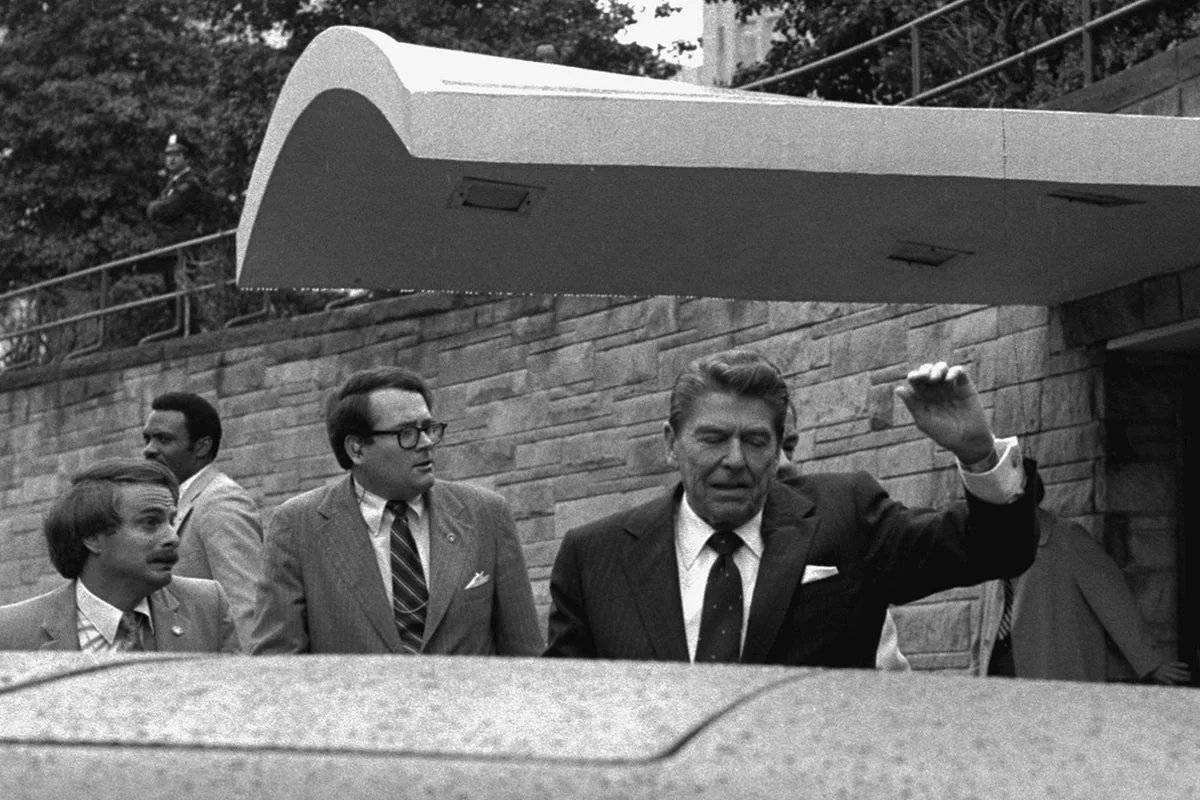
When President Ronald Reagan left the Washington Hilton Hotel and headed for his waiting limousine on a gray March afternoon in 1981, he was exposed for mere seconds. That was all it took for a would-be assassin to take aim and fire. Reagan was struck in the chest and nearly died. Forty-five years later, another gunman is accused of trying to storm into the same hotel's ballroom during the White House Correspondents' Association dinner on Saturday night. The suspect fired at least one shot, authorities said, before being subdued in a chaotic scene that forced the evacuation of President Donald Trump and other top administration officials. The gunman never entered the ballroom or came close to the president.

Security then and now

The Washington Hilton has hosted hundreds of large events attended by presidents and other dignitaries since it opened in the 1960s. While on the surface there appear to be similarities in the incidents beyond their location, stark differences highlight how much has changed in the decades since Reagan was shot. “Security is a lot more robust today than it was then,” said Stephen T. Colo, a former assistant director of the Secret Service. “But you still deal with the same tension involving politicians and the public’s access to them.”

Wide Pickt banner — collaborative shopping lists app for Telegram, phone mockup with grocery list

The Hilton's design and history

The Washington Hilton Hotel and its cavernous ballroom were designed to be a prime venue for presidential speeches and events. To entice high-profile speakers, primarily the president, architects designed a VIP entrance on the side of the hotel and, one floor below it, a holding room known as the bunker. In the decade before Reagan was shot, presidents visited the hotel more than a hundred times. The 1981 shooting was set in motion when John Hinckley Jr. got on a bus in Los Angeles, where he had been trying to write and sell music, and headed to Washington. There, he planned to hop on another bus to New Haven, Connecticut, to stage a suicide in front of the object of his obsession, movie star Jodie Foster. In the nation's capital, he learned Reagan would be speaking at the Washington Hilton on the afternoon of March 30, and he changed his plans. He would try to kill the president to impress the actress.

How close Hinckley got

Outside the hotel that afternoon, Hinckley found himself 15 feet from Reagan as the president headed to his limousine. In a small crowd of onlookers and journalists behind a rope line, the would-be assassin pulled out a gun and fired six shots in 1.7 seconds, wounding Reagan, White House press secretary Jim Brady, District of Columbia Police Officer Thomas Delahanty, and Secret Service agent Tim McCarthy. Reagan was struck below his left armpit, the bullet lodged an inch from his heart. He survived thanks to the quick thinking of Secret Service agent Jerry Parr and the medical personnel at George Washington University Hospital. Hinckley was found not guilty by reason of insanity.

Pickt after-article banner — collaborative shopping lists app with family illustration

Enhanced security measures

In the wake of the shooting, the Secret Service enhanced security in dozens of ways. The most visible action came when the Secret Service began deploying checkpoints and metal detectors to screen visitors at the White House and at public events. Hinckley did not have to pass through either a checkpoint or metal detector to get so close to the president. The hotel built a bunker-like garage for the armored limousine to park and drop off and pick up the president at the VIP entrance. The Secret Service and local police assigned more agents and officers to guard presidential events at the Hilton. Even with such enhancements, former agents said, securing the Hilton is challenging and highlights the tension between protecting politicians and ensuring the public has access to them. The hotel also has many public areas, and it would be hard to shut them down for an event, even one as high profile as the correspondents' dinner. That was why the main security checkpoint, they said, was near the ballroom and not in the hotel lobby or entrance — measures that would be disruptive to hundreds of guests and hotel operations. Inside the ballroom, more agents and heavily armed tactical officers were stationed close to the president.

The incident on Saturday

On Saturday, the suspect sprinted through the checkpoint leading to the ballroom, according to video posted by Trump. The video shows officers and agents pivoting and pointing guns at the man as he ran away. The assailant was quickly subdued and was not injured, officials said. An officer was shot in a bullet-resistant vest, officials said, but was not seriously hurt. Acting U.S. Attorney General Todd Blanche said Sunday that the gunman was likely seeking to target the president and members of the administration. The assailant is suspected of having traveled by train from California to Chicago and then on to Washington, where in recent days he checked in as a guest at the hotel, Blanche said. Law enforcement officials familiar with the matter identified the suspect as 31-year-old Cole Tomas Allen of Torrance, California. Cole sent writings to family members minutes before the shooting referring to himself as a “Friendly Federal Assassin,” railing against Trump administration policies and signaling what investigators increasingly believe was a politically driven attack, according to another law enforcement official who spoke on condition of anonymity. The writings made repeated references to Trump, the official said, without directly naming the president, and alluded to grievances over a range of administration actions.