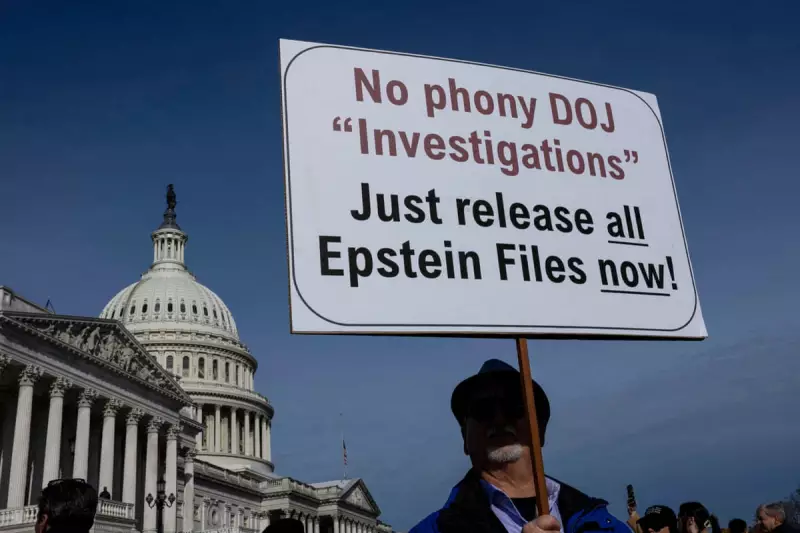
One month after a legal deadline passed, the US Department of Justice has failed to release the vast majority of its investigative files on the late financier and convicted sex offender Jeffrey Epstein. This failure to comply with the Epstein Files Transparency Act has sparked outrage among survivors' advocates and bipartisan lawmakers, who are now calling for a court-appointed special master to force disclosure.
A Legal Obligation Ignored
Congress passed the Epstein Files Transparency Act with a clear mandate: the Department of Justice, under the Trump administration, was legally required to disclose all its investigative documents on Epstein by 19 December 2025, barring rare exceptions. However, in a court filing on 5 January, DoJ attorneys revealed they had posted only about 12,285 documents, or roughly 125,575 pages, to its website.
Critically, the same filing admitted that officials had identified "more than 2 million documents" potentially subject to the act that were still under review. This means the disclosed files represent less than one per cent of the total material, a situation attorneys for survivors describe as a "drop in the bucket."

Bipartisan Lawmakers Demand Court Intervention
The congressmen who co-sponsored the act, Democrat Ro Khanna and Republican Thomas Massie, have taken the extraordinary step of asking a federal judge to intervene. In an 8 January letter to Manhattan Judge Paul Engelmayer, they requested the appointment of a special master and independent monitor to "compel" the DoJ to comply with the law.
They accused the Department of Justice of multiple failures, including missing the statutory deadline, asserting improper legal privileges, and applying "extensive redactions" that appear designed to protect politically exposed persons—a practice the act expressly forbids. The DoJ has also flouted a requirement to provide a detailed report on what was released and withheld.
"Put simply, the DOJ cannot be trusted with making mandatory disclosures under the Act," Khanna and Massie wrote.
Survivors' Trauma and the Call for Transparency
For those who survived Epstein's abuse, the delay is a profound betrayal. Attorney Spencer Kuvin, who represents dozens of survivors, stated that every day the records remain hidden sends a message that "transparency is optional when powerful interests are involved."
"These files are not abstract government records; they are evidence of how institutions failed children," Kuvin said. "Continued secrecy retraumatises victims and undermines public confidence in the justice system."
The Path Forward: Litigation and Oversight
The legal path to securing the files remains complex. Judge Engelmayer, who is involved due to the related Ghislaine Maxwell case, has asked the DoJ to clarify whether he even has the authority to enforce the act. Legal expert David Weinstein of Jones Walker noted that if the judge rules he lacks authority, it would likely trigger new litigation, potentially in Washington DC.
Meanwhile, the news outlet Radar Online, which has a longstanding lawsuit seeking the files, supports the call for a special master. A spokesperson argued that an independent official, not a DoJ employee, would not make "political decisions about what to release and when."
While a special master could bring structure and accountability, experts caution it is not a quick fix. The process could involve multiple legal steps across several courts. Ultimately, as Kuvin argues, "Transparency doesn’t fail because statutes are unclear – it fails when institutions choose protection over accountability." The pressure is now mounting on the US justice system to choose the former.