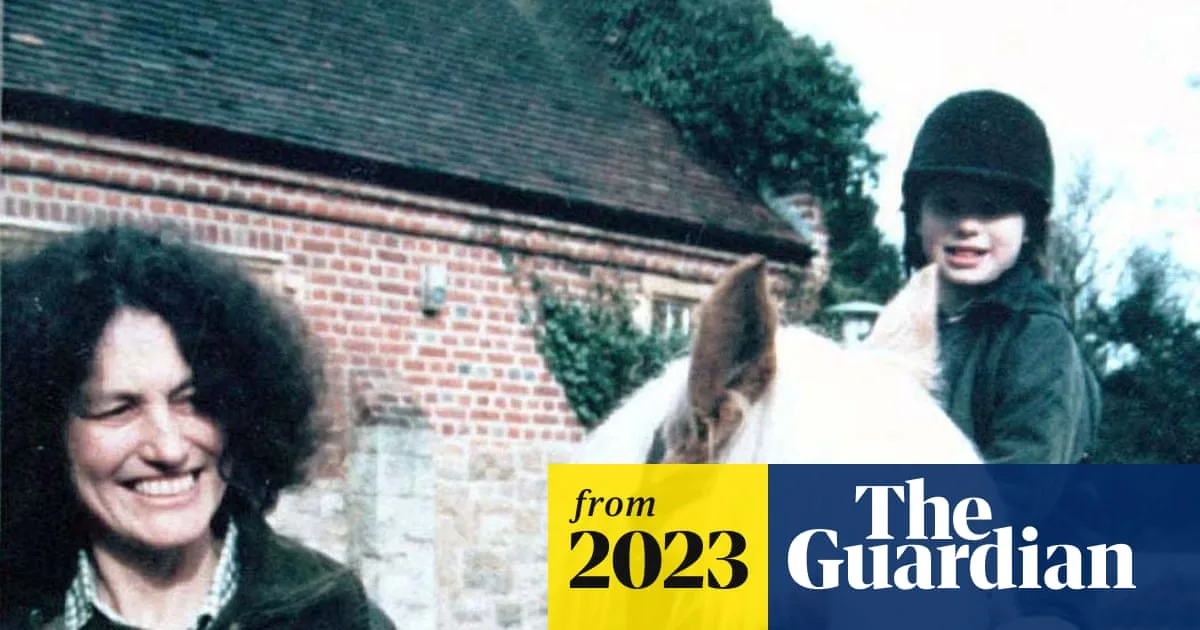
It was, said the judge, 'a scene taking place all over England every day - a mother and two small children walking home from school.' The children, aged nine and six, had been walking through cornfields and a small wood with their mother, full of excitement after the end of term swimming gala carrying their wet swimsuits wrapped in towels. Little did they know the horrific bloodbath they were about to innocently stroll into.
I reported on every day of Michael Stone's trial and retrial for the murders of Lin Russell and her younger daughter Megan and the attempted murder of older daughter Josie. I vividly remember the harrowing details nearly 30 years later.
The killer had tied up and blindfolded mother and daughter. When Josie had tried to escape he ran after her, tied and blindfolded her too then hit all three of them repeatedly around the head with a hammer.
When they failed to come home and the alarm was raised police eventually found the murder scene and bodies after midnight. At first they thought Josie was dead too. An hour later an officer spotted her twitching, she was rushed to hospital after lying bound and unattended for nine hours.
There was no DNA evidence, no murder weapon found and no positive identification from an eye witness. But what the prosecution did have was some of the most extraordinary evidence I have ever heard in 40 years of covering court cases.
The doll's house evidence
On day two of the trial at Maidstone Crown Court in October 1998 the jury was transfixed by the sight on TV screens in front of them of young Josie, clearly still damaged mentally and physically, moving tiny three inch figures around a doll's house-sized country scene. The figures represented the girls, their mother, their dog Lucy, also killed in the attack, and the murderer himself.
In a vivid red hat to hide her scars she moved the figures in response to the patient questioning of DC Pauline Smith and PC Edwin Tingley trying to tease out the traumatic truth of what had happened to her while still remaining legally correct with no prompting or enticement.
'This man hurt your head? How did he do it?' Asked DC Smith. There was a pause then Josie, with her back to the camera, quite deliberately clenched her fist, raised her right arm behind her with a violent jerk then smashed it down towards the back of her head. 'Did he use a weapon?' Josie nods. 'What sort of weapon?' Josie opened a scrapbook of drawings. At the first page she showed no reaction. As she turned to the second page she immediately pointed to a picture of a hammer. 'Did he strike your mummy?' Josie shrugged. 'Did he hit Megan? Did he hit Lucy?' Josie shrugged each time. 'Did you see the attack' Josie indicates no. 'Did you see anything else?' Josie places her hands behind her back to show she had been tied up. 'Was this before or after the attack?' Josie indicates with shrugs, nods and gestures that it was before.
Fourteen months of interviews with the two officers had been pared down to four hours of video evidence for the jury of eight women and four men. They had started just a few months after the attack near Chillenden, Kent. The officers used brightly coloured scrapbooks of pictures, photos and designs for Josie to point to. The murder scene was constructed from plywood with twigs for trees and coloured cotton wool for hedgerows and bushes as if by a Blue Peter presenter.
The models of the girls were dressed in their school uniforms of scarlet cardigans and blue and white skirts and the killer had a blue top and black trousers. There was a model of dog Lucy - Josie laughed at that.
As the tapes were played the jury could see Josie visibly progressing as months passed from barely audible groans allied to nods and gestures towards more confident but still monosyllabic responses to, finally and joyously, recognisable answers and conversations.
When DC Smith asked her what the killer had used to tie up her mother Josie beckoned for a scrapbook, leafed through the pages, turned to another book but was still unable to find the correct drawing to point to. Finally she sees a drawing of towels and waves her arms in the air in triumph. Then she rips her arms apart violently to show how the man had torn them into strips with his bare hands.
In the second interview she reconstructed the exact sequence of events handling the models like toys. She placed the mother and children figures by the side of a lane and showed the man's car speeding past. Then she showed how she had waved. 'Did the man wave back?' asked DC Smith. Josie shook her head sternly.
Josie then showed how the car had stopped ahead of them, the killer got out, she placed the hammer in his hand and brought the figure over to loom menacingly. 'Where did the man get the hammer from?' asked the officer. Josie pointed to the back of the car, clearly indicating it was not from the boot but from behind the rear seat.
Then she took her own model and moved it down the lane showing how she had run away and took the man in her other hand show him chasing her and bringing her back. Then she placed all the family on their backs in the wood. Picking up a paper hanky she folded it with studied concentration and tore it into strips to show how the man had tied them up with their swimming towels. Intricately she placed a strip of hanky around her mother's face and tied it in a knot at the back like a blindfold. She then drew her fingers across her own eyes to indicate she was blindfolded as well and tied a bow in the red shoelace the man had used.
It was slow and painstaking but utterly enthralling as the jury and entire courtroom sat in silence with their eyes only leaving the screens to look at the actual model set on the exhibits table in the centre of the court.
The case against Stone
Of course it wasn't Josie's evidence which won the case for the prosecution - she was never able to identify the killer. But the key evidence was controversial at the time and remains highly contentious to this day.
The police were convinced the killer was a violent drug addict desperate for money and who carried a hammer in his car. He had even ransacked the lunchboxes the girls had taken to school in the hope they might contain a penny or two. A blood-stained shoe lace - more of which later - was found at the murder scene. It provided no forensic evidence detectable by DNA techniques of that time but it was typical of tourniquets used by heroin addicts.
Michael Stone had mental issues, a serious heroin addiction and multiple convictions over 16 years for ever escalating violence. He also knew Chillenden and was known in his area of Kent as Mad Mick the Hammer Man because he had been jailed for two years in 1981 for a robbery in which he attacked a man with a hammer. Between sentences for armed robbery, wounding, assault and burglary he had been assessed at Broadmoor and Rampton maximum security hospitals. At another hospital he was rated as 'an extremely violent and dangerous individual.'
But he was released and returned to Kent where his family described him as 'spinning out of control' under the influence of heroin and amphetamines. His former girlfriend Rachael Marcroft said he used to beat her repeatedly and was 'scary and brutal.' He was known to keep lists in his mind of people he wanted to kill and torture and fantasised about killing children yet somehow he managed to slip through the net set up by the justice system and health authorities to protect the public. His barrister William Clegg QC said Stone was even too dangerous for the level of secure accommodation available at that time.
On the first anniversary of the murders forensic psychiatrist Dr Philip Sugarman, head of the Trevor Gibbon unit in Maidstone, a rehab centre for drug addict, had found himself watching a BBC TV Crimewatch reconstruction of the attack. When an e-fit likeness of a driver seen in the area looking angry and agitated appeared on the screen it dawned on him suddenly that this was a man he had treated and who he knew all too well. Sugarman rang the police who now had a name for their prime suspect. When arrested Stone said he had been so high on heroin he didn't know where he had been on the day of the murder and had no alibi. Yet he had still burned all the clothes he had been wearing then.
Finding the evidence to go with the name proved a problem. Much of the case was built around the least trustworthy people in Britain - criminals and former and serving prisoners. Child killers are the most hated criminals among prisoners but then so are informants. Yet the police found no shortage of inmates prepared to go to court and reveal what Stone had allegedly told them while awaiting trial for the murders.
The prosecution chose what they considered the best three - self-styled hardman Damien Daley, convicted murderer Mark Jennings and Barry Thompson all told the jury that Stone had either confessed or incriminated himself in front of them. Daley said Stone had told him in Canterbury prison that he had smashed the victims' heads like eggshells and Jennings added that Stone justified the murders by saying he had to eliminate every witness or run the risk of a long sentence. Each of them was grilled in cross examination by Stone's barrister Clegg and denied they had invented their stories to win favours from their prison governor or the police. The judge warned the jury they should treat the prisoners' evidence with great caution and my view in the press box was: Why are they saying this? What's in it for them?
Nevertheless I think the jury were impressed particularly when Daley was escorted out of court and turned at the door to give Stone the fiercest, most frightening glare I have ever seen.
The verdict came on a Friday afternoon after three days deliberations and by a 10-2 majority Stone was convicted on all charges and sentenced to life imprisonment. Stone had been convinced the long deliberations meant he would go free. Twenty four hours earlier he had leant over the dock rail and made walking gestures with his fingers towards his sister Barbara. When the decision went the other way he yelled out, 'I didn't do it, your honour. It wasn't me.' As he was led away he threw his arms open wide in a gesture of innocence and helplessness towards Barbara and his mother.
I was surprised by the verdict as I didn't think the prosecution case was strong enough, but believed the world was a safer place with Stone locked up. I was surprised that this story was far from over.
Retrial and aftermath
Eighteen months later Stone was in the Appeal Court and this time with the hint of a smirk on his face. Thompson, exposed as a perjurer and police informant, had retracted his evidence and Jennings was found to have taken money from a newspaper. Three Appeal Court judges agreed this blew a hole in an 'integral' part of the Crown's case and - dismissing defence claims Stone should walk free - ordered a re-trial.
So in October 2001 another jury was sworn in, this time at Nottingham Crown Court, and the case started again. The video of poor battered Josie giving evidence was played again and this time I could clearly see some jurors in tears. Although Jennings and Thompson had been dropped as Crown witnesses Daley was back and repeated his fearsome stare at Stone.
The trial continued on the same lines as the first one but the press box remained packed until one quiet afternoon when word suddenly went around that passenger planes had been flown into New York skyscrapers and journalists were all summoned back to London. Just under a month later the focus swung back as Stone was convicted for the second time by an identical 10-2 majority and once again jailed for life. The prosecution case remained, in my eyes, weak, possibly even weaker without Thompson and Jennings. But Stone had once again declined to enter the witness box to give evidence personally. Jurors always like to hear a defendant first hand to make their personal judgement. Were they so upset for Josie, her injuries and her lost family to an extent that they felt someone had to be punished?
Despite that I remain unconvinced by the vociferous campaign for Stone's release. I find claims that multiple killer Levi Bellfield - one of whose victims was Milly Dowler - was the true murderer and that he has made a genuinely truthful confession implausible. The notorious blood-stained shoelace has still not revealed any secrets despite constant retesting and went missing for many years although police say that it has been recovered. Stone's Barrister, Mark McDonald, said earlier this year that he has commissioned a forensics expert to review the evidence which led to Stone's conviction. He said the shoelace could be subject of greater and more sophisticated testing.
I left court thinking: Did Stone kill Lin and Megan? Probably. Is there room for doubt? Possibly. Will this case run and run? Definitely.
Josie, now in her late 40s, has made an astonishing recovery after extensive surgery had left her, the court was told, with some 'intellectual impairment' and a titanium plate in her skull. She lives in the house she used to live in when she was younger with her fiancé Iwan Griffith, whom she has been with for 20 years. Her father, Shaun Russell, lives nearby. Today she has graduated with a degree in design and textiles from Bangor University and is flourishing as an artist in North Wales. The one happy ending to a gruesome and troubling case.
Stone, meanwhile, is still behind bars today but has long protested his innocence and his case is being reviewed by the Criminal Cases Review Commission (CCRC), which will decide if it should be referred to the Court of Appeal.