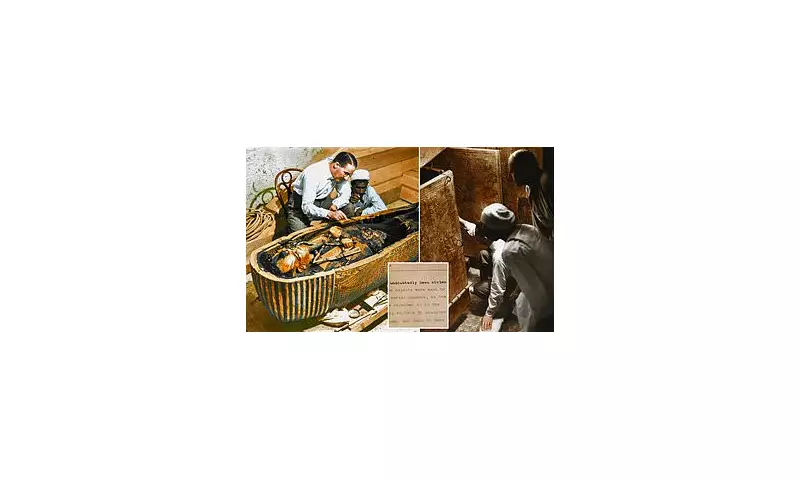
More than a century after the discovery of Tutankhamun's tomb, the celebrated British archaeologist Howard Carter faces renewed and compelling accusations of theft. A new Channel 4 documentary has brought to light unpublished letters that appear to provide the first hard evidence supporting long-standing rumours that Carter illicitly removed treasures from the boy pharaoh's vault before its official opening.
Unpublished Letters Reveal Startling Claims
The documentary, "Valley of the Kings: Secret Tomb Revealed," features Egyptian heritage expert Sally El-Sabbahy examining correspondence that had never before been seen on camera. The letters, exchanged between Carter and fellow British archaeologist Sir Alan Gardiner in 1934, centre on a specific artefact—a "whm amulet" used for offerings to the dead.
Carter had given this amulet to Gardiner as a gift, assuring him it did not originate from Tutankhamun's tomb. Gardiner, however, sought verification from Rex Engelbach, the official responsible for registering artefacts at Cairo's Egyptian Museum. Engelbach's inspection yielded a damning conclusion: the amulet unquestionably came from Tutankhamun's tomb, as it matched other examples all created from the same mould.

A Damning Conclusion and Awkward Position
In a letter to Carter, Gardiner relayed Engelbach's verdict, stating: "The whm amulet you showed me has been undoubtedly stolen from the tomb of Tutankhamun." Gardiner expressed deep regret at being placed in such an awkward position but notably assured Carter, "I naturally did not tell Engelbach that I obtained the amulet from you."
El-Sabbahy, who works for the American Research Center in Egypt, emphasised the significance of this correspondence during the documentary. She explained that these letters represent the first written, concrete proof that objects were taken from Tutankhamun's tomb, apparently directly by Carter himself. "What these letters really show me," she noted, "is that there was really a concerted effort to not tarnish this incredible discovery by revealing unsavoury things about Carter."
Historical Context and Motive
The documentary provides crucial historical context that may explain a potential motive. Until just weeks before Carter's monumental discovery in November 1922, Egypt operated a system that allowed foreign excavators to retain roughly half of their finds. However, this policy was abruptly changed, meaning the Egyptian government would keep all historically significant or high-value items, with foreign teams permitted only lesser or duplicate pieces.
El-Sabbahy suggested this change was "a tough pill to swallow" for Carter, who had fought against the new regulations. "There was always a concern from officials that something could be taken without their knowledge," she observed, "and because of that Carter had to tread very carefully."
Defending Carter's Legacy
Despite the compelling new evidence, Carter's legacy continues to have defenders. His great-niece, Susan Allen, who runs an Egyptian-themed art gallery and cafe called "Tutankhamun's Emporium" in Swaffham, Norfolk—the town where Carter grew up—has vehemently denied the theft allegations. "He never stole anything," Mrs Allen told the Daily Mail.
Carter, who died in 1939 with no direct descendants, began his archaeological career at age 17 with the British-sponsored archaeological survey of Egypt. Before his most famous discovery, he had already uncovered the tombs of Hatshepsut and Thutmose IV in 1902. His partnership with the 5th Earl of Carnarvon, an antiquities collector, led to the first signs of Tutankhamun's tomb on November 4, 1922.
The Historic Discovery and Its Aftermath
The discovery itself remains one of archaeology's most iconic moments. When Carter first peered into the tomb on November 26, 1922, Carnarvon famously asked, "Can you see anything?" Carter's breathless reply, "Yes, wonderful things!" has echoed through history. In his diary, Carter described the scene: "It was some time before one could see, the hot air escaping caused the candle to flicker. But as soon as one's eyes became accustomed to the glimmer of light the interior of the chamber gradually loomed before one, with its strange and wonderful medley of extraordinary and beautiful objects heaped upon one another."

Carter then spent the next decade meticulously supervising the removal of the tomb's contents—approximately 4,500 treasures including chariots, household items, jewelled ornaments, and Tutankhamun's iconic golden mask. These artefacts now reside in the Grand Egyptian Museum in Giza.
Documentary Timing and Broader Implications
The Channel 4 documentary arrives at a time of renewed interest in Egyptology and colonial-era archaeological practices. While the existence of these letters has been known since at least 2022—when they were published in Egyptologist Bob Brier's book "Tutankhamun and the Tomb that Changed the World"—their visual presentation on television marks a significant development in public awareness.
El-Sabbahy concluded her analysis by reflecting on the broader significance: "Because at the end, this was not about Carter. He was the discoverer, yes, but this was about Tutankhamun and this incredible legacy of the Valley of the Kings." The documentary thus raises important questions about historical preservation, archaeological ethics, and how we reconcile flawed human actions with monumental historical discoveries.
Tutankhamun himself died between 1323 and 1324 BC at age 18 or 19, with studies suggesting malaria combined with a bone disorder as his cause of death. He was mummified and buried in the Valley of the Kings inside three nested coffins, all placed within four gilded shrines—a burial arrangement that Carter's discovery brought to light for the modern world, even as new evidence suggests the discoverer may have taken more than just knowledge from the ancient site.