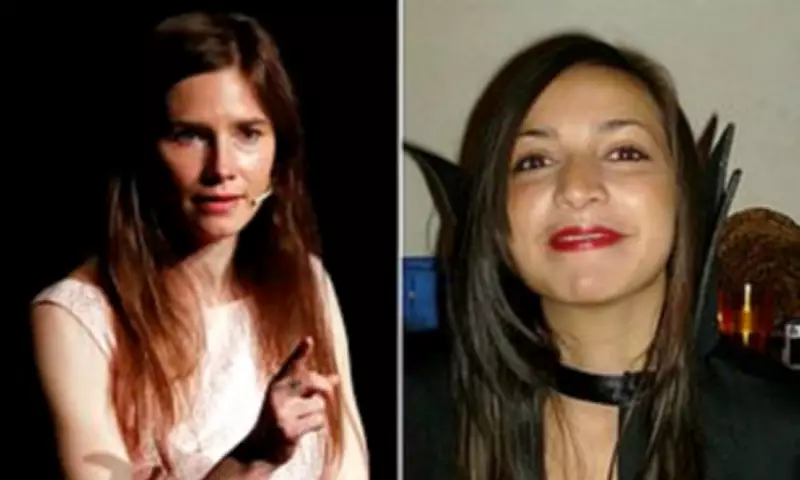
Amanda Knox has vowed not to cancel her controversial Edinburgh Fringe show, stating she 'cannot put my life on hold'. The American, 38, faces intense criticism for her one-woman comedy debut at the popular festival this summer, which has been branded 'offensive and deplorable' by the Kercher family lawyer.
The show, presented by high-profile Edinburgh Festival Fringe operator Gilded Balloon, is expected to include jokes about her experiences of being accused of the 2007 murder of British exchange student Meredith Kercher. When asked about the possibility of the Kercher family explicitly asking her not to perform, Knox said: 'I would ask if they wanted to talk to me. I’d ask for that opportunity. But I can’t force that. I also can’t put my life on hold waiting for permission to be a person who exists in the world, who has a legitimate story to tell.'
Francesco Maresca, the Kercher family lawyer, criticised her Fringe plans, describing the comedy show as an 'offensive and deplorable' insult to the victim’s memory. He said he had 'lost all hope' that Knox could 'comprehend the feelings' her actions have prompted among the Kercher family. Knox was famously tried, convicted, and later acquitted for the murder of the 21-year-old student. Both were language exchange students sharing a house in Perugia, Italy, when Kercher was found dead with her throat cut and sexually assaulted.

Knox's show, titled 'Cartwheel', references the exercises she reportedly performed at a police station after the murder. Speaking on holiday in Scotland with her husband, four-year-old daughter, and two-year-old son, she said: 'I don’t like assuming the worst about people or places. I want to believe that at Edinburgh I could get a fair hearing.' She added: 'I feel wronged and I don’t like letting the people who wronged me win... I don’t want to let the bullies win. I know I have something legitimate to say, I’m not just going up there for the heck of it. It’s not just about me but it’s about what it means to be a woman in the world.'
Knox insisted the show does not make light of the horror of what happened to Kercher. She said: 'It is absolutely true that for anyone to have any understanding about what happened to me, you have to go back to a young woman named Meredith Kercher. There is genuine ethical complexity and I think some serious people can raise it in good faith. Our stories are inextricably linked. And, furthermore, Meredith’s family, who did nothing wrong and who lost everything, may be reactivated every time they hear my story.' She argued that the demand for her silence is unusual, stating: 'I personally have never heard of anyone saying that the Guildford Four or the Central Park Five or literally any other wrongly convicted person should be silenced out of deference to the victims of the original crime.'