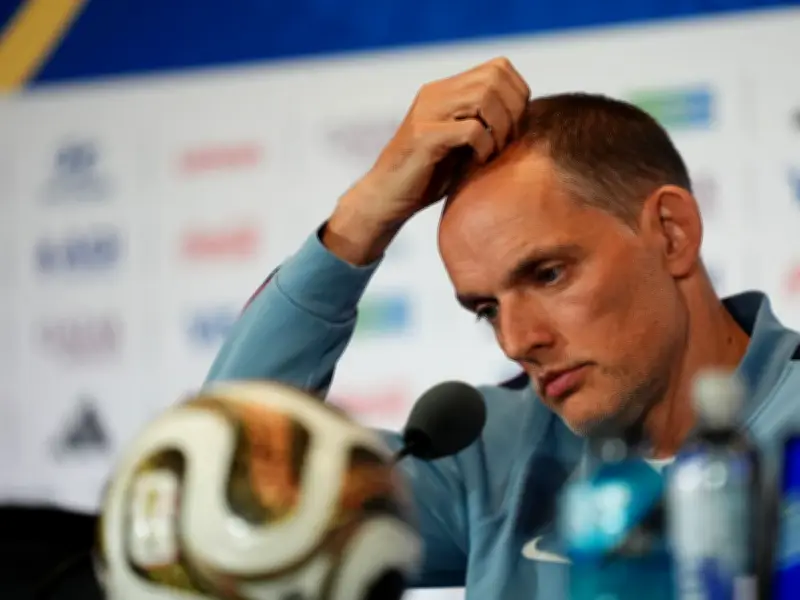
Thomas Tuchel has admitted he has been left with a “scar” after England’s World Cup heartbreak, but insisted he will shoulder full responsibility and wants to continue as manager despite the backlash following the semi-final defeat to Argentina.
In a brutal and painful press conference ahead of the third-place play-off with France, Tuchel looked visibly upset but defiant as he faced tough questions. The biggest issues revolved around the “blame game” and whether the manager or players should take responsibility.
Tuchel Accepts Blame
Tuchel said: “I take responsibility. Listen, if it's easier, easier if someone takes the blame, I take the blame. It's not wrong. This is the death that you sign up for, as I understand it. But you have every right to do so. But I will not engage in this kind of game. For me, there is no one to blame. Need someone to blame? I take the responsibility and the head coach.”

He added: “We make in-game decisions based on trust, on our competitiveness, on the experience, and on what we actually feel and I feel in the game. And then from there we go. Every other scenario is just a scenario. No one knows the outcome of any other substitution or any other change. It's an easy approach to think in structures and to think in offensive and defensive. I think the game is more complex. It is about how you live a structure. It is always how you play within a structure.”
Fatigue a Factor
Tuchel cited fatigue as a contributing factor, pointing to the gruelling World Cup schedule and altitude in Mexico City. “I think even if we don't want to admit it, because it always feels like an excuse, and we would never talk about it, but I feel that the game in Mexico, the altitude, the travelling, we lost a complete amount of sleep, and the game in the heat in Norway in extra time and was smaller than. So I felt that, and I think it is part of the development of the game. The players; these players are very important. They will literally gain everything physically in every single match.”
He noted: “If you see these data drop, there must be a reason behind it because the motivation was through the roof, like for every other team who made it into. We could not reach these kind of intensities. I think Argentina found another year, found another moment, found another belief. They built something over several years and have of course the experience of overcoming these kind of moments and these kind of matches and winning titles together. So this came into play. Messi was on the other side.”
Public Mood and Future
When asked about the changing public mood and whether it would affect his desire to carry on, Tuchel said: “Not. It never changed my thinking. If I would like (to carry on).” He insisted England should remember this is only their fourth semi-final and they were outsiders among the top four ranked nations, but wants to close the gap.
“I think the gap is there because of the titles that Argentina and Spain have as national teams. What they built over many years with the coaches and the team. There's still a slight gap to close. I think the gap shows the expectations of these countries winning the World Cup and European final, and we did not. I think we demanded it from ourselves within camp for sure, and we dreamed about it, and we pushed for it, and we competed for it. But there's still a gap to close in the way how to play football under pressure, and the way to implement yourselves, and the way to reach the next level.”
Analysis: Intense Press Conference
It was genuinely one of the most intense and tense press conferences in 27 years of covering England. The fall-out from Wednesday has been huge. Even US President Donald Trump questioned England’s tactics and use of Harry Kane. “What do I know about soccer?” Trump said. “They took the lead, and they took their best player, and they put him on defence.”
The frustration and disappointment quickly turned to anger and recriminations. Tuchel was held up as public enemy No1. The Football Association quickly put out a statement from chief executive Mark Bullingham saluting the team and backing Tuchel. But that only turned Tuchel’s future into a debate. He has two years left on his contract.

Then came the blame game. Players were surprised by Tuchel’s substitutions. One source close to the dressing room claimed the manager had “failed the players.” Tuchel’s remarks also caused raised eyebrows among players and those close to them, suggesting he was deflecting blame onto the players.
It is not in the FA’s thinking to get rid of Tuchel. They remain convinced he is the right man for the job. If England beat France, they would finish third, their best-ever World Cup campaign on foreign soil and best since 1966. But Tuchel has a habit of being combustible; his exits from Borussia Dortmund, Bayern Munich, Paris Saint Germain, and Chelsea were acrimonious. It would not be beyond imagination for him to quit, but he would need to walk for a change in manager.
The far bigger issue is winning back the trust of the fans. Few managers lose the fans and get them back onside. That is the battle facing Tuchel. Loyal England fans had been won over, then he lost them. They are genuinely angry and some want him gone. Even impartial observers think England have the best range and squad of players at this tournament, but they lack the experience and proven winners of Spain or Argentina. Now, Tuchel has a big job on his hands to take England forward and win back the fans.