

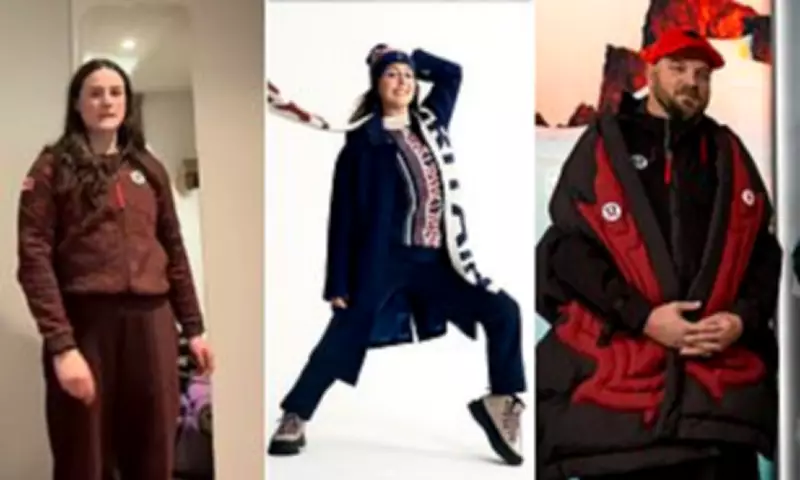
The commencement of the 2026 Winter Olympic Games in Milan has ignited a fierce debate far removed from athletic performance, focusing instead on the controversial team uniforms paraded during the opening ceremony. As ninety-two nations showcased their national pride through fashion on February 6th, a wave of criticism has swept across social media, with Canada's Olympic kit bearing the brunt of the outrage. Designed by the renowned Canadian brand Lululemon, the ensemble has been described by viewers as 'hideous, embarrassing, and ugly', sparking a global conversation about Olympic style.
The Canadian Controversy: From Maple Leafs to 'Walking Tents'
Canada's official Olympic uniform, crafted by Lululemon under a contract extending to 2028, features a distinctive oversized convertible quilted wrap vest adorned with a prominent red maple leaf on the front. This is paired with a red puffer jacket printed with subtle outlines of the Canadian landscape. Despite Lululemon's reputation for sleek athletic wear, the design has faced severe backlash. Critics have mercilessly compared the athletes to 'walking tents' or 'oven mitts', questioning the practicality and aesthetic of the bulky garments.
Lululemon marketed the wrap vest as the 'statement item' of the collection, retailing for $198 Canadian Dollars (approximately £106.73) on their website, where it quickly sold out. The brand promoted its versatility, suggesting it could be worn as a vest, scarf, or even packed up as a pillow. They stated, 'The large maple leaf design on the front will provide instant global recognition as Team Canada proudly marches into Milano San Siro Olympic Stadium.' However, public reception has been overwhelmingly negative.

Social Media Erupts Over Olympic Fashion
Lifestyle blogger Ryan Massel managed to acquire one of the controversial wrap vests and shared a review on TikTok, which rapidly went viral, amassing over 140,000 likes. In his video, Massel expressed confusion and disappointment, stating, 'It makes no god damn sense, it is one piece, it is like a sleeping bag. I don't know what this is.' He highlighted the vest's single pocket, adding to the perplexity. Social media users echoed his sentiments, with one commenting, 'The uniforms are hugely disappointing,' and another humorously noting, 'It's a coffee cup sleeve but for people!! Can I order a double double please?' A particularly scathing comparison emerged, with a critic remarking, 'Someone said it looks like a Tim Hortons cup and now I can't unsee it.'
In a promotional video on Team Canada's official Instagram page, athletes Trinity Ellis and Embyr Susko, both competing in luge, showcased the full range of outfits. This included all-brown tracksuits with matching jackets, green trousers, and black sweatshirts. While followers offered messages of good luck, many could not resist critiquing the fashion choices, blending support with sartorial disapproval.
Global Uniform Discontent: Germany and Great Britain Under Fire
Canada is not alone in facing fashion criticism. The German Olympic team's outfits, designed by Adidas under the direction of design director Jacqueline King, have also sparked controversy. The 70-piece collection includes an oversized waterproof poncho in the national colours and a bucket hat, described by some as a 'bizarre choice'. Social media users were quick to judge, with one declaring, 'The worst dressed athletes at the Olympics are once again the Germans,' and another asserting, 'Something this hideous has probably never existed before.' However, King defended the design, explaining, 'Our ambition was to create kits that not only help athletes tackle the challenges of winter sports but also capture what makes the Games so special.'
Team Great Britain has similarly drawn mixed reactions for its kit, designed by British clothing brand Ben Sherman. The uniforms are 'grounded in the United Kingdom's traditional colours' but feature a 'pop of energetic pink'. Five-time Olympic medalist Tom Daley personally knitted scarves for the team's flagbearers, worn by Princess Anne and Sir Timothy Laurence at the opening ceremony. Despite this royal endorsement, online critics were unimpressed. One commenter questioned, 'Why are the GB team in pink coats? Looks like white coats washed in with a red sock!' while another branded the outfits as 'truly dreadful'.

France's Fashion Misstep and Ceremony Blunder
Team France, typically known for its style, also faced scrutiny. Their uniform, designed by esteemed designer Stephane Ashpool—who previously worked on the nation's 2024 Paris Olympic kits—failed to secure a place in Vanity Fair's ranking of the top five best-dressed nations at the opening ceremony. The 'astronaut'-style white snowsuit with a purple collar and gloves, produced by Le Coq Sportif, divided opinion. One social media user criticised it as more suited to an 'astronaut' than an athlete, while another joked they would 'definitely wear that for Halloween'.
Adding to France's opening ceremony woes, cross-country skier Jules Lapierre suffered an unexpected fall during the procession. Although he later clarified to EuroSport that the fall was unplanned, stating, 'I was a bit stressed, but everyone had a good laugh all the same,' the incident attracted global attention, momentarily overshadowing the fashion discourse.
Defenders and Future Outfits
Amidst the criticism, a few voices rose in defence of the Canadian uniforms. One commenter expressed, 'I don't understand why people are mad at these! I love it!' while another added, 'Omg I love it!' Some even questioned why the wrap vest wasn't designed as a more conventional jacket. Looking ahead, the Canadian team is set to wear a blue-green outfit inspired by the north's icy waters for the closing ceremony on February 22nd. They have also been equipped with brown travel gear, including a 'Team Canada' suitcase, sliders, and a miniature Lululemon bag, ensuring their controversial style extends beyond the stadium.
As the Winter Olympics continue, the debate over team uniforms highlights how fashion has become an integral, and often contentious, part of the Games' spectacle. From Canada's 'walking tents' to Germany's ponchos and Great Britain's pink accents, these sartorial choices have sparked conversations that rival the athletic competitions in fervour and public engagement.





