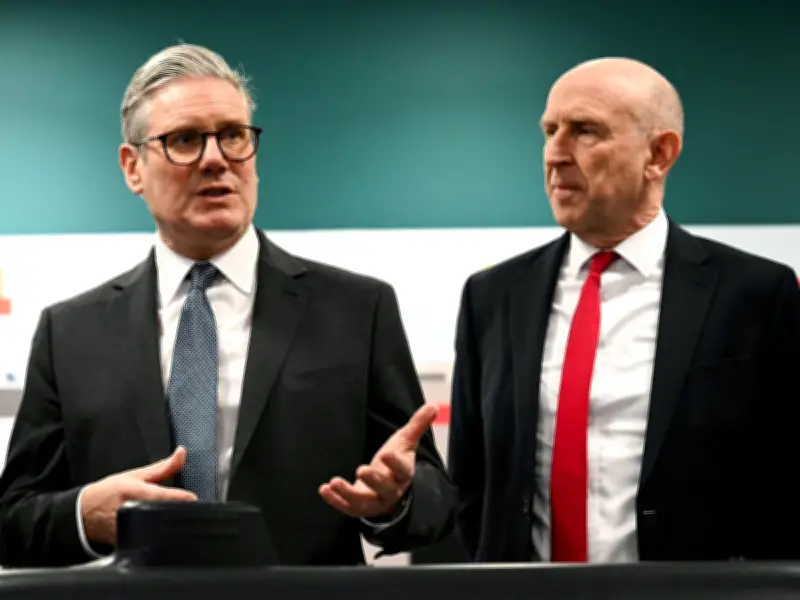
Keir Starmer's government has been shaken to its core after two esteemed defence ministers resigned with devastating criticism of military spending plans.
Double Resignation Triggers Crisis
The PM was dealt a significant blow on Thursday after the shock resignation of Defence Secretary John Healey, triggering a crisis in the Ministry of Defence. Hours later Al Carns, a former Royal Marine, quit as Armed Forces Minister with a withering broadside criticising "inadequate" defence funding. Pamela Nash, a ministerial aide in the department, also resigned, and Rachel Hopkins, another aide, walked out.
Ministers have been locked in a tense battle over how to fund the long-awaited defence investment plan (DIP), which is already more than six months late. In his blistering resignation letter, Mr Healey accused the PM of not standing up to the Treasury, which he claimed was unwilling to commit the funds needed to defend the nation.

Business Secretary Defends Government
Business Secretary Peter Kyle on Friday morning insisted the DIP is not in "tatters" and is "being developed". Asked if it was in "tatters", he told Times Radio: "The plan is being developed. We are determined to get it right. We are talking about an enormous amount of money going into defence at a period of time where we have to modernise the way we think about defence, but also make sure that we do so in a way that benefits British jobs. This is highly complex." Mr Starmer has vowed to promise the plan by the NATO summit on July 7.
Al Carns Does Not Rule Out Leadership Bid
Al Carns, who quit as armed forces minister on Thursday, did not rule out a potential bid for the Labour leadership and the keys to No 10. Asked if his resignation was due to a matter of principle or ambition, he told BBC Radio 4's Today: "People get confused about ambition and service. My whole career has been put to service. If I wanted to be ambitious, I wouldn't have got into politics. If I wanted to make more money, I wouldn't have got into politics."
Funding Dilemma
The big question hanging over the crisis in defence spending is: If we are to hike military cash, how will it be funded? Downing Street and the Treasury are steadfast in their position that they will not sign off defence spending increases if they are funded in an irresponsible way. Keir Starmer hit out at John Healey last night in a letter after his resignation, telling him: "Strong public finances are part of what keeps us safe - irresponsible borrowing only puts that at risk."
Tax rises, spending cuts or increasing borrowing are the Chancellor's main options to fund an increase. On Wednesday, at PMQs, Mr Starmer twice failed to rule out tax hikes to fund the Government's long-delayed defence investment plan (DIP). Rachel Reeves the day before had admitted the "money has to come from somewhere".
One economic expert warned that if the DIP is exposing funding gaps, there needs to be a "national conversation" on how to fund the 3.5 per cent uplift by 2035. To get an idea of the scale of that increase, which is about £30-40 billion a year, it would mean an extra £500 per person in taxes if it was funded through the tax rise route.
The figure floating around the DIP at the moment is more like £13.5 billion (which Mr Healey was unhappy with). Even for this, No10 is imposing cuts on government departments to fund it. Business Secretary Peter Kyle confirmed he will be making cuts to contribute to defence spending, saying he "made the decision within seconds of being asked".
Starmer Hits Back
Keir Starmer has insisted he will deliver "an unprecedented increase in defence spending" after John Healey dramatically quit as Defence Secretary. Mr Healey lashed out at the Prime Minister and Chancellor Rachel Reeves, saying long-delayed plans for military investment would leave the armed forces vulnerable and make Britain less safe. But in a letter responding to Mr Healey's resignation, Mr Starmer suggested he was wrong to criticise the Government's commitment to defence spending, saying the Defence Investment Plan (DIP) will "provide the resources our military need to keep us safe".

He said the plans are backed by "necessary investment", adding that the DIP will be underpinned by "sustainable and fair" increases in spending. The PM added: "Strong public finances are part of what keeps us safe - irresponsible borrowing only puts that at risk."
Economy Contracts Amid Iran War
The UK economy contracted by 0.1 per cent in April, the Office for National Statistics said, heaping more pressure on Starmer. Chancellor of the Exchequer Rachel Reeves acknowledged the war in the Middle East was hitting the economy. She said: "Before the conflict in the Middle East, growth was higher than expected and inflation was falling. This is not a war we wanted or joined, but one that will have an impact at home."
New Defence Secretary Appointed
Dan Jarvis has been appointed as the new Defence Secretary after John Healey's bombshell resignation. The Security Minister was handed the top Cabinet post nearly nine hours after Mr Healey quit with a blistering takedown of the Government's defence spending plans. His shock departure triggered a crisis in the Ministry of Defence, with Armed Forces Minister Al Carns following him out of the door. Mr Carns told the PM he could not defend "a level of investment I know to be inadequate to the task". Ministerial aides Pamela Nash and Rachel Hopkins are also said to have quit.
Business Secretary Not 'Blindly Loyal'
Business Secretary Peter Kyle said he was not "blindly loyal" to Sir Keir Starmer but the Prime Minister had earned his support. Mr Kyle told Sky News: "It is a purpose that brought me into politics, not a person. He has earned my loyalty. I'm not blindly loyal to him. He has earned my loyalty, because we are aligned in the purpose of this government."