

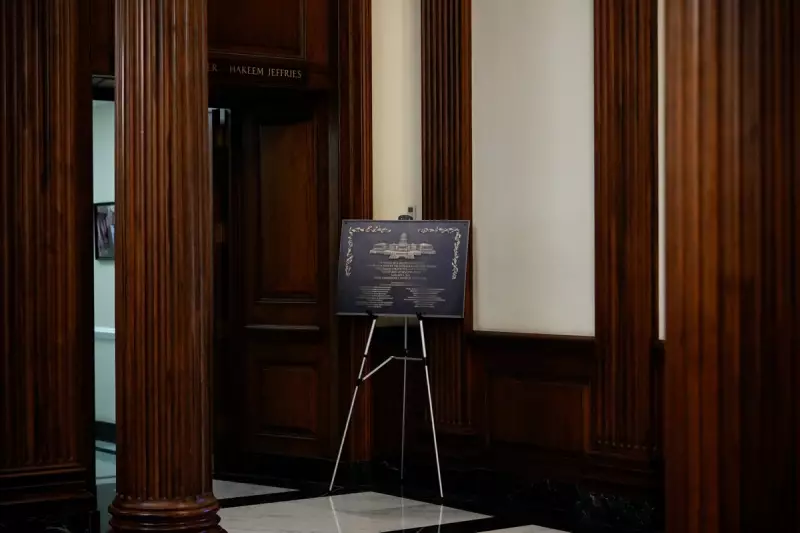
As the fifth anniversary of the January 6, 2021, attack on the United States Capitol approaches, a legally mandated plaque honouring the police officers who defended it is conspicuously absent. The official bronze marker, approved by Congress in March 2022, is nowhere to be seen on the Capitol's walls, its whereabouts unknown and believed to be in storage.
A Hallway of Makeshift Memorials
In response to the missing tribute, roughly 100 members of Congress, predominantly Democrats, have taken matters into their own hands. For months, they have displayed poster board-style replicas of the plaque outside their office doors, creating a corridor of makeshift remembrance throughout the Capitol complex.
The replicas bear the intended inscription: "On behalf of a grateful Congress, this plaque honors the extraordinary individuals who bravely protected and defended this symbol of democracy on Jan. 6, 2021. Their heroism will never be forgotten." These stand-ins now hang outside the offices of figures like House Minority Leader Hakeem Jeffries and Speaker Emerita Nancy Pelosi.

Legal Battles and a 'Culture of Forgetting'
The failure to install the plaque has sparked a federal lawsuit. Two police officers who fought the mob that day, Harry Dunn and Daniel Hodges, sued over the delay, arguing Congress is "encouraging a rewriting of history" by not following its own law. The Justice Department under the Trump administration is seeking to have the case dismissed.
Historians and lawmakers warn the void left by the missing plaque fosters a "culture of forgetting." Visitors can now pass through the Capitol without a formal reminder of the violent attempt to overturn the 2020 election results, which left five people dead and over 140 officers wounded. "With memory left unchecked, it allows new narratives to swirl," the original report noted.
Political rhetoric around the event has shifted dramatically. Once condemned as an "insurrection" by senior Republicans, former President Donald Trump now refers to it as a "day of love." Current House Speaker Mike Johnson, who challenged the 2020 election results, has yet to unveil the plaque.
Divergent Paths to History
The debate over how to remember January 6 is now playing out in competing congressional committees. Democrats are reconvening their January 6 panel to examine ongoing election threats, while Republicans under Speaker Johnson have launched their own inquiry to uncover what they call the "full truth."
Representative Jamie Raskin, a Democrat who served on the January 6 committee, emphasises the stakes for future generations. "People need to study that as an essential part of American history," he said, comparing the date to July 4 or September 11.
Meanwhile, the scale of the event remains stark: approximately 1,500 people have been charged in one of the largest federal prosecutions in US history, all of whom were pardoned by Trump when he returned to power in January 2025.
For now, the halls of the Capitol are lined not with one unified bronze marker, but with a hundred paper testaments to a nation still deeply divided over how to record one of its most turbulent days.






