Federal Judge Mandates Restoration of Washington Slavery Exhibit in Philadelphia
A federal judge has issued a direct order compelling the Trump administration to reinstate an educational exhibit focusing on nine individuals who were enslaved by George Washington. This exhibit, previously displayed at his former residence in Philadelphia, was dismantled by officials last month under President Donald Trump's executive directive.
Legal Battle Over Historical Interpretation
The city of Philadelphia initiated legal proceedings in January following the removal of explanatory panels by the National Park Service from Independence National Historical Park. This site served as the temporary national capital in the 1790s, where George and Martha Washington resided with nine enslaved people. The removal was executed in compliance with a Trump executive order aimed at "restoring truth and sanity to American history" across museums, parks, and landmarks. This order instructed the Interior Department to prevent displays that "inappropriately disparage Americans past or living."
U.S. District Judge Cynthia Rufe, appointed by Republican President George W. Bush, delivered her ruling on President's Day. She mandated that all materials be restored to their original state pending the outcome of a lawsuit challenging the legality of the removal. Judge Rufe explicitly prohibited Trump officials from installing alternative versions that present the history differently. In her written order, she invoked a quote from George Orwell's dystopian novel "1984," drawing a parallel between the Trump administration and the book's totalitarian Ministry of Truth, which manipulated historical records to fit its narrative.

"As if the Ministry of Truth in George Orwell's 1984 now existed, with its motto 'Ignorance is Strength,' this Court is now asked to determine whether the federal government has the power it claims — to dissemble and disassemble historical truths when it has some domain over historical facts," Judge Rufe wrote. "It does not."
Broader Context of Content Removal
During a January hearing, Judge Rufe cautioned Justice Department lawyers, describing their arguments as "dangerous" and "horrifying." They contended that Trump officials possess the authority to selectively display aspects of U.S. history at National Park Service sites. The Interior Department has not provided an immediate response to the ruling, which was announced while government offices were closed for the federal holiday.
This historical site is part of a broader pattern where the administration has discreetly removed content related to enslaved people, LGBTQ+ individuals, and Native Americans. For instance, signage at Grand Canyon National Park that described settlers displacing Native American tribes "off their land" and exploiting the landscape has vanished. Additionally, a rainbow flag was recently taken down at the Stonewall National Monument, a pivotal location in the LGBTQ+ rights movement, and references to transgender people have been erased from its webpage.
Details of the Exhibit and Its Significance
The Philadelphia exhibit, developed two decades ago through a collaboration between the city and federal authorities, provided biographical information about each of the nine enslaved individuals, including two who achieved escape. Among them was Oney Judge, born into slavery at the Washington family's Mount Vernon plantation in Virginia. She escaped from the Philadelphia house in 1796, fleeing to New Hampshire, a free state, while Washington declared her a fugitive and advertised for her return.
Due to Judge's escape from the Philadelphia location, the park service endorsed the site's inclusion in a national network of Underground Railroad sites in 2022, intended to educate about abolitionists and escaped slaves. Judge Rufe highlighted that materials about Oney Judge were among those removed, which she stated "conceals crucial information linking the site to the Network to Freedom."

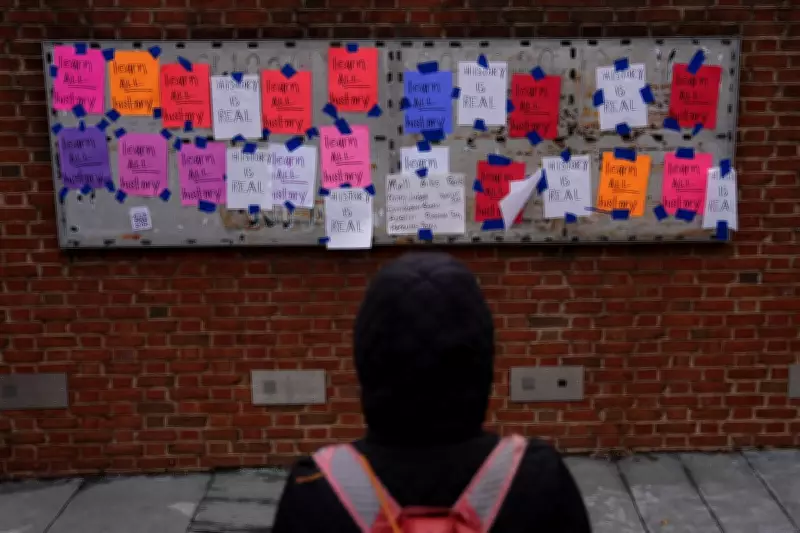
Following the removal on January 22, only the names of the enslaved individuals—Austin, Paris, Hercules, Richmond, Giles, Moll, Joe, and Christopher Sheels—remained engraved in a cement wall after park service employees used a crowbar to detach the plaques. Hercules also escaped in 1797 after being taken to Mount Vernon, reaching New York City and living under the name Hercules Posey despite being declared a fugitive slave.
Community Reaction and Future Implications
Local politicians and Black community leaders have welcomed the ruling, which coincided with rallies at the site advocating for restoration. State Representative Malcolm Kenyatta, a Philadelphia Democrat, praised the community's resilience against what he termed an attempt by the Trump administration to "whitewash our history."
"Philadelphians fought back, and I could not be more proud of how we stood together," he declared. The judge did not specify a timeline for the exhibit's restoration, and federal officials retain the right to appeal the decision, setting the stage for potential further legal disputes over historical representation and governmental authority.