
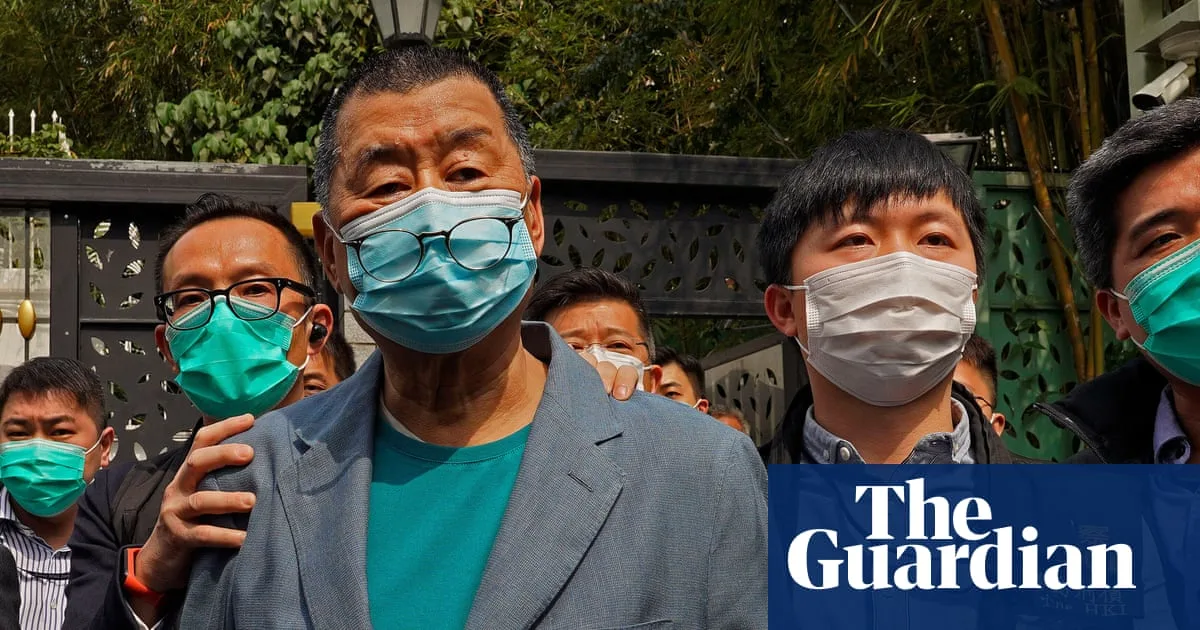
Jailed Hong Kong pro-democracy media tycoon Jimmy Lai has been awarded Deutsche Welle's freedom of speech award for his contribution to the city's pro-democracy movement. The German public broadcaster announced on Thursday that Lai, 78, would be honoured in absentia at the DW Global Media Forum in Bonn on 23 June.
Deutsche Welle's director general, Barbara Massing, praised Lai for standing 'unwaveringly for press freedom in Hong Kong at great personal risk'. She said that with his now-shuttered newspaper Apple Daily, he gave journalists a platform for free reporting and a voice to the democracy movement.
Lai, a British citizen, was one of Hong Kong's most prominent pro-democracy advocates before his imprisonment. He provided financial backing to democratic parties and took part in mass protests against Beijing's rule in 2019 and 2020. Authorities arrested him in 2020, accusing him of using Apple Daily and his political connections to lobby for foreign sanctions on China and Hong Kong.
A Hong Kong court sentenced Lai to 20 years in prison in February on charges including 'conspiracy to collaborate with foreign forces' and publishing 'seditious material', under the city's national security law imposed by Beijing in 2020. The ruling was condemned as politically motivated by rights groups and the British government, with Human Rights Watch warning the sentence amounted to 'effectively a death sentence'.
Beijing says the law was necessary to restore stability. Lai, born in southern China in 1947 and who fled to Hong Kong in 1960, said he owed 'everything to the people of Hong Kong' and that a prison term would be 'redemption' for the 'wonderful life' the territory gave him.




