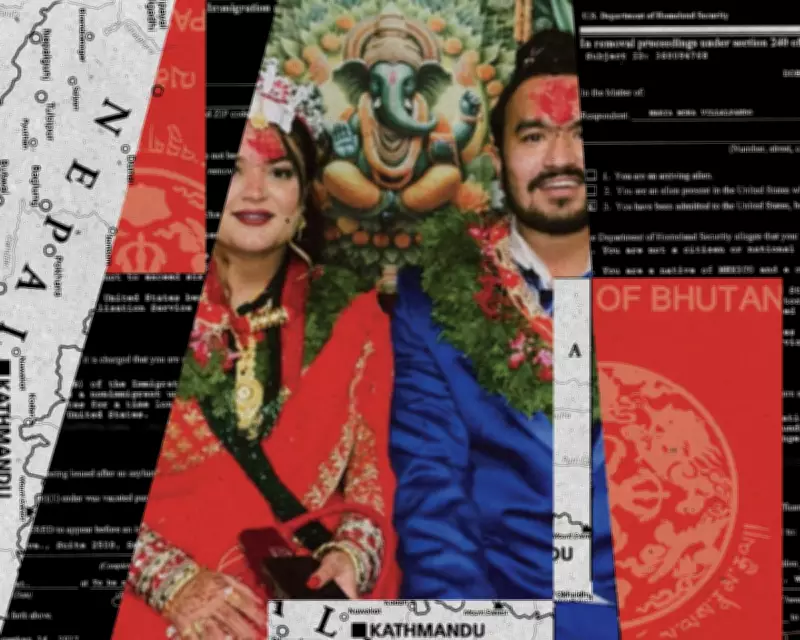
Stateless Father Deported to Bhutan by ICE, Leaving Family in Ohio
Mohan Karki was deported to Bhutan on 13 January, after more than nine months in detention and a series of legal battles led by his wife and attorneys in a final effort to halt his removal. This case highlights a troubling trend under the Trump administration, where individuals, including refugees, are being sent to countries with which they have little or no connection, often endangering their lives.
A Family Torn Apart
Tika Basnet sat with her seven-month-old daughter, Briana, sleeping on her lap, as she video-called her husband, Mohan Karki, who was thousands of miles away in hiding in South Asia. Karki, who has never held his daughter, described feeling like a ghost, living without a home or identity. Born in a refugee camp in Nepal to Bhutanese parents, Karki is stateless, and his deportation to Bhutan exposes him to risks of persecution and renewed statelessness.
Human rights advocates argue this reflects a broader pattern. Aisa Villarosa, an attorney with the Asian Law Caucus, noted that Bhutan had long refused to repatriate refugees, and no public agreement exists between the countries. "When you see a sudden shift in removal practices like this, it usually signals that some kind of government-to-government understanding exists," Villarosa said.

Historical Context and Legal Battles
Karki's deportation echoes a painful history. In the early 1990s, over 100,000 ethnic Nepali-speaking Bhutanese were expelled and stripped of citizenship. Both Karki's and Basnet's families resettled in refugee camps in Nepal before moving to the US under a large-scale resettlement program. Karki arrived in Georgia in 2011, dreaming of joining the US army, but his plans unraveled after a 2013 arrest for minor offenses.
He accepted a plea deal, unaware of the immigration consequences. Brian Hoffman, his immigration attorney, explained that minor crimes can be reclassified as aggravated felonies, triggering deportation. "It doesn't make any objective sense, but that's the system," Hoffman said. An immigration judge ordered Karki's removal in 2014, but he was released under supervision when neither Bhutan nor Nepal accepted him.
Life in Limbo and Sudden Detention
Karki maintained regular ICE check-ins, earned his GED, and worked in Georgia before moving to Ohio to be with Basnet. They eloped in December 2023, saving for a home and planning a future. However, after Trump's 2024 election win, reports surfaced of Bhutanese refugees being targeted by ICE. On 2 April 2025, during a routine check-in, Karki was detained and processed for deportation to Bhutan, despite Basnet's protests.
Travel documents showed Bhutan accepted deportees as "non-Bhutanese," offering no residency rights. The UN refugee agency warned that returning stateless people to a country that refuses to recognize them creates a precarious situation. Karki was transferred to multiple detention centers, facing poor conditions and harassment, before being deported on a commercial flight via India.
Ongoing Struggle and Advocacy
Since his deportation, Karki remains stateless, calling Basnet daily as she campaigns for his return while raising their daughter alone. Basnet works full-time, organizing and speaking at events, driven by the fight for her family. "I'm fighting for my husband and the future of my daughter that's being stolen by the government," she said.
Advocacy groups estimate at least 70 Bhutanese refugees have vanished into statelessness after similar deportations. John Sifton of Human Rights Watch emphasized the dangers, noting that refugees sent to Bhutan are often pushed to India, leaving them stranded. "The idea that the US government would now say the place they were expelled from is safe contradicts two decades of US policy," Sifton said.
This case underscores the brutal mechanics of immigration enforcement and the human cost of policies that separate families and endanger lives.