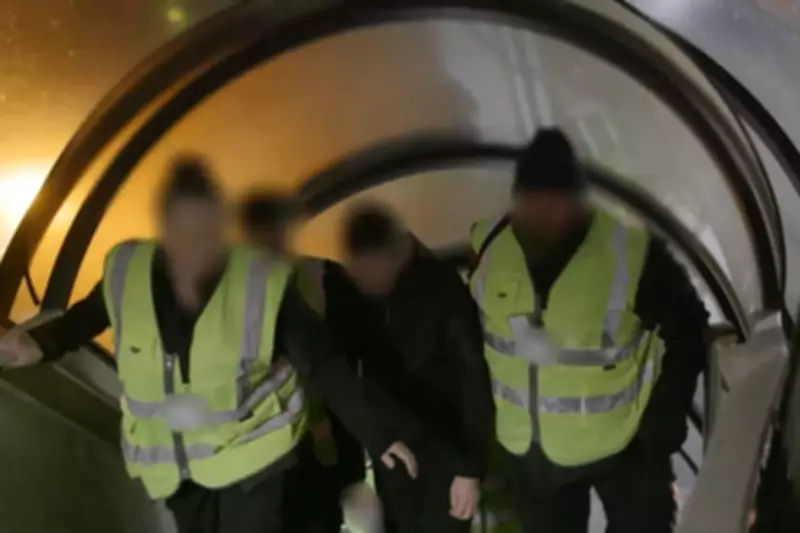
Restraints Deployed on Asylum Seekers During UK Removal Flights
A recent inspection report has uncovered that waist and leg restraints were utilised on asylum seekers being deported from the United Kingdom to France as part of the Government's controversial "one in, one out" immigration scheme. The findings, detailed by Charlie Taylor, the chief inspector of prisons for England and Wales, highlight multiple instances where force was employed during removal operations.
Details of Force and Restraint Use
Records from three separate removals documented that force had been applied five times in total. Specifically, waist restraints were imposed on three male asylum seekers during the deportation process. According to the report, two of these individuals remained in the waist belts throughout their entire removal journey after they "demonstrated continuing resistance" to the procedure.
In addition to the waist restraints, leg restraints were also applied to these two men to facilitate their transportation onto the vehicle and aircraft involved in the deportation. The report notes that in one case, the leg restraints were removed promptly once the individual was on the vehicle, but for the other detainee, they remained in place during the travel to France.

Furthermore, "arm holds" were used to restrain the two men in their seats when they became disruptive after the plane landed at its destination. A paramedic examined all three men after the restraints were removed, and inspectors concluded that the use of force in these instances "seemed justified" given the circumstances.
Inspections Reveal Mixed Findings
Mr. Taylor's team conducted an inspection of a deportation flight in January where no restraints had to be used, indicating variability in operational conduct. However, the report referenced records from other removals, including an operation the week before the inspection that was disrupted by a detainee protest. This incident "required deployment of specialist national resources" to manage, according to the findings.
Despite concerns from some detainees about potential force use during subsequent operations, inspectors observed that escort staff maintained a consistently professional and respectful demeanor in all interactions. Mr. Taylor commended this aspect, stating it reflected well on the training and protocols in place.
Incident of Unprofessional Behaviour
In a separate inspection of a deportation flight in November of the previous year, the report found that two members of the Home Office team fell asleep while on duty. Inspectors described this as "unprofessional behaviour," noting that both escort staff, who had been assigned to monitor one person, were "asleep at the same time." This lapse raises questions about vigilance and accountability during sensitive removal operations.
Context of the "One In, One Out" Scheme
The Government's "one in, one out" deal was implemented in August to address migrant crossings in the English Channel. Under this scheme, migrants who arrive via the Channel are sent back to France, while approved asylum seekers are brought to the UK through safe and legal routes. This policy aims to manage immigration flows and deter dangerous crossings.
In 2025, a total of 41,472 migrants arrived in the UK after crossing the English Channel, marking the second highest annual figure on record. So far this year, there have been 5,136 arrivals, indicating ongoing challenges in border control and migration management.
The use of restraints and force, as detailed in the report, underscores the complexities and tensions inherent in deportation operations, balancing security concerns with human rights considerations. As debates over immigration policy continue, such inspections provide critical insights into the practical implementation of government schemes.