

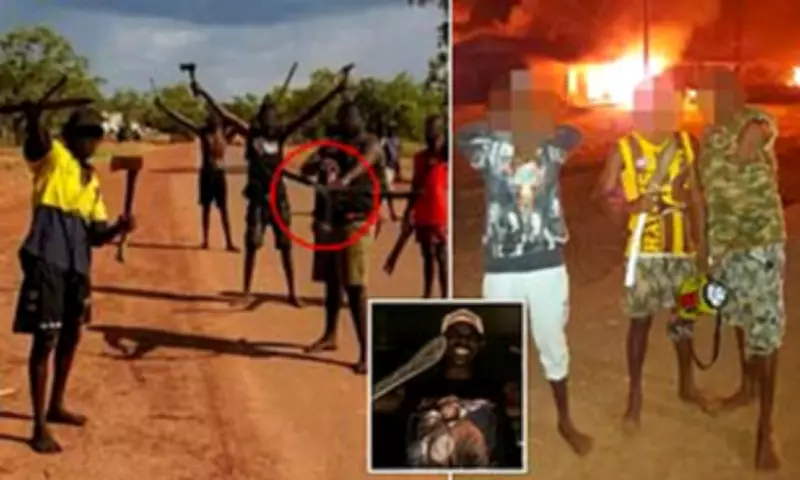
The remote Northern Territory community of Wadeye has been plunged into a state of near-lawlessness, with escalating violent crime and unrest attributed to a notorious outback gang. The Indigenous gang known as the Jovi Boys is at the centre of the turmoil, having allegedly instigated a massive street brawl in the violence-riddled coastal town, located 420 kilometres southwest of Darwin.
Store Raid Sparks Violent Confrontation
The latest outbreak of violence began when the Jovi Boys allegedly raided a community store in Peppimenarti, a flood-ravaged town approximately 90 minutes east of Wadeye. The store had just been restocked with essential food, drinks, and supplies following the Daly River floods, but gang members reportedly forced through security doors to pillage alcohol supplies and steal precious food and water resources.
Irate residents from Peppimenarti pursued the gang members back to Wadeye two weeks ago, leading to a confrontation that rapidly escalated into an all-out street battle. Hundreds of locals, including children as young as eight years old, engaged in open combat using blunt objects, edged weapons, and various improvised arms. The violent outbreak continued well into Saturday morning, with participants wielding crossbows and axes in the blood-spattered dirt streets.

Police Targeted During Response
When Northern Territory Police officers arrived at the scene, the mob turned on them. Authorities allege that brawling locals fired a crossbow bolt and hurled other improvised weapons toward officers and the Wadeye police station. This dangerous escalation prompted police to deploy additional resources to the area, resulting in dozens of arrests as they worked to contain the situation.
Northern Territory Acting Chief Minister Gerard Maley addressed the crisis, emphasising that families in the troubled community need to take greater responsibility to stop the unrest. "You really think that some of those community need to take control and bit of responsibility themselves here," Maley told a Darwin radio station on Monday.
"In Peppimenarti, the store has been stocked up for the wet season, for the flooding, and they've broken in and stolen their own food and own water essentially, and some alcohol too, I understand," Maley continued. "So, it's time to work with the police, with the community members to be able to make those places safe."
Political Responses and Criticism
Federal Government MP Marion Scrymgour called the recent violence in Wadeye "unacceptable" but argued that the Northern Territory government should do more to curb unrest in remote communities. "No one wants to see fighting in our remote communities. The recent violence is unacceptable," Scrymgour stated. "At the same time, our remote communities are often used as political footballs. This is also unacceptable."
Scrymgour urged the Northern Territory Government to remember it represents the entire territory, not just Darwin, and emphasised its obligation to work with remote communities to prevent violence. She noted that the Commonwealth delivers significant funding to the Northern Territory Government for critical services in remote communities, including substantial resources for remote policing.
Indigenous Australians Minister Senator Malarndirri McCarthy echoed these demands for greater NT political action, stating: "I urge the Northern Territory Government to get out to Wadeye and work in partnership with the community to get better results."
Community Council Condemns Violence
Wadeye's local council expressed deep concern about the ongoing unrest. "West Daly Regional Council does not condone violence in any form," a council spokesman said. "The current unrest is destructive and harmful to our community. West Daly Regional Council works hard to create real opportunities in the region through providing services and facilities for everyone. Community safety is continually a key focus in our service provision."
Ineffective Police Efforts
The update comes after NT Police admitted that recent attempts to quell the unrest have been "ineffective." An NT Police spokesman explained: "Attempts by police to disperse the offenders during a previous brawl have been ineffective, as large groups continue to reform and engage in further acts of violence and property damage."

Police have responded to multiple reports of large disturbances erupting on the streets of Wadeye and Peppimenarti since early January. Some violent gatherings, involving children, have drawn crowds of up to 100 people. The situation has become so dire that some law-abiding locals are reportedly too scared to leave their homes.
A particularly alarming incident occurred late last month when footage emerged of a white ute driving into crowds. The video showed the ute driver accelerating rapidly before suddenly veering toward dozens of people, eventually losing control and colliding with a street pole. This incident proved to be the final straw for police, prompting additional deployments to the area.
Underlying Causes of Violence
NT Police Acting Commander Terry Zhang acknowledged the limitations of law enforcement alone in addressing the crisis. "While police will continue to respond and prioritise the protection of the community, it is clear that law enforcement alone cannot address the underlying causes of these senseless acts," he said.
Police have identified several contributing factors to the persistent public violence, including feuding between more than 20 clans, high unemployment rates, and alcohol abuse issues. Earlier last month, a man was shot with a crossbow bolt in Wadeye, while several other buildings have been torched and ransacked during consecutive days of violent unrest.
The violence in Wadeye escalated significantly after a 33-year-old man was killed during a four-family feud in April 2022. The killer, Ezekiel Narndu, 19, was found guilty of manslaughter in 2023 after throwing a steel bar that pierced the victim's skull. Acting Justice Graham Hiley, who sentenced Narndu, noted that rocks, louvres, and steel bars are commonly thrown during violent outbursts in Wadeye "without fatal consequences," but said Narndu "should have known" his actions carried a "strong risk of causing serious injury." Narndu received a seven-year sentence with a non-parole period of three years and six months.
As the Northern Territory grapples with this ongoing crisis, the combination of gang activity, inter-clan conflicts, and socioeconomic challenges continues to fuel one of Australia's most dangerous situations in remote community policing.





