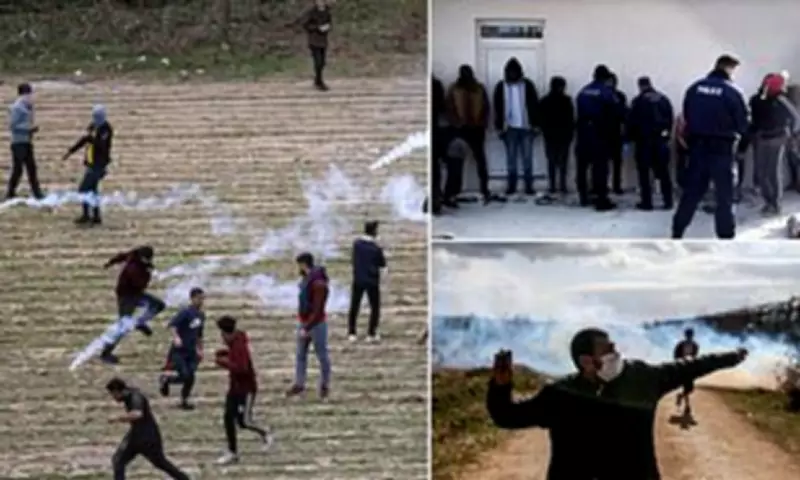
Greek Police Hired Migrants to Push Back Asylum Seekers, BBC Investigation Reveals
A shocking new investigation by the BBC has exposed that Greek police have been systematically hiring migrants to prevent other foreigners from entering the country. Internal police documents analysed by the broadcaster reveal that since 2020, senior officers have ordered border guards to recruit migrants, primarily from Pakistan, Syria, and Afghanistan, to carry out pushbacks at the Greece-Turkey land border.
Allegations of Extreme Violence and Abuse
The findings detail harrowing allegations of violence, with witnesses reporting that incoming migrants were stripped, robbed, beaten, and even sexually assaulted. These so-called mercenaries are allegedly rewarded with cash, mobile devices looted from other migrants, and documents that could eventually allow them passage through Greece.
Forcing migrants and asylum seekers back across international borders without due process is widely considered illegal under international law. However, evidence gathered by the BBC appears to show migrants being mistreated at the border by other migrants before being forcibly returned to Turkey.

Video and Testimonies Paint a Disturbing Picture
The broadcaster analysed a video from June 2023 that purportedly shows a group of migrants, who had just crossed into the Evros region, being attacked by masked men. Other documents revealed how a border guard told a disciplinary hearing they had information that mercenaries had been raping female migrants.
Two migrants and a former mercenary provided testimonies to the BBC about witnessing extreme violence perpetrated by both mercenaries and Greek police, including people being violently beaten until they lost consciousness.
Personal Accounts of Trauma and Suffering
A female migrant, who was forced back to Turkey, claimed that two masked men demanded she hand over her phone before she was driven to the border in a van. She described a man removing her daughter's nappy in a search for valuables, leaving the child screaming in fear. She also witnessed a young man being beaten unconscious by masked assailants.
Another migrant recounted being among dozens loaded into a truck for transport out of Greece, where people were left suffocating and unable to breathe. They were then handed to a group of mercenaries who strip-searched them, loaded them into dinghies halfway across the Evros River, and pushed them into the water.
Legal Action and Independent Reports
The BBC also met a lawyer who lodged a case at the European Court of Human Rights on behalf of an Afghan woman alleging she was raped by a masked man who spoke Farsi just before a pushback in 2023.
A separate report by the Fundamental Rights Office, an independent investigator within Frontex, found that in one instance, between 10 and 20 'third-country nationals' had been acting under the instruction of Greek officers. The report stated they subjected migrants to physical and verbal abuse, including death and rape threats, intrusive and sexualised body searches, beatings, stabbings, and theft. The migrants were then forcibly transported back to Turkey, in violation of EU human rights law.
Official Denials and Political Context
Greek authorities have denied that any migrants from this group were found in the area on that day. A police source claimed that mercenaries were being used to push back as many people as possible, stating: 'There is no soldier, police officer or Frontex officer serving here in Evros who does not know that pushbacks are taking place.'
Greece's Prime Minister told the BBC he was 'totally unaware' of the allegations that migrants were used for pushbacks. Located on the southeastern fringe of Europe, Greece has long been a main entry point into the EU for people fleeing conflict and poverty in the Middle East, Africa, and Asia.
Tens of thousands make it into the country each year, mostly via dangerous sea journeys. Athens has adopted an increasingly hardline stance on migration. Earlier this year, Greece began collaborating with Germany, the Netherlands, Austria, and Denmark to establish deportation centres in third countries, likely in Africa, for migrants whose asylum applications are rejected.

Migration Minister Thanos Plevris said the government was working on creating so-called return hubs, 'preferably in Africa,' for those whose asylum claims are denied and whose countries of origin will not take them back. He argued these hubs would act as a deterrent to prospective migrants unlikely to be granted asylum, with an initial plan expected in the coming months.