
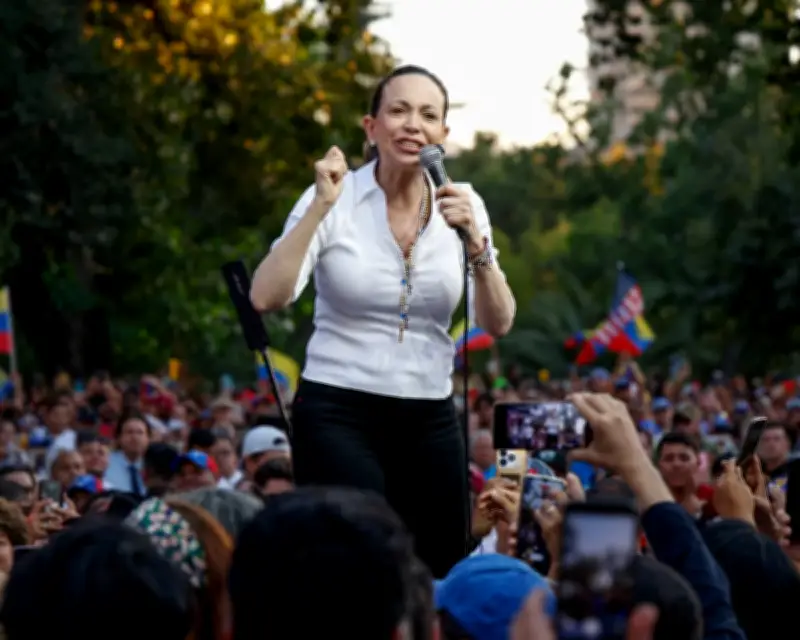
Venezuela’s interim government and opposition have announced the start of formal talks aimed at strengthening democracy, a move backed by the United States. However, contrary to expectations, Nobel laureate María Corina Machado will not lead the opposition delegation. Instead, Dinorah Figuera, who returned from exile in Spain, will serve as the main opposition representative.
Formal Talks Announced
The talks were first announced by Figuera on Tuesday and confirmed by Jorge Rodríguez, president of the national assembly. Rodríguez, whose sister Delcy Rodríguez is acting president, said a joint working group would begin on 1 August, including former members of the 2015 national assembly—the only opposition-controlled congress elected under Chavismo. Many of those members were later imprisoned or forced into exile.
US Role and Machado’s Exclusion
The US state department praised Figuera’s meeting with Jorge Rodríguez as the start of a “roadmap for a political dialogue on a democratic transition.” Washington has been influential in Venezuela since US forces abducted dictator Nicolás Maduro in January. Despite Machado’s popularity and her expressed desire to return to Venezuela, the White House has discouraged her, reportedly fearing civil unrest. Machado announced that opposition coalition parties would meet on Wednesday to “define a public position” on the talks.
Electoral Reforms and Timetable
The joint working group’s priority is strengthening the electoral system and restoring guarantees for political participation, according to the national assembly’s social media account. The US secretary of state, Marco Rubio, reposted the statement. Rubio has been described by the New York Times as effectively running Venezuela from Washington as a “de facto viceroy.” Despite the announcements, no timetable for new elections has been set. Maduro is widely believed to have stolen the 2024 election, and rebuilding the electoral system is expected to take at least eight months.
Public Anger and Earthquakes
Public anger has grown over the government’s response to twin earthquakes that killed more than 4,700 people. The opposition and many voters had expected Machado to lead negotiations, but the US intervention has shifted the dynamics. The talks represent a significant step in Venezuela’s political crisis, though the path to democratic transition remains uncertain.




