
From Aintree to Number 10: The Making of a Prime Minister
Andy Burnham is set to become the United Kingdom's seventh Prime Minister in the last decade after a seismic by-election win in Makerfield and the resignation of Sir Keir Starmer. Born in Old Roan, Aintree, Burnham spent only his first year in Merseyside before his family moved to Culcheth, Warrington. Yet the region's culture, politics, and tragedies have profoundly shaped the man and politician he is today.
A Modest Upbringing with Deep Roots
In his book Head North, Burnham describes his family life as "modest," never having a holiday abroad, but says he and his two brothers "never wanted for anything." The move to Culcheth was prompted by his father's promotion within the Post Office, which relocated him to Manchester. Burnham writes that his parents "randomly decided on Culcheth because Roy had once spent the day there working at the little telephone exchange and liked the feel of the place."
The Scouse Influence: From Boys from the Blackstuff to Everton
Burnham credits Liverpool writer Alan Bleasdale's television drama Boys from the Blackstuff for planting the first political seeds in his mind. The show depicted the struggles of Scousers during the unemployment and lack of social support of the Thatcher era. Burnham recalls: "We used to watch it every week and my brother Nick and I would ask if life was really like that for people in Liverpool. The rawness of it all and the injustices it captured, planted the first political seeds in my mind."
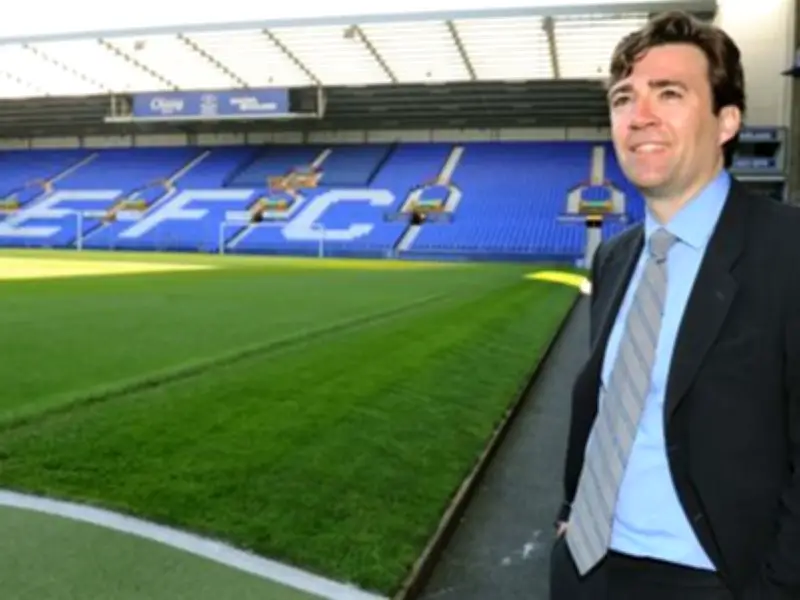
His love for Everton FC is another enduring Scouse influence. In Head North, he describes following the Blues everywhere during their peak in the mid-1980s, with match gear including "Sergio Tacchini trackie bottoms, a Lacoste T-shirt and a Kappa jumper." His haircut at the time was a mullet popularised by Brookside character Damon Grant.
Hillsborough: The Defining Moment
The Hillsborough disaster of 1989 is the most fundamental day in shaping Burnham's character. The opening chapter of Head North recounts his and Liverpool City Region Mayor Steve Rotheram's experiences on that day. While Rotheram was at the fateful game in Sheffield, Burnham was watching Everton play in the other FA Cup semi-final in Birmingham. He writes that if April 15, 1989 was the most fundamental day, the second most significant came exactly 20 years later, when he walked onto the pitch at Anfield for the 20th anniversary memorial.
As a government minister, Burnham received a tough reception from the Kop, with chants for justice drowning him out. He recalls: "It felt like I was standing on the edge of the abyss between the government I was in and the people with whom I had grown up." This led him to ask Prime Minister Gordon Brown to raise Hillsborough at cabinet, paving the way for the independent panel and the eventual truth.
A Promise to Deliver the Hillsborough Law
In 2017, Burnham tabled the Hillsborough Law bill in Parliament, which would impose a legally-binding duty of candour on public officials to prevent smears and cover-ups. Despite promises from the current Prime Minister, the bill has not yet become law. Burnham's impending premiership raises hopes that he will finally deliver it.
A Political Journey Shaped by Merseyside
Burnham's recent by-election campaign repeatedly referenced the enduring impact of the Thatcher era on northern communities, a theme that has stayed with him since childhood. Paul Martin, speaking from Old Roan in January, told the ECHO: "He is just one of us." That sentiment captures how Merseyside has shaped the man set to lead the nation.




