

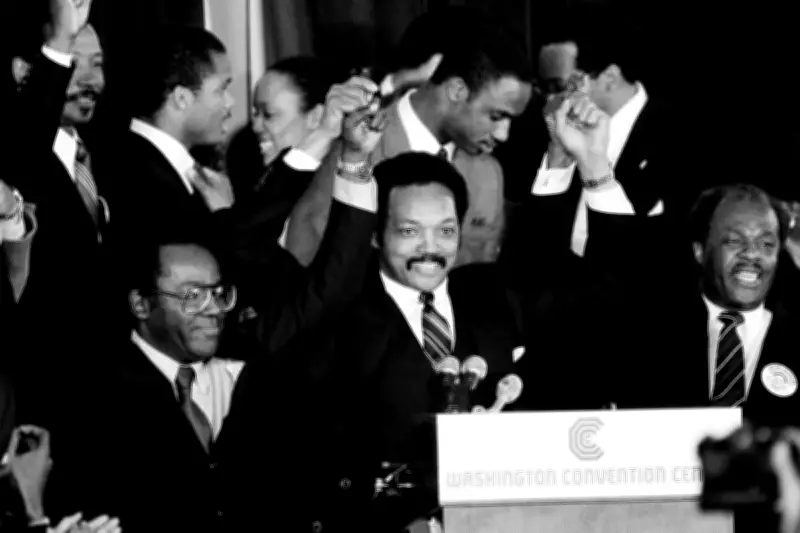
AP's 1983 Profile: Jesse Jackson's Prophetic Drive Before Historic 1984 Presidential Run
In August 1983, The Associated Press published a detailed profile of the Reverend Jesse Jackson, capturing the 41-year-old civil rights activist as he prepared his groundbreaking 1984 campaign for the presidency. This article, written by the late AP journalist Sharon Cohen, offers a vivid portrait of a man driven by religious duty and political ambition.
A Man on a Messianic Mission
Jackson saw himself walking the lonely, dusty road of the prophets—a man ordained by spirit and sent forth like Jesus, Gandhi, or Martin Luther King Jr. to guide others from the wilderness. "I'm very much driven by my religion to rise," he declared. "There's a push that comes from religious duty. Gandhi couldn't stop. Martin couldn't stop. Jesus couldn't stop." Nor, according to Jackson, could he himself cease his prophetic ministry, which he described as challenging the conduct of kings and queens.
Jesse Louis Jackson, the son of the South and a child of the civil rights movement, was a man almost obsessed with his self-appointed mission. Wherever he traveled, his message was hope, delivered with rhythmic style and masterful sloganeering. "If you are behind in a race, you CAN'T run equally," he told church audiences. "The race does not go to the fast or to the strong but to those who hold out."

From Civil Rights to Political Force
Jackson's evolution from a brash lieutenant of King to a magnetic—if controversial—political force was marked by distinct phases. In the 1960s, he battled for equal rights through pickets and marches. The 1970s brought a focus on self-respect and economic justice, including the Push-Excel program urging students to study and corporate agreements ensuring black participation.
By the early 1980s, his emphasis shifted to leadership: a Southern voter registration drive, more blacks in public office, and ultimately, a black president—potentially himself. "It's not enough to get in the mainstream and swim," Jackson asserted. "You must get in the mainstream and redirect its course."
Controversial Actions and Mixed Reactions
Jackson's highly visible efforts often sparked dismay and irritation. He assailed disco lyrics, mediated labor disputes, and led corporate boycotts. He advocated for Haitians, Palestinians, and Poles, visited Panama to assess the canal treaty, and spoke to 20,000 blacks in South Africa about apartheid. While American Jews were appalled by his embrace of PLO leader Yasser Arafat, legislators applauded his address to Alabama's Legislature—the first black to do so in a century.
As Jackson weighed a presidential bid through the Democratic primaries, black leaders reacted with skepticism. One poll showed him more popular than some announced candidates. "God did not limit genius to white males," Jackson countered. "He distributed it all over town."
Operation PUSH and Organizational Challenges
Jackson had never run for political office, with his only formal constituency being Chicago-based Operation PUSH (People United to Serve Humanity), which he founded in 1971 after splitting from the Southern Christian Leadership Conference. As president, he earned a $40,000 annual salary, but the organization was essentially an extension of himself.
Friends and foes alike noted his ego, drive, grand ideas, and weakness as an organizer, alongside his adept media courting. Half-brother Noah Robinson observed, "He sees himself on a messianic mission... For Jesse, it's his ego. God bless him for having that ego." Gary, Indiana Mayor Richard Hatcher praised his visionary outlook, while Mary Frances Berry of the U.S. Civil Rights Commission noted, "Jesse's not really an organization man."
Political strategist Don Rose offered pointed criticism: "The most pungent criticism is that he is constantly announcing campaigns and crusades that evaporate after the TV set is turned off." Hatcher added that Jackson elicited either strong support or intense dislike, sometimes bordering on hatred.

Personal Life and Unrelenting Drive
Jackson cut an impressive figure: athletic at 6-foot-2, dressed in conservative suits that replaced 1960s dashikis, with retained Baptist preacher eloquence. He didn't smoke or drink but displayed humor that friends said could have made him a dazzling comedian. Perennially busy, he still found time to quiz teachers about his son Jesse Jr.'s performance at a private Episcopalian school in Washington, D.C.
His message consistently emphasized an unrelenting drive to succeed. "When you do less than your best, it's a SIN," he told audiences. "To be black in America, you have to be superior to be equal." Born in Greenville, South Carolina, in 1941, Jackson graduated from North Carolina A&T, married Jacqueline Davis in 1962, and joined King in civil rights protests after entering the Chicago Theological Seminary.
PUSH-EXCEL and Financial Scrutiny
As PUSH president, Jackson acted as an urban Dale Carnegie, pushing blacks to work hard, excel in school, and demand power. Operation PUSH claimed over $1 billion in trade agreements with companies like Burger King and Coca-Cola, promoting black distributorships and advertising. However, not all efforts won friends; a boycott of Anheuser-Busch beer faced backlash from some St. Louis blacks.
The PUSH-EXCEL program, started in 1976 to encourage study hours and discipline, faced scrutiny. Department of Education auditors sought to disallow $736,000 in spending, questioning another $1 million due to inadequate documentation—part of about $6 million awarded over several years. Jackson stated PUSH representatives were working to resolve the matter, with no criminal violations alleged.
Presidential Prospects and Legacy
As Jackson ventured into national issues like re-industrialization and defense, critics questioned his qualifications. He bristled: "I had a liberal arts education... So if on a given day Mr. Reagan can speak about agricultural policy and trade policy and international affairs and art and culture and science, who's to suggest I should be less able?"
He said his Southern registration drive's success, finances, and organization would determine his presidential run. If not him, he argued, some black should run, criticizing Democrats for treating blacks like the Harlem Globetrotters—providing thrills but excluded from policy decisions.
Despite divided opinions, Georgia state Senator Julian Bond noted benefits: "He's made the party more cognizant of black voters. It has made race—in a positive way—an agenda item in the campaign for the Democratic nomination." Jackson's 1983 profile captured a pivotal moment as he poised to make history, driven by prophecy and political ambition.





