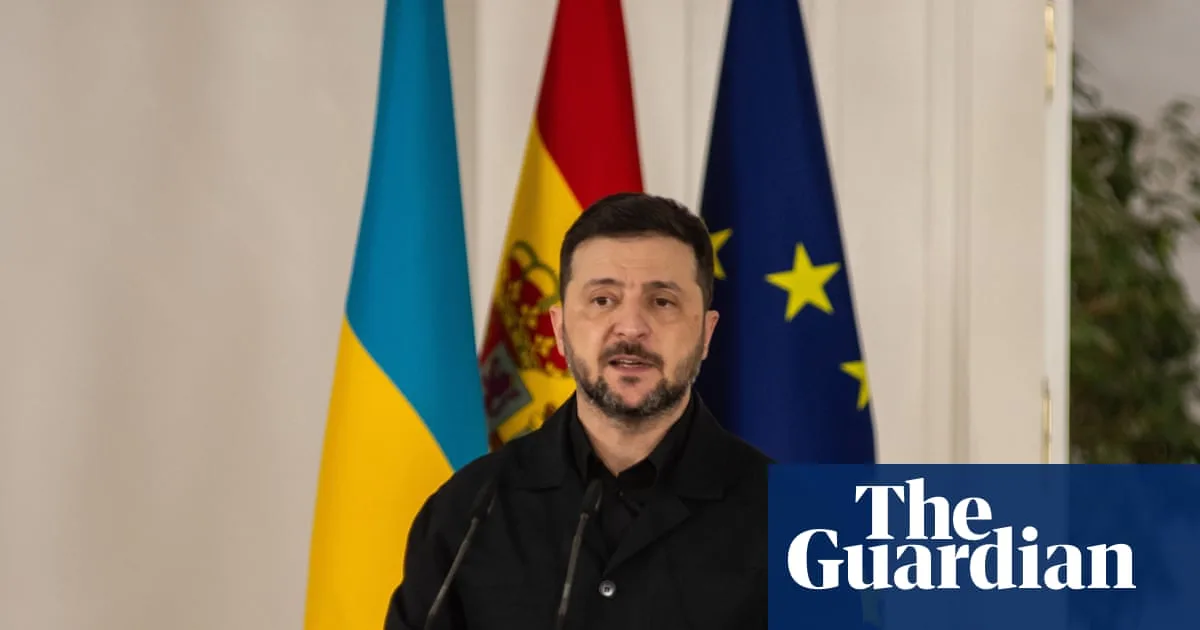
In a resolute interview marking four years since Russia's full-scale invasion, Ukrainian President Volodymyr Zelensky has emphatically declared that his country will not be forced into surrendering land to Moscow. Speaking to the BBC in Kyiv, Zelensky struck a tone of unwavering resistance, dismissing claims that Ukraine must concede territory to secure peace and warning that Vladimir Putin has already ignited a global conflict.
Defiance in the Face of Russian Demands
Moscow continues to demand that Ukraine formally hand over swathes of territory in the east and south, including areas of Donetsk, Kherson, and Zaporizhzhia – regions that have been battered by some of the fiercest fighting of the war. However, Zelensky rejected the idea that surrendering land would be a price worth paying for a ceasefire.
'I see this differently,' he stated. 'I don't look at it simply as land. I see it as abandonment - weakening our positions, abandoning hundreds of thousands of our people who live there. That is how I see it. And I am sure that this 'withdrawal' would divide our society.'
Warning of a Temporary Peace
Zelensky argued that any deal satisfying the Kremlin would only be temporary. He suggested that Putin 'would probably satisfy him for a while... he needs a pause... but once he recovers' the war would resume. In his view, Russia could rebuild its strength within a couple of years, posing a renewed threat not just to Ukraine but to global stability.
'Where would he go next? We do not know, but that he would want to continue [the war] is a fact,' Zelensky warned, emphasising that stopping Putin today is crucial to preventing a wider catastrophe.
Strained Relations and Failed Peace Talks
The United States has been pushing for an end to the nearly four-year war, but has so far failed to broker a compromise between Moscow and Kyiv. Relations with Washington have been strained since Zelensky's fraught visit to the White House last year, when a heated public exchange with former President Donald Trump and Vice-President JD Vance signalled a sharp shift from the staunch backing offered under Joe Biden.
US-mediated peace talks on Ukraine collapsed in less than two hours last week after Zelensky claimed it was unfair that Trump was placing more pressure on his country than on Russia. The talks wrapped up after just two hours, much shorter than the six hours of meetings on the previous day, according to the head of Russia's delegation.
Pressure from Western Allies
Some Western officials and analysts believe Ukraine cannot reclaim all occupied territory and that concessions are inevitable. Trump has previously suggested territorial compromise could unlock a ceasefire. However, Zelensky remains undeterred, asserting: 'Will we lose? Of course not, because we are fighting for Ukraine's independence.'
He stressed that any long-term security guarantees from Washington must be enshrined through US institutions rather than dependent on a single leader. 'Congress is needed,' he argued, noting that while presidents change, institutions endure.
The Human Cost and Future Elections
While Zelensky maintained that Ukraine would ultimately restore its internationally recognised borders, he acknowledged the brutal cost of trying to do so immediately. 'We'll do it. That is absolutely clear. It is only a matter of time… What is land without people? Honestly, nothing,' he reflected, highlighting the human dimension of the conflict.
Under martial law, elections scheduled for 2024 were postponed. Moscow has repeatedly branded Zelensky illegitimate – a line that has found echoes in some American political circles. The Ukrainian leader said he has yet to decide whether he would run again: 'I might run and might not.'
However, he suggested elections could be organised if it were genuinely required to end the war and if Ukraine first secured binding security guarantees. 'If this is a condition for ending the war, let's do it,' he said, before challenging critics to be honest about their intentions.
A Message of Unyielding Resistance
Four years into Europe's deadliest conflict since the Second World War, Zelensky's message remains unchanged: no retreat, no capitulation – and no belief that appeasing the Kremlin would bring lasting peace. He emphasised that victory is not just about battlefield lines but about preventing a wider disaster, stating: 'I believe that stopping Putin today and preventing him from occupying Ukraine is a victory for the whole world. Because Putin will not stop at Ukraine.'
Despite the challenges, including curtailed US military shipments and ongoing reliance on American intelligence and weapons funded by European allies, Zelensky's defiance underscores Ukraine's determination to continue the fight for its sovereignty and territorial integrity.






