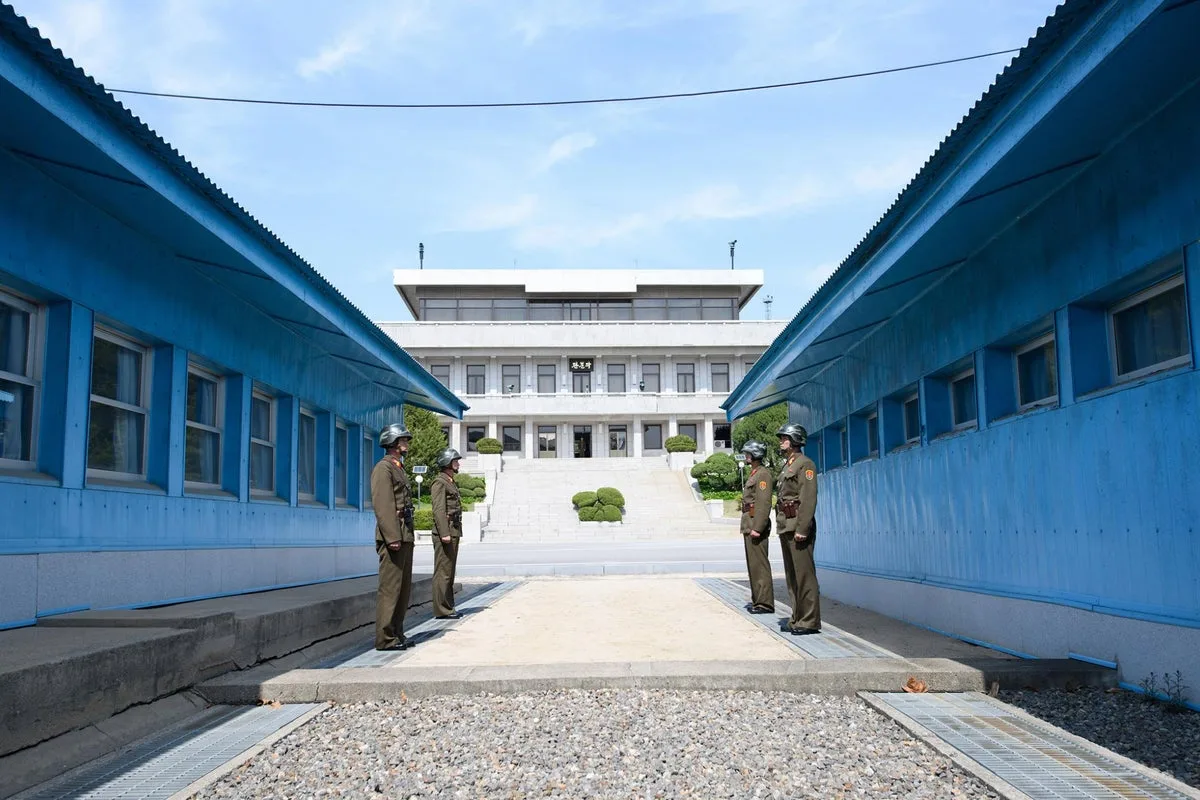
Visiting the North Korean border: stranger than I imagined
Visiting the North Korean border: stranger than expected

One day in 2015, Baek Ji Yong decided she would escape North Korea. The decision came to her suddenly during a trip to the local market, where the munitions factory guard sold honey after work. Surprisingly, her journey out of the hermit country was smooth. With the help of a broker, Baek, her husband and then nine-year-old daughter travelled north west, over the frozen Yalu River, into China. They had to be quick, as the Chinese authorities send back escapees. A three-year prison sentence awaits those caught in North China, who are assumed to be economic migrants there to send money to their families. Get caught in the south, and you’re judged a political prisoner deserving of a much harsher punishment. But the three of them made it to a Vietnamese refugee camp before moving on to South Korea, where an intense six months of vetting by intelligence agents concluded they were not spies.

The 200 North Koreans who make it out of the country each year can claim a series of generous benefits from the South Korean state, including free university education, food and housing. Government departments have a number of roles reserved for North Koreans. Some of them, such as Baek, work at the Demilitarised Zone (DMZ), as close as anyone in the south can get to a country they’re still technically at war with. Eleven years after her escape, Baek shares her story with visitors to the border, offering them an incredibly rare chance to have answered their burning questions about the hermit kingdom.

The DMZ experience

The DMZ is South Korea’s best-known tourist attraction, with all of the 3,000 daily permitted slots snapped up months in advance. What I hadn’t realised was quite how odd it’d feel to be there. The approach to the zone is slow, through a sparse landscape dotted with memorials to the millions killed in the Korean War, and to those British soldiers who died so far from home. An hour and a half north of Seoul, our coach stopped at a checkpoint. One of South Korea’s 450,000 active soldiers stepped on, scrutinising each of our passports. We trundled over a bridge, weaving between roadblocks, to another checkpoint and another round of checks. All photography, even out of the coach window, is banned, at the pains of a three-year prison sentence. There is a tension in the air as the second soldier does his due diligence.

Wide Pickt banner — collaborative shopping lists app for Telegram, phone mockup with grocery list

Along the 160-mile-long border sit several public attractions, including a curious film beamed onto the walls of a bunker-like cinema in a large car park. An AI voice explains how four tunnels dug by political prisoners from the North to South have been discovered over the years, with an estimated 20 more buried somewhere under the border zone. It’s a sobering thought, hammered home once the film is done by a trip down into one of the four, brought to the South’s attention by a defector. Hard hats and empathy for the tunnel diggers are essential in the brutally cramped passageway.

A clash of tones

The pre-tunnel video also has an accidentally comic edge in odd contrast to the sleek modernity on show everywhere else in South Korea. Clipart-style explosions cause a snigger, as does the grandiose parting statement 'for unity, forever'. It’s almost as if the closeness of North Korea has caused its propaganda stylings to rub off. Of course, there is nothing really funny here. We’re standing on the edge of a tragedy. A place of repression, vengeful political murders and starvation in contrast to the democratic success story to the south.

This is brought home at the observation tower, where tourists can look over the DMZ into the North. A huge North Korean flag flutters in the breeze above a small town. Through binoculars, tiny figures can just be seen walking the streets. Up here, I have the chance to ask our four tour guides how they feel about the North. They’re in their 20s, meaning the war and a united Korea predates them by three generations. Two say they’re against reunification even if it could happen; the others are neutral. None had met a North Korean before Baek’s appearance earlier on.

Pickt after-article banner — collaborative shopping lists app with family illustration

Shifting attitudes in the South

Over my week in the country, I have a sense that the North no longer looms that large in the minds of those in the South. Each year, the state-affiliated Korea Institute for National Unification has been asking South Koreans if they think reunification is 'necessary'. In 2014, 69% did. Last year, that figure fell below 50% for the first time. Maybe it’s the passage of time. Maybe it’s because little new information now flows across the border, the Republic’s Sunshine aid programme brought to an explosive end in 2020, when the North Koreans destroyed an inter-Korean liaison office in the border city of Kaesong with a 'terrific explosion.' Or maybe it's just that the South is a bit busy now, being the international cosmetics and pop music powerhouse that it is. BTS's Jungkook once sang: 'You'll never love me like the way you did before, but would you open up if I knocked on your door?' The answer when it comes to the Koreas is increasingly 'no'.




