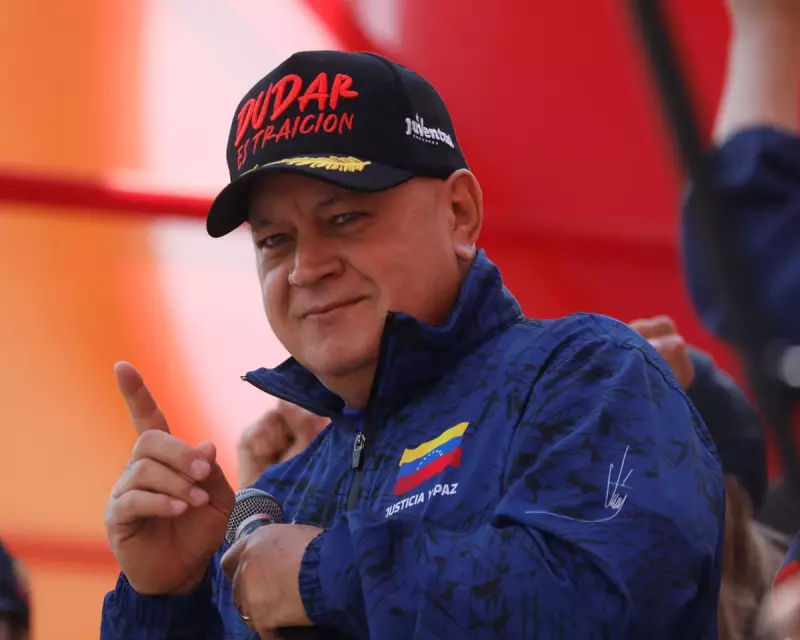
In the turbulent aftermath of President Nicolás Maduro's dramatic seizure by US forces, the fate of Venezuela's socialist regime may now rest in the hands of its most feared and powerful security chief, Diosdado Cabello. Known as 'the Octopus' for his far-reaching influence, Cabello controls the nation's police and prisons as Interior Minister and faces a stark ultimatum from Washington.
The Power Behind the Throne
For three decades, Cabello has been a central figure in Chavismo, the political movement founded by the late Hugo Chávez. His nickname is well-earned; his tentacles of influence extend across the ruling party, state enterprises, and the entire security apparatus. While Delcy Rodríguez serves as the interim president following Maduro's abduction on 3 January, many believe the real power resides with Cabello.
His weekly television show, Con el Mazo Dando (Hitting it with a Sledgehammer), is a platform for rallying loyalists and attacking enemies. Yet his authority is now under unprecedented strain. The failure of his security forces to prevent the US raid that captured Maduro has left him critically exposed.

Andrés Izarra, a former minister now in exile, described Cabello as a "walking zombie" who has been "left with his pants down." Izarra stated, "He just was totally overrun. I mean, he is the security minister. And they took away the head of state under his nose."
A $25 Million Sword of Damocles
The United States has placed a $25 million (£19m) bounty on Cabello's head and issued an indictment against him. Washington accuses him of crimes including money laundering, human rights abuses, and running a military drug network dubbed the 'Cartel of the Suns'. This makes him a prime target, with reports suggesting the US has warned he will be "the next to fall" unless he complies with American demands.
This pressure severely restricts his options. According to Izarra, who has known Cabello for years, "He has a gun to his head. Either he does what the Rodríguezes do, or he’s going to be taken out." The reference is to interim president Delcy Rodríguez and her brother, Jorge, the head of the national assembly, who are seen as cooperating with the Trump administration.
For many Venezuelans who despise the regime, Cabello's predicament is a source of grim hope. A resident of the 23 de Enero neighbourhood in Caracas said, "We’ve always thought that Maduro was a mannequin... A lot of people around here are saying: ‘I hope they get this damn Diosdado – this guy’s the real ringleader.'"
From Humble Roots to Regime Enforcer
Cabello's journey to the heart of power began in humble circumstances in Monagas state. He joined the military and became a key co-conspirator in Hugo Chávez's failed 1992 coup attempt. When Chávez later won power democratically in 1998, Cabello was rewarded with a series of high-profile posts, from vice-president to governor, allowing him to build a vast patronage network.
After Chávez's death in 2013, he was passed over for the presidency in favour of Maduro, but retained his power base. In 2024, with the regime in turmoil after a hijacked election, Maduro appointed him Interior Minister to quash dissent. Cabello vowed to hunt down opponents "like rats."
Now, his task is one of delicate balance. He must project enough force to intimidate the regime's opponents without provoking another US strike that could end with him in handcuffs. He has urged defiance and been photographed with loyal police, but is ultimately considered a pragmatist who knows his liberty depends on the regime's survival.
As a 34-year-old supermarket employee from Anzoátegui state summarised, "The guy they took [Maduro] is a puppet. The real boss is still in power." For Venezuela and its entangled global relations, the Octopus's next move will be decisive.