
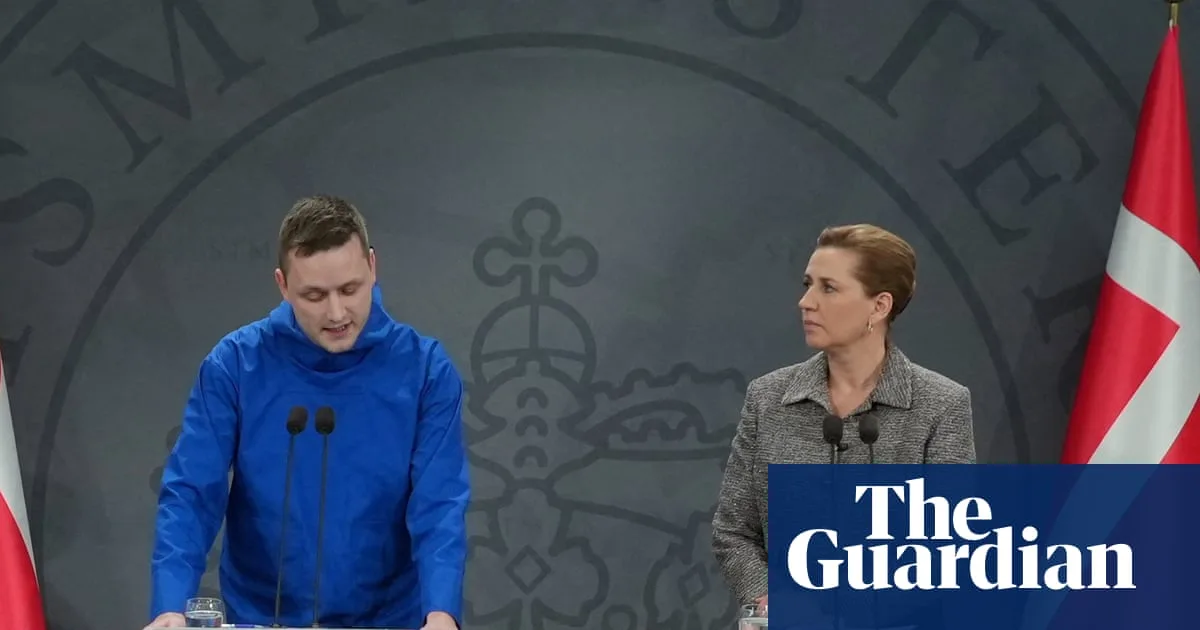
Greenland’s prime minister has declared “we choose Denmark” ahead of high-stakes talks at the White House, as Donald Trump intensifies his push to take control of the Arctic territory. Jens-Frederik Nielsen told a joint press conference with Danish counterpart Mette Frederiksen that the island would not be owned or governed by Washington.
“We are now facing a geopolitical crisis. If we have to choose between the US and Denmark here and now, we choose Denmark, Nato and the EU,” Nielsen said, adding that the island’s “goal and desire is peaceful dialogue, with a focus on cooperation”. Trump’s pursuit of Greenland was a matter of “international law and our right to our own country”, he said.
Trump first raised the idea of a US takeover in 2019 and has ramped up his rhetoric this month, saying the US would take it “one way or the other”. The threats have caused anxiety among Greenland’s 57,000 residents, with one shop in Nuuk displaying T-shirts reading: “GREENLAND IS NOT FOR SALE!”
The foreign ministers of Denmark and Greenland are due to meet US Vice-President JD Vance and Secretary of State Marco Rubio in Washington on Wednesday. Naaja H Nathanielsen, Greenland’s minister for business and mineral resources, urged the US to act as allies, saying: “For others it might be a piece of land but for us it is home.”
Frederiksen said it had not been easy to “stand up to completely unacceptable pressure from our closest ally”, adding that “borders cannot be changed by force”. Germany’s defence minister warned that any US move to take control of Greenland “would be a real unprecedented situation in the history of Nato”. Denmark plans a larger military presence alongside other Nato countries in Greenland this year.




