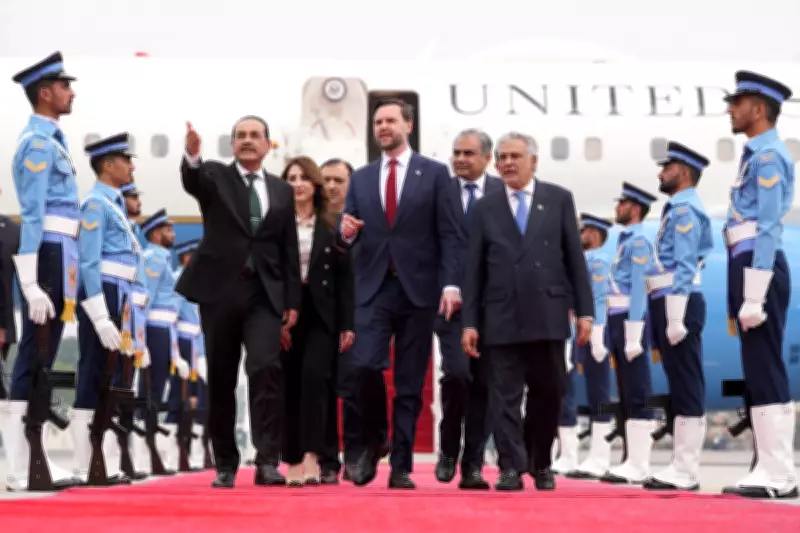
Face-to-face negotiations between the United States and Iran have officially commenced in Islamabad, Pakistan, as the devastating war that has claimed thousands of lives and destabilised global markets enters its seventh week. These talks represent the first direct diplomatic engagement between the two nations in over a decade and the highest-level discussions since the 1979 Islamic Revolution.
High-Stakes Diplomacy Amid Military Posturing
The US delegation, led by Vice President JD Vance, and the Iranian delegation, headed by Parliament Speaker Mohammad Bagher Qalibaf, are focused on advancing a fragile ceasefire. However, deep-seated disagreements and Israel's persistent attacks against Iranian-backed Hezbollah in Lebanon threaten to undermine these efforts from the outset.
Simultaneously, the US military confirmed that two of its destroyers transited the Strait of Hormuz to prepare for mine-clearing operations, marking the first such movement since the conflict began. In a contradictory claim, Iran's state media asserted that it forced a US military vessel attempting to cross the strait to turn back, highlighting the tense military backdrop to the diplomatic proceedings.

Complex Negotiations and Regional Involvement
Iran's state-run news agency reported that three-party talks initiated after Iranian pre-conditions were met, including a reduction in Israeli strikes on southern Lebanon. Both US and Iranian officials held separate meetings with Pakistani Prime Minister Shehbaz Sharif prior to the negotiations. A Pakistani official familiar with the peace efforts stated, "I cannot say whether they are sitting in the same room or in separate rooms but talks have started and are progressing well."
Iran reinforced aspects of its earlier proposal, with its delegation informing Iranian state television that it presented certain plan ideas as non-negotiable red lines during discussions with Sharif. Reflecting the international significance of these talks, officials from China, Egypt, Saudi Arabia, and Qatar are present in Islamabad to indirectly facilitate the negotiations.
Human Cost and Economic Impact
The conflict has resulted in catastrophic human losses, with at least 3,000 fatalities in Iran, 2,020 in Lebanon, 23 in Israel, and over a dozen in Gulf Arab states. It has inflicted lasting damage on infrastructure across multiple Middle Eastern countries. Iran's strategic control over the Strait of Hormuz has severely disrupted Persian Gulf oil and gas exports, causing global energy prices to skyrocket and effectively cutting off the region from the world economy.
Conflicting Proposals and Regional Dynamics
Ahead of the weekend talks, Iran and the US outlined competing proposals that underscore the vast divide between them on critical issues. Iran's 10-point plan demands:
- A guaranteed end to the war and prevention of future attacks
- Lifting of economic sanctions
- Iranian control over the Strait of Hormuz
- Cessation of hostilities against Iran's regional allies, specifically calling for an end to Israeli strikes on Hezbollah
Conversely, the United States submitted a 15-point proposal that includes restrictions on Iran's nuclear programme and the reopening of the strait to international navigation.
Ongoing Violence and Separate Negotiations
Despite the peace talks, Israel continued its strikes in Lebanon on Saturday, with the Lebanese state-run news agency reporting at least three casualties. Iran has explicitly conditioned ceasefire discussions on a pause in fighting there, creating a significant obstacle to progress.
Separate negotiations between Israel and Lebanon are scheduled to begin on Tuesday in Washington. Israel aims for the Lebanese government to assume responsibility for disarming Hezbollah, as outlined in a November 2024 ceasefire agreement. However, the feasibility of Lebanon's army establishing a monopoly on arms or confiscating weapons from Hezbollah, which has resisted disarmament for decades, remains uncertain.

Israel's insistence that the ceasefire with Iran does not include a halt to its conflict with Hezbollah jeopardises the entire deal. The militant group entered the war in support of Iran during its initial days. On the day the truce was announced, Israel conducted devastating air strikes on Beirut, resulting in over 300 deaths—the deadliest single day in Lebanon since the war began on 28 February.
Security Measures and Diplomatic Caution
Islamabad appeared deserted on Saturday as security forces sealed roads and authorities urged residents to remain indoors, transforming the typically bustling Pakistani capital into a city resembling one under curfew. Vice President Vance expressed cautious optimism about the talks on Friday but issued a stern warning: "If they're going to try and play us, then they're going to find that the negotiating team is not that receptive."
The convergence of high-level diplomacy, military manoeuvres, and ongoing violence underscores the precarious nature of these peace efforts, with regional stability and global economic interests hanging in the balance.