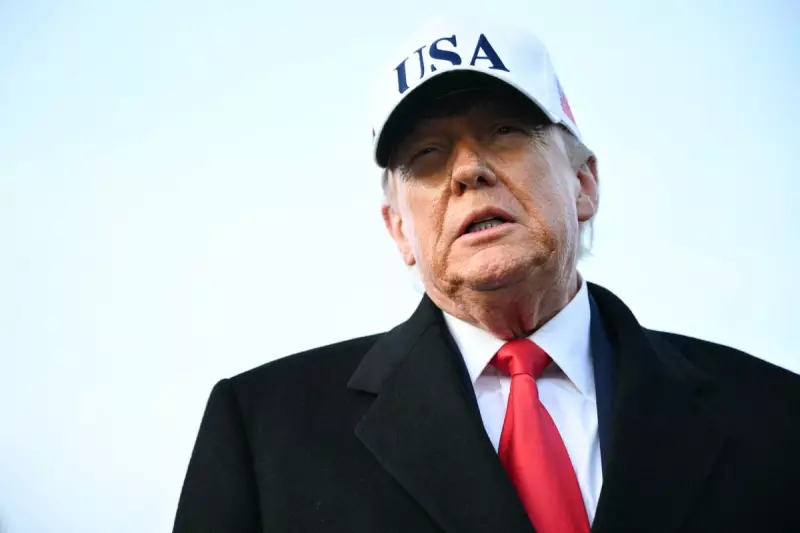
In a notable shift from a recent pattern of dramatic military action, the United States under President Donald Trump has appeared to adopt a more cautious, wait-and-see approach towards the ongoing unrest in Iran. This comes despite the President's earlier, very public promises of support for protesters and threats of "very strong action" against the Iranian regime.
From 'Locked and Loaded' to a Strategic Pause
The start of 2026 saw an almost relentless demonstration of American military power. From Christmas Day strikes in northern Nigeria to the extraction of Venezuela's president and a series of strikes on Islamic State targets in Syria, the US has been exceptionally active. Threaded through these actions was Trump's running commentary on Iran, where he pledged that the US would come to the rescue if Iran "violently kills peaceful protesters."
He followed this with direct encouragement to "Iranian patriots," assuring them that "help is on its way." White House press secretary Karoline Leavitt added that while diplomacy was preferred, "air strikes would be one of the many, many options." Yet, as of Thursday 15 January 2026, no direct intervention had materialised.

The Diplomatic Signal and a Shift in Rhetoric
The momentum for intervention seemed to stall shortly after. President Trump stated he had been informed that killings in Iran were subsiding and there were no plans for "large-scale" executions. In a significant diplomatic event, given the two nations have had no formal relations since 1979, Iran's Foreign Minister Abbas Araqchi appeared on Fox News. He publicly stated that Iran had "no plan for hanging at all… hanging is out of the question."
This public assurance, aimed directly at a US audience, created a new dynamic. It raised questions: were the Iranian authorities constrained by Trump's threats? Did the US President's rhetoric actually save lives? Analysts suggest that Araqchi's statement now makes it politically difficult for Iran to embark on executions without revealing deep internal divisions.
The Realist Calculation Behind the Bluster
A more compelling reason for the pause may be Trump's underlying realism. For all his public bravado, he has shown a marked aversion to large-scale, open-ended nation-building interventions, often criticising past US ventures in Iraq, Libya, and Afghanistan. His operations, including the 2020 assassination of Qasem Soleimani and the capture of Venezuela's Nicolas Maduro, have been narrowly drawn missions where benefits are calculated to outweigh risks.
This caution appears to extend to Iran. Intervening in a vast, centrally-administered country embroiled in what remains a domestic dispute carries the risk of unforeseen and dire consequences. Furthermore, Trump has notably avoided endorsing calls for the restoration of the Iranian monarchy, despite some protesters' demands, and has expressed uncertainty about the strength of opposition figures—a parallel to his stance on Venezuela's opposition.
Other calculations are likely in play: the proximity of Congressional midterm elections, where a messy intervention could be a political liability, and the complex regional dynamics as the US pursues its broader Middle East strategy. The current policy of keeping options open and "keeping the ayatollahs guessing" may, in itself, be a deliberate and potentially fruitful strategy.
While future US intervention in Iran is not off the table, it will likely depend on a cold calculation of the odds for a successful, orderly transition—and on keeping American boots very far from the ground.