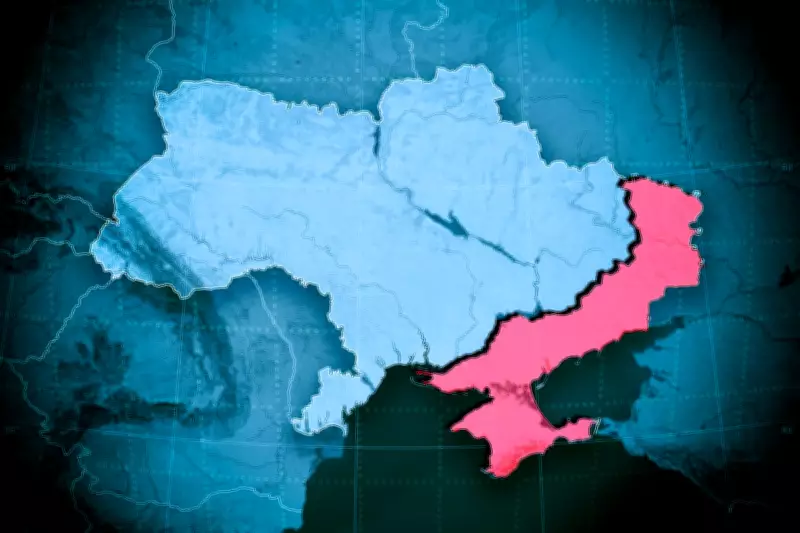
Ukraine War Frontline: 745-Mile Stalemate Enters Fifth Year with No Breakthrough
As the war in Ukraine enters its fifth year, Ukrainian and Russian forces remain locked in a grinding stalemate along a 1,200-kilometre (745-mile) frontline, with neither side able to secure a decisive advantage. Despite symbolic victories and incremental gains, military analysts describe a battlefield dominated by drones and attrition, where breakthroughs have slowed to a crawl.
Frontline Dynamics and Territorial Gains
Ukrainian President Volodymyr Zelensky recently asserted that recovering all lost territory is "only a matter of time," but the reality on the ground tells a different story. In February, Ukraine's military announced the recovery of 400 square kilometres of territory, including eight settlements, improving upon the 300 square kilometres claimed the previous week. These gains effectively cancel out the 389 square kilometres Russia captured in January.
However, experts note that most Ukrainian advances have occurred in the southeast, away from strategically valuable eastern regions where decisive victories could alter the war's trajectory. Emil Kastehelmi, a military analyst and co-founder of the Black Bird Group, told The Independent that breaking the deadlock where it matters remains extremely difficult for both sides.

The Drone-Dominated Battlefield
Modern frontlines bear little resemblance to traditional trench warfare. "Drones have made it so that frontlines are blurry and troops may be intermingled in a certain area of presence," explained Kastehelmi. This "drone dominated battlefield" has effectively "demechanised" combat, making large-scale advances nearly impossible.
The threat from above has rendered tanks increasingly vulnerable, forcing Russia to rely on infantry-heavy tactics in a brutal war of attrition. Tank platoon commander Valentyn Bohdanov described how his T-72 tank, captured from Russian forces, now serves as static artillery near Kharkiv, hidden beneath camouflage webbing. "They won't enter an open field: they'll be peppered by FPV drones and stronger ones," he told Reuters, suggesting such weapons are becoming obsolete.
Human and Economic Costs
The attritional nature of the conflict has exacted a heavy toll. Drone-inflicted casualties have skyrocketed from less than 10% of total losses in 2022 to up to 80% in 2025. Russia reportedly suffered approximately 80,000 casualties last year while gaining just 0.8% of Ukrainian territory (about 4,800 square kilometres).
Despite plans to expand its army to 1.5 million personnel, Russia's war economy shows signs of strain. Economic growth slowed to just 1% in 2025, with the defence sector consuming 8% of GDP. The budget deficit is widening, and Russia grows increasingly reliant on foreign troops, wary that another mobilisation could spark domestic unrest.
Prospects for Breaking the Deadlock
Military analysts offer cautious predictions for 2026. Kastehelmi expects Russia to continue making slow, incremental progress month by month, pursuing an attrition strategy to "bleed out the Ukrainian army." He notes that Russian advances averaged only 400-500 square kilometres monthly in 2025, indicating persistent battlefield challenges.
Dr Jack Watling of the Royal United Services Institute (RUSI) emphasized that Ukraine must apply successful tactics from southern counterattacks more broadly. "Fixing Ukraine's training process is the key to addressing the challenge of force generation," he said, enabling Ukrainian units to resist Russian infiltration tactics when spring vegetation returns.
Technological and Diplomatic Factors
While current conditions favour defensive operations, military analyst Rob Lee suggests technological breakthroughs could eventually restore manoeuvre warfare. "Right now, the current role [of tanks] is diminished, and I think we're waiting for the next technological breakthrough that will enable manoeuvring again," he told Reuters.
Diplomatically, efforts remain stalled. Russia maintains maximalist territorial demands, while Ukraine refuses to cede eastern provinces. European unity faces obstacles, as Hungary's Viktor Orban continues to oppose sanctions, preventing the EU from implementing its 20th sanctions package.

Watling concluded that while Russia's economy can sustain the war effort for now, growing debt and dwindling reserves increase vulnerability. "The question is whether Europe is prepared to apply the pressure," he assessed, highlighting the geopolitical dimensions of the prolonged conflict.