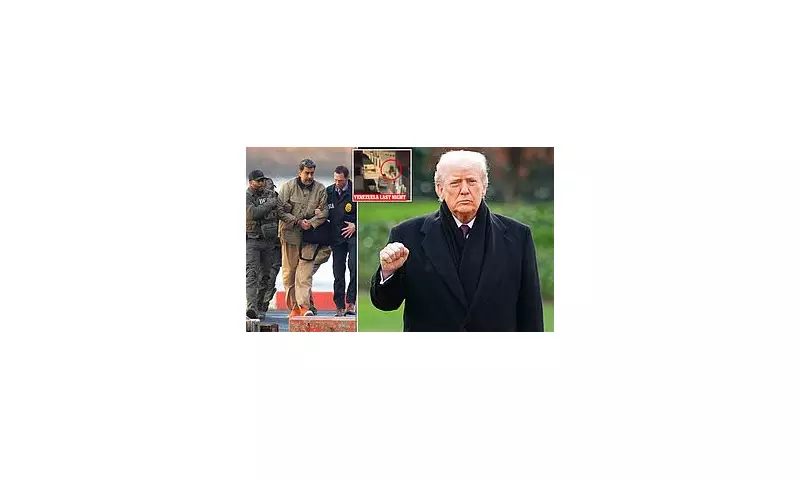
The dramatic capture of Venezuelan President Nicolás Maduro and his subsequent appearance in a Manhattan courtroom this week may represent merely the opening salvo in a far more ambitious American campaign. This operation is underpinned by a newly published National Security Strategy that lays out a sweeping vision to leverage US military dominance and remake the international order.
A New Doctrine for a New Era
Published last month, the strategic document explicitly commits to asserting and enforcing a "Trump Corollary" to the historic Monroe Doctrine. This 19th-century policy, declared by President James Monroe in 1823, aimed to prevent European powers from establishing new colonies in the Western Hemisphere. The modern iteration, as detailed in the policy, seeks to "tie together all of these world-leading assets... to strengthen American power and preeminence." Its goal is to ensure favourable trade conditions by preventing nearby nations from falling under the control of adversarial powers.
The early stages of Venezuela's forced transition were marked by volatility. As Maduro pleaded not guilty to drug trafficking charges in federal court on Monday, January 3rd, violence erupted on the streets of Caracas. Locals reported hearing 'anti-aircraft' blasts near the presidential palace, though a White House official told CNN the US was not involved, attributing the gunfire to confusion among paramilitary groups.

Rebuilding Venezuela: Oil and Occupation
President Donald Trump has asserted ultimate authority over the South American nation's future. He told NBC News that US oil companies would be integral to rebuilding Venezuela's shattered energy infrastructure, suggesting American taxpayers might foot the initial bill before being reimbursed through future oil revenues. "A tremendous amount of money will have to be spent and the oil companies will spend it, and then they'll get reimbursed by us or through revenue," Trump stated.
According to The Wall Street Journal, Trump told US oil executives to "get ready" a full month before launching the operation to oust Maduro. Venezuelan opposition leader María Corina Machado has pledged to assist Trump, promising to turn Venezuela into "the energy powerhouse of the Americas" with open markets and investment.
Trump outlined a lengthy process, estimating it could take 18 months before new elections could be held. "We have to nurse the country back to health," he said, arguing that no legitimate vote could be held in the current chaotic state.
Greenland in the Crosshairs
The administration's ambitions appear to stretch far beyond Latin America. In a combative television interview, Homeland Security Advisor Stephen Miller openly challenged Denmark's sovereignty over Greenland and refused to rule out military action to secure the Arctic territory for the United States.
"Nobody's gonna fight the United States militarily over the future of Greenland," Miller declared on CNN. He questioned the basis of Denmark's claim, calling Greenland a colony and arguing that for the US to secure the Arctic and defend NATO interests, "obviously, Greenland should be part of the United States." Greenland, which has had the right to declare independence since 2009, remains heavily dependent on Danish support.
Meanwhile, the legal proceedings against the captured Venezuelan leaders commenced. Maduro, 63, and his wife Cilia Flores, 69, appeared shackled in the Metropolitan Detention Center in Brooklyn. Maduro identified himself as the kidnapped President of Venezuela and proclaimed his innocence. Flores similarly declared herself the "First Lady" and "completely innocent." The court set their next hearing date for March 17, with no application for bail made.
The events of the past days signal a profound and aggressive shift in US foreign policy, invoking historical doctrine to justify contemporary interventionism with potentially global ramifications.