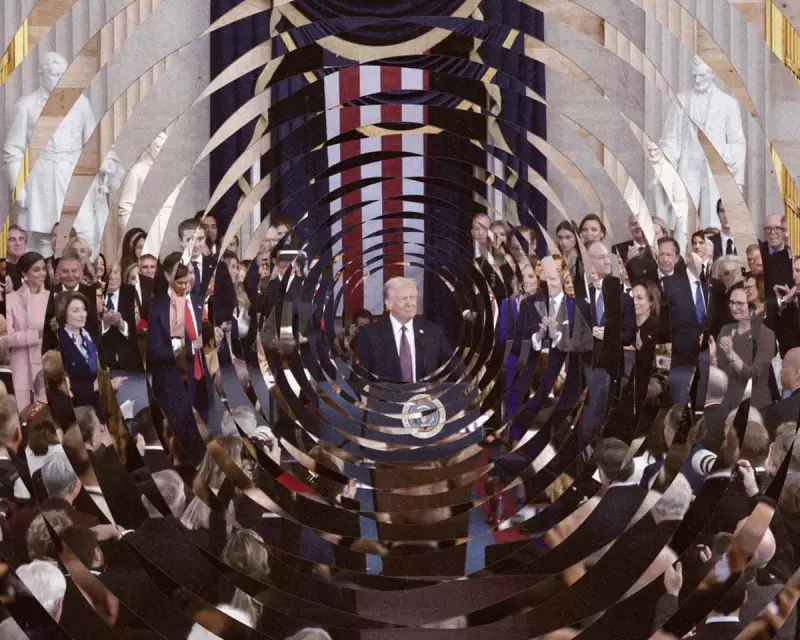
One year on from a frigid inauguration day in Washington, the administration of Donald Trump has pursued an ambitious and contentious agenda. On 20 January 2025, with the temperature at -3C, the 47th president delivered a half-hour address in the Capitol rotunda, vowing to reclaim sovereignty, restore safety, and rebalance justice.
Before an audience including former presidents and tech billionaires, Trump painted a bleak picture of America and promised a flurry of executive action. We examine the fate of ten key pledges made that day, tracking the policy shifts and their consequences over the following twelve months.
Justice, Immigration and a Divided Nation
In his inaugural address, Trump pledged to end the "weaponisation" of the justice department. His attorney general, Pam Bondi, has enforced his will with zeal. The president dismissed 17 independent inspectors general and ordered investigations into figures like former FBI director James Comey and Federal Reserve chair Jerome Powell.

Crime statistics showed a notable decline, with murders down roughly 20% compared to 2024, according to the Real Time Crime Index. "He has helped make the country safer in terms of crime," noted Henry Olsen of the Ethics and Public Policy Center, though he cautioned direct attribution.
However, commentator Kurt Bardella argued Trump had done precisely what he bemoaned: "We've seen him at every step of the way turn around and do that, wielding the power of executive in ways that we've just never seen before."
On immigration, Trump declared a national emergency on day one. His administration reinstated the 'Remain in Mexico' policy, ended 'catch and release', and deployed troops. By December, over 622,000 deportations and 1.9 million self-deportations were recorded, reducing border encounters to 1970s levels.
The aggressive enforcement sparked major controversy. Federal forces were deployed to Democratic-run cities, leading to harrowing reports of excessive force. In a January operation in Minneapolis, mother and poet Renee Good was shot and killed by an ICE officer; federal officials called it self-defence while the mayor deemed it reckless.
"Poll after poll shows the American people do not approve of the ways in which the Trump administration has pursued immigration enforcement. They think he's gone too far," Bardella stated.
Economic Promises and Global Strikes
Trump vowed to marshal his cabinet to defeat record inflation. When he took office, the rate was 3%; by December 2025, the Consumer Price Index showed a 2.7% year-on-year rise—a slight improvement but evidence of persistent inflation. Only 36% of Americans approved of his economic handling in a January 2026 Reuters/Ipsos poll, down from 42% a year prior.
His 'energy dominance' agenda saw the US become the world's leading oil and gas producer, with drilling permits surging by 55%. He also initiated withdrawal from the Paris climate agreement.
A cornerstone of his trade policy was tariffs, which he imposed on 2 April 2025—'Liberation Day'. A 10% baseline tax on imports, plus additional levies on about 90 countries, was justified using the 1977 International Emergency Economic Powers Act. The Supreme Court is now hearing a challenge that could overturn them. "The short-term pain is less than many... would have expected," Olsen observed, "but the gain is years off."
In a surreal bureaucratic venture, Trump established the Department of Government Efficiency (Doge), placing Elon Musk in charge. The project, aimed at drastic spending cuts, caused widespread chaos before disbanding eight months early. Musk later called it a "side quest."
Culture Wars and Military Action
The administration moved swiftly on social policy, eliminating Diversity, Equity and Inclusion (DEI) programmes across government and declaring official policy that there are only two genders. It removed the non-binary 'X' option from US passports and sought to end gender-affirming care for under-19s.
On free speech, Trump targeted law firms representing perceived enemies and froze billions in funding for universities like Harvard, exploiting controversies over antisemitism. He also waged legal war on media outlets including the BBC and the New York Times.

Foreign policy presented a stark contradiction. Despite campaigning as a peacemaker, Trump ordered military strikes in Iraq, Nigeria, Somalia, Syria, Yemen, and Iran. The most dramatic action came in early 2026 with the bombing of Venezuela and capture of its leader, Nicolás Maduro. He repeatedly sided with Russia over Ukraine.
"Trump obviously has a very different idea of what respected all over the world means," said Larry Jacobs of the University of Minnesota. "Probably what he means is feared and intimidated."
As the first year of Trump's second term concludes, the assessment of his ten pledges reveals a record of forceful action, significant controversy, and outcomes that remain fiercely debated across the American political spectrum.