Davos Observers Spot Striking Resemblance Between Trump's New Logo and UN Emblem
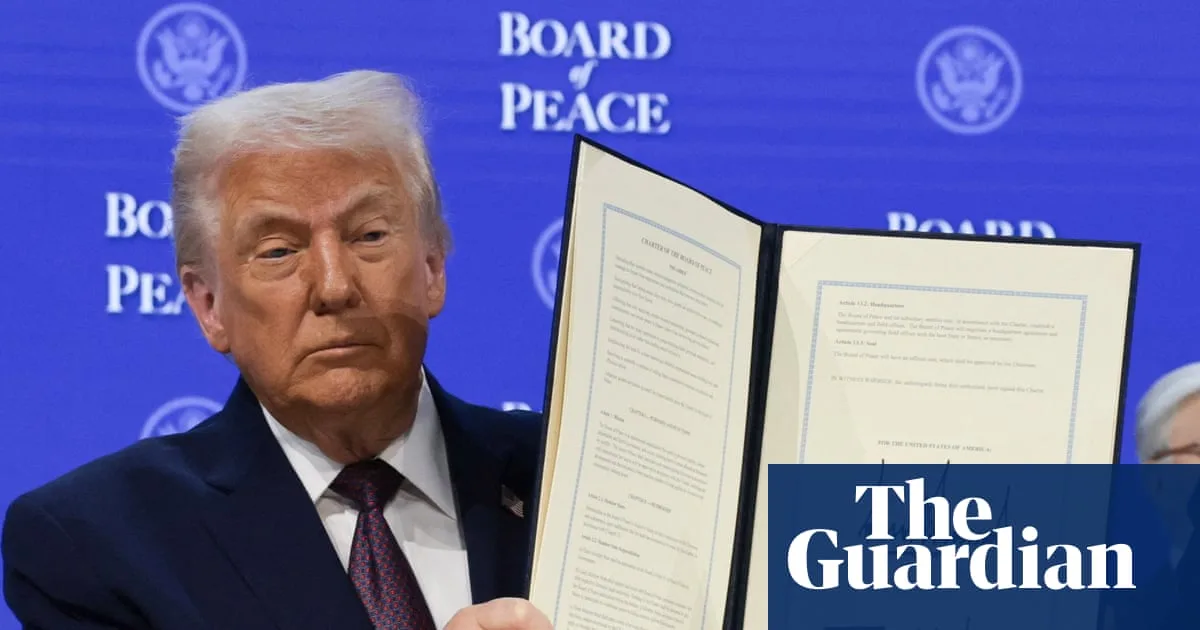
Attendees at the World Economic Forum's annual meeting in Davos this week have been quick to notice a remarkable visual similarity between the newly launched "board of peace" logo and the longstanding emblem of the United Nations. The initiative, unveiled by US President Donald Trump, features a gold-coloured design that has immediately drawn comparisons and criticism from European delegates.
A Golden Interpretation of Global Diplomacy
The board of peace logo maintains the basic structure of the UN symbol - featuring a globe flanked by olive branches - but with several significant modifications that reflect Trump's distinctive style. Where the UN emblem displays a complete world map in its characteristic blue hue, Trump's version focuses primarily on North America with partial representation of South American nations like Venezuela, where the administration has previously sought to assert influence.
Perhaps most noticeably, the entire design has been rendered in bright gold, creating a stark contrast with the UN's traditional blue colour scheme. This aesthetic choice aligns with what has become known as Trump's "golden touch" across various aspects of his presidency and personal branding.
From Gaza Ceasefire to Global Ambitions
The initiative originally gained UN Security Council endorsement in November with the stated purpose of brokering a ceasefire in Gaza. However, Trump has since repositioned the board as a comprehensive global conflict resolution body that would be chaired by the president himself. This expansion of scope appears to be part of a broader administration effort to reshape international diplomatic structures in the post-war era.
Speaking at Davos, Trump suggested the board would "work with" the United Nations to address global conflicts, while simultaneously requiring participating nations to contribute $1 billion in cash for permanent membership status. "Once this board is completely formed, we can do pretty much whatever we want to do, and we'll do it in conjunction with the United Nations," the president stated during his remarks.
European Resistance and Diplomatic Concerns
Several European countries have already indicated they will not join the initiative, with some expressing concerns that the board could potentially undermine or even seek to replace existing UN structures. The visual similarity between the logos has only heightened these diplomatic anxieties, with critics suggesting the design choices symbolise a broader attempt to reposition American influence within global governance frameworks.
The Trump Golden Aesthetic Extends Beyond Diplomacy
The gold logo represents just the latest manifestation of Trump's well-documented preference for golden aesthetics. Last year, the president oversaw what was described as a "golden office for the golden age" transformation of the Oval Office, complete with gold trimming, trophies, vases, and even personalised gold drinks coasters. White House officials emphasised that the renovations were personally funded by Trump and executed with what they called "the highest quality" materials.
This golden theme has extended into commercial ventures as well, including a $499 gold smartphone launched by the Trump Organization in June and a proposed $1 million "gold card" visa programme for wealthy foreign investors announced in December. International leaders have seemingly embraced this aesthetic, with gifts including a "golden pager" from Israeli Prime Minister Benjamin Netanyahu and an engraved glass disk with a 24-karat gold base from Apple CEO Tim Cook.
Perhaps most notably, a group of Swiss billionaires presented Trump with a gold Rolex desk clock and a $130,000 engraved gold bar in November - shortly before the administration agreed to reduce tariffs on Swiss imports from 39% to 15%.
The board of peace logo controversy emerges as just one element in what appears to be a concerted effort to imprint Trump's distinctive style onto both domestic and international institutions, raising questions about how traditional diplomatic symbols and protocols are being reinterpreted for a new era of American foreign policy.






