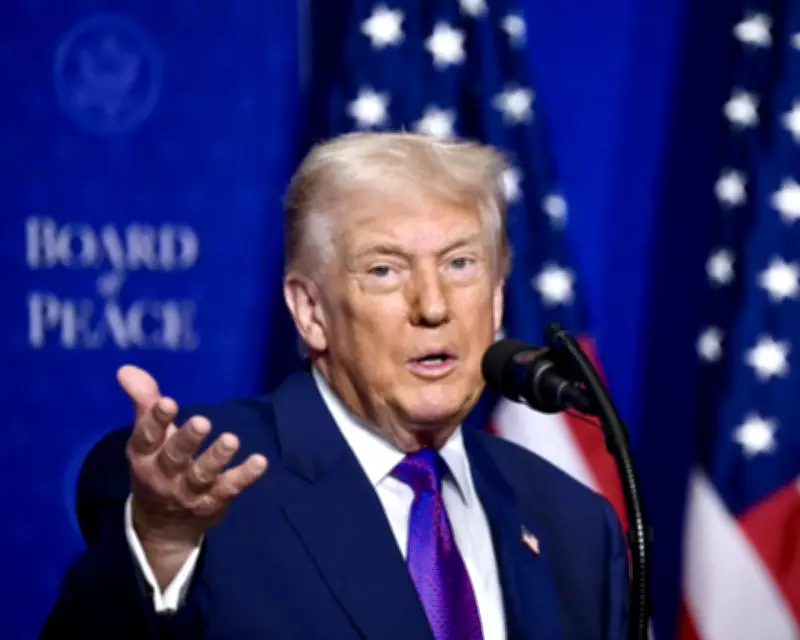
Trump's Board of Peace Launches Ambitious Gaza Plan with Troops and Funding
Donald Trump delivered opening remarks at the inaugural meeting of his Board of Peace in Washington DC, setting the stage for a controversial agenda focused on deploying troops to Gaza and committing billions in reconstruction funds. The US president vowed to lead a multinational force and provide substantial financial support, as autocrats and rightwing allies gathered under heavy international scrutiny.
Multinational Force Proposal for Postwar Gaza
The United States has proposed commanding a multinational force in postwar Gaza, with troops contributed from Albania, Indonesia, Kazakhstan, Kosovo, and Morocco. This plan, unveiled during the board's meeting, requires the full disarmament of Hamas and support from Israel, though expectations are tempered by the committee's composition of Trump-friendly autocrats and rightwing allies.
Despite skepticism, the board pushed forward with a massive peacekeeping and reconstruction mission. At the summit, Kazakhstan's president, Kassym-Jomart Tokayev, suggested a Trump peace prize, while FIFA head Gianni Infantino wore a red USA cap and announced a partnership with the committee, which charges $1 billion per seat.

Financial Commitments and Reconstruction Vision
In his speech, Trump announced a US commitment of $10 billion to a fund aimed at reconstructing Gaza, describing it as a small amount to "achieve the dream of bringing lasting harmony to a region tortured by centuries of war, suffering and carnage." Additional contributions include $7 billion collectively from Azerbaijan, Bahrain, Kazakhstan, Morocco, Qatar, Saudi Arabia, and the United Arab Emirates, $2 billion from the UN, and $75 million from FIFA.
Trump expressed confidence, stating, "We're going to straighten out Gaza, we're going to make Gaza very successful and safe," and hinted at expanding the board's role to address global hotspots. Maj Gen Jasper Jeffers III, appointed to command the future International Stabilisation Force (ISF), detailed plans to deploy 20,000 soldiers across five sectors of Gaza, starting with Rafah, and a long-term goal of 12,000 police trained by Egypt and Jordan.
Criticism and Challenges Ahead
The board has faced criticism as a shadow UN, with major European allies like the UK, France, and Germany declining to join, and the Vatican also opting out. Israeli Prime Minister Benjamin Netanyahu did not attend, but his foreign minister, Gideon Sa'ar, emphasized Israel's security concerns, highlighting the plan's focus on disarming Hamas and Islamic Jihad, demilitarizing Gaza, and deradicalizing Palestinian society.
Aid workers have reported frustrations with the National Committee for the Administration of Gaza, citing a lack of direction and an empty ISF office in the territory. The ISF's remit and rules of engagement remain unclear, potentially hindering reconstruction efforts without a political solution. Yakir Gabay, leading the reconstruction, outlined ambitious plans to remove over 70 million tonnes of rubble and develop the Gaza coastline into a "new Mediterranean Riviera with 200 hotels and potential islands," contingent on Hamas's disarmament.
Broader Geopolitical Context
The meeting occurred as the US has massed forces in the Middle East, including two aircraft carriers and dozens of warplanes, for a potential attack on Iran. Trump referenced previous strikes on Iran's nuclear facilities and hinted at further actions, saying, "Now we may have to take that a step further, or we may not. Maybe we're going to make a deal. You're going to be finding out over the next probably 10 days."
He also made controversial remarks, endorsing Hungary's Viktor Orbán in upcoming elections and joking about renaming the DC venue in his honor. The board's proposals mark a significant but contentious step in US foreign policy, blending military strategy with reconstruction ambitions amid ongoing regional tensions.