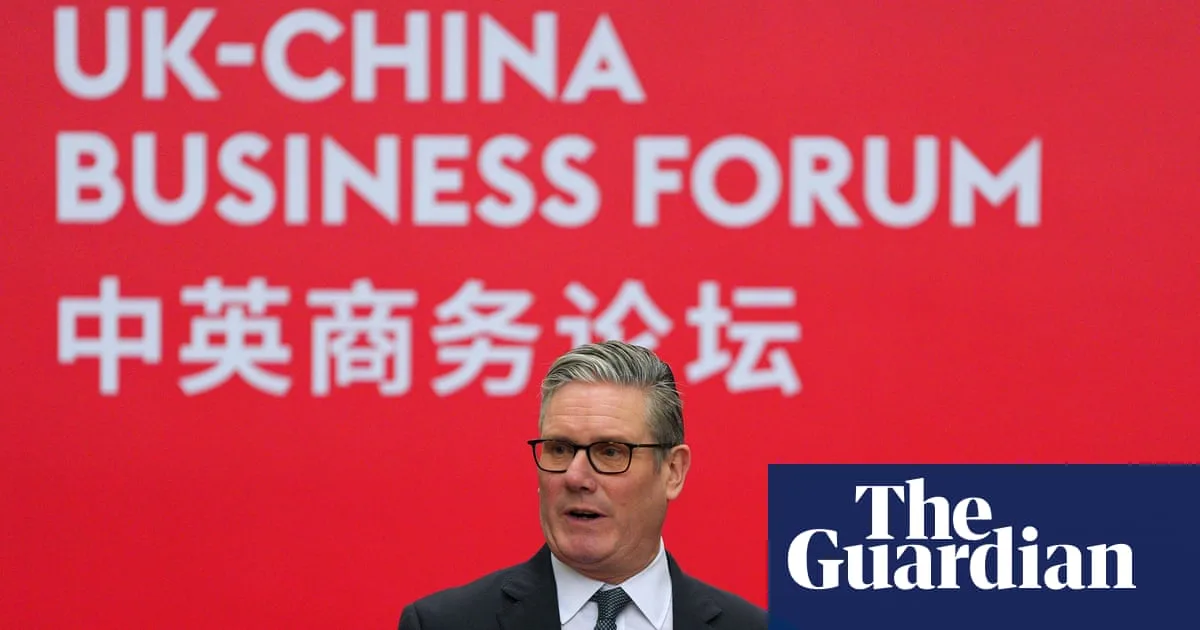
In a striking intervention, former US President Donald Trump has issued a stark warning to the United Kingdom, declaring it "very dangerous" for the nation to pursue deeper business ties with China. This caution came mere hours after British Prime Minister Sir Keir Starmer concluded significant talks in Beijing aimed at resetting economic relations.
A Landmark Visit and a Stark Warning
Sir Keir Starmer's visit to Beijing marked the first by a British prime minister in eight years, signalling a deliberate thaw in previously strained diplomatic relations. During a three-hour meeting with Chinese leader Xi Jinping at the Great Hall of the People, discussions focused on forging a "more sophisticated" bilateral relationship.
The Prime Minister later addressed the UK-China Business Forum at the Bank of China headquarters, stating the relationship was in a "good, strong place" and that his engagements had yielded the "level of engagement that we hoped for." He highlighted tangible progress, including agreements on improved market access for British goods, lower tariffs, and new investment deals.
Trump's Caution Creates Diplomatic Ripples
However, from Washington, Donald Trump offered a sharply contrasting perspective. When questioned about Starmer's efforts to reset economic ties with Beijing, the former president responded bluntly: "Well, it's very dangerous for them to do that."
Trump's remarks are likely to cause concern within Downing Street, given his history of unpredictability and well-documented hostility towards China. The warning underscores the delicate balancing act facing the UK as it seeks to strengthen economic partnerships in Asia while maintaining its crucial 'special relationship' with the United States.
One UK official sought to downplay potential friction, noting that the US administration had been briefed on the trip's objectives in advance.
Business Leaders Hail Pragmatic Approach
Despite the political warnings, British business representatives in China viewed the Prime Minister's visit as a necessary and pragmatic step. Chris Torrens, Chair of the British Chamber of Commerce in China, described the trip as "successful," telling the BBC that "it makes sense for the UK to be looking to China, it's one of its larger trading partners."
Chinese state media has framed Starmer's visit as an act of economic pragmatism, recognising the mutual benefits of enhanced trade. The UK leader is the latest in a string of Western officials to visit Beijing recently, as nations seek to build ties with the world's second-largest economy and hedge against an unpredictable US foreign policy landscape.
Broader Context of US Trade Tensions
Trump's comments arrive amid a backdrop of ongoing trade tensions initiated by the former president. Earlier in the week, he threatened to impose tariffs on Canada if it proceeded with economic deals secured during its own prime minister's visit to Beijing.
"It's even more dangerous, I think, for Canada. Canada is not doing well," Trump added, while paradoxically noting, "President Xi is a friend of mine, I know him very well." He is expected to visit Beijing himself in April.
Prior to Trump's statement, US Commerce Secretary Howard Lutnick expressed scepticism about the UK's chances of securing favourable terms with China, citing the nation's reputation as a difficult export market. However, he played down the immediate risk of the US threatening Britain with tariffs, as it had Canada, unless the UK government were to "take on the United States and say very difficult things."
Starmer's Balancing Act
Before his departure for Beijing, Prime Minister Starmer explicitly addressed the potential for diplomatic friction. In an interview with Bloomberg, he asserted that Britain would not have to choose between the US and China, arguing the country could strengthen economic ties with Beijing without damaging its vital relationship with Washington.
"We've got very close relations with the US – of course, we want to – and we will maintain that business, alongside security and defence," Starmer stated, outlining his vision for a multifaceted foreign policy.
Following his engagements in Beijing, the Prime Minister was scheduled to travel to Shanghai before departing for Tokyo to meet Japanese counterpart Sanae Takaichi, continuing a diplomatic tour focused on strengthening UK ties in the Asia-Pacific region.