Trump Declares US Military 'Raring to Go' as Critical Iran Talks Approach Deadline
Former US President Donald Trump has issued a stark warning that American forces are prepared to launch renewed attacks against Iran if progress stalls at eleventh-hour negotiations currently scheduled in Pakistan. The talks hang in the balance as a tense stand-off continues in the strategically vital Strait of Hormuz, severely disrupting international shipping lanes and causing significant global economic repercussions.
Ceasefire Deadline Looms Amid High-Stakes Diplomacy
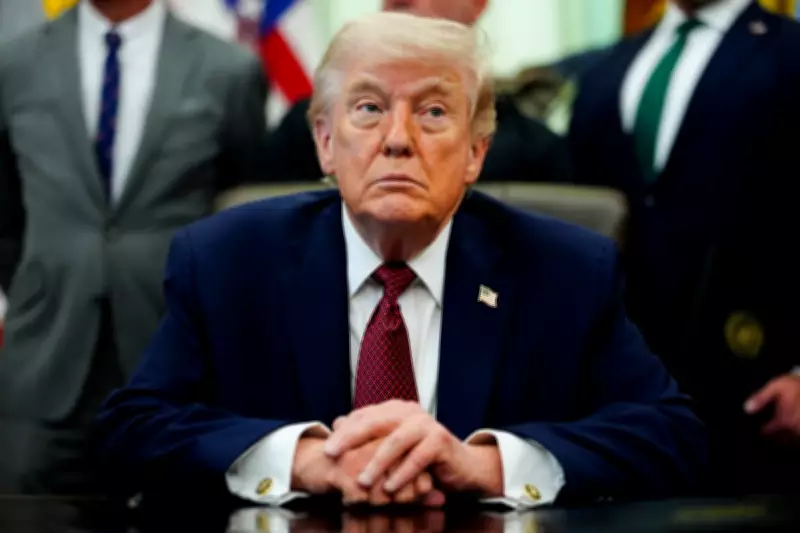
In an interview with CNBC, Trump explicitly stated his reluctance to extend the current two-week ceasefire with Tehran, emphasizing that the deadline is rapidly approaching. "I don't want to do that. We don't have that much time," he declared, while simultaneously expressing confidence in America's negotiating position. "I think we're going to end up with a great deal," Trump asserted, claiming the United States has achieved military dominance by neutralizing Iran's naval and air capabilities during previous conflicts.
The former president elaborated on his aggressive stance, stating: "Well, I expect to be bombing because I think that's a better attitude to go in with. But, you know, we're ready to go. I mean, the military is raring to go." Trump further justified his position by referencing what he described as Iran's limited options following significant military losses, while also suggesting that current Iranian leadership under Parliament Speaker Mohammad Bagher Qalibaf is "much more rational" than previous administrations.

Global Economic Impact and Diplomatic Efforts
The effective closure of the Strait of Hormuz during the ongoing conflict has created substantial global economic shockwaves, sending energy prices soaring and disrupting supply chains worldwide. UK Foreign Secretary Yvette Cooper, who has been engaged in discussions with international counterparts aimed at safeguarding the strategic waterway, characterized the situation as "a critical diplomatic moment" in the escalating crisis.
Meanwhile, Iranian negotiator Mohammad Bagher Qalibaf has publicly accused Trump of attempting to transform the negotiating table into "a table of surrender." In a social media post, Qalibaf declared: "We do not accept negotiations under the shadow of threats," and indicated that Iran is preparing "to reveal new cards on the battlefield" should diplomacy fail.
International Coordination and Domestic Preparations
US Vice President JD Vance is expected to lead the American delegation in Pakistan, though the White House confirmed he remained in Washington as of Tuesday afternoon, with exact timing of the talks still unconfirmed. On the British front, Prime Minister Sir Keir Starmer convened the Middle East Response Committee to discuss the government's efforts to mitigate public impacts from the conflict.
A government spokesperson revealed that the committee addressed multiple contingency plans, including coordination with fuel suppliers and airlines, diplomatic support for US-Iran negotiations, military planning for post-conflict operations to keep the Strait of Hormuz open (a mission co-led with France), and broader measures to decouple gas and electricity pricing structures. These preparations underscore the widespread recognition that the outcome of these negotiations will have profound consequences extending far beyond the immediate region.