Trump Postpones Iranian Strikes as Tehran Ramps Up Global Threats
In a significant diplomatic shift, former US President Donald Trump has announced a five-day postponement of planned strikes against Iranian energy sites. This decision follows his earlier ultimatum demanding Iran fully reopen the Strait of Hormuz within 48 hours or face military action. The move comes after Washington and Tehran engaged in talks aimed at achieving a "complete and total resolution of hostilities" across the Middle East, with Trump suggesting the conflict could conclude within a week if negotiations proceed favorably.
Iran's Missile Capabilities Reach European Capitals
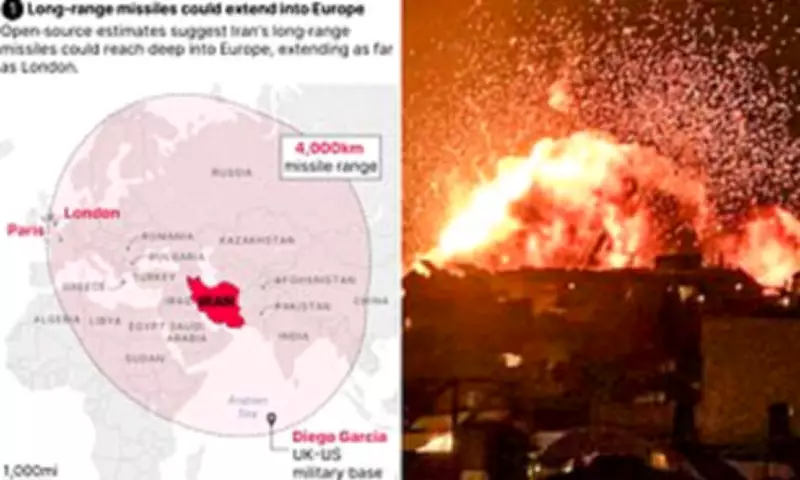
The postponement coincides with alarming escalations from Tehran, including the regime's first deployment of long-range ballistic missiles in the conflict. These missiles targeted Diego Garcia, the joint US-UK military base in the Chagos Islands, located approximately 2,361 miles from Iran. While one missile was intercepted by US defenses, the second failed mid-flight after traveling nearly 2,000 miles.
Military experts warn this demonstration suggests Iran's missile range has dramatically expanded beyond previous estimates of 1,243 miles to approximately 2,500 miles, potentially placing European capitals including London, Paris, Berlin, and Rome within direct threat range. Israel's chief of staff, Eyal Zamir, confirmed this assessment, stating that Tehran's missiles now reach major European cities.

Foreign affairs analyst Nawaf Al-Thani noted on social media that this represents a "strategic leap" in Iran's capabilities, moving from medium-range to intermediate-range ballistic missiles. "The real story is not whether the missile was intercepted," Al-Thani wrote. "It is that Iran may have demonstrated reach far beyond what much of the world believed it possessed."
Global Energy Crisis Intensifies
The continued shutdown of the Strait of Hormuz has triggered the world's most severe oil crisis since the 1970s, with European gas prices soaring by as much as 35 percent last week. Brent crude has surged approximately 55 percent since late February to around $110 per barrel, while US West Texas Intermediate has climbed 50 percent to approximately $99.
Iran has threatened to "irreversibly destroy" essential infrastructure across the Middle East, including vital energy facilities and desalination plants. State media has published infographics titled "Say goodbye to electricity!" showing potential targets in Saudi Arabia, the United Arab Emirates, Qatar, and Kuwait, along with Israel's two largest power plants.
Attacks on desalination facilities could prove particularly catastrophic, as the Middle East relies heavily on desalinated water, with approximately 42 percent of global desalination capacity located in the region. Water economist Esther Crauser-Delbourg emphasized, "Over there, without desalinated water, there is nothing," highlighting the potential for a major humanitarian crisis.
Expanding Military Threats
Iran's Revolutionary Guards have threatened to deploy "naval mines" throughout the Persian Gulf if the US or Israel attacks Iranian coasts or islands, with reports indicating mining operations have already begun in the Strait of Hormuz. The regime's defense council warned that "the entire Gulf will practically be in a situation similar to the Strait of Hormuz for a long time" if such attacks occur.
Furthermore, Iran could enlist its Houthi allies in Yemen to shut down shipping in the Red Sea, creating additional pressure on global energy markets. The Bab al-Mandeb strait, linking the Red Sea to the Gulf of Aden, represents another critical chokepoint that could be targeted, according to Combined Maritime Forces.
Sleeper Cells and Global Security Concerns
Security experts warn that Iran may be activating international sleeper cells to extend its military campaign beyond the Middle East. Recent incidents include an arson attack on Jewish community ambulances in London, treated as an antisemitic hate crime by the Metropolitan Police, and violent attacks in Austin, Texas, and New York.

Terrorism specialist Roger Macmillan told the Daily Mail, "Iran's terror network doesn't stop at the Middle East. It reaches into European capitals, onto American soil, and onto British streets. Since 2022, UK security services have disrupted well over twenty Iranian-linked, potentially violent plots on home soil."
Political Fallout and Defense Preparations
British political figures have responded to the escalating crisis, with Tory leader Kemi Badenoch accusing Prime Minister Keir Starmer of covering up details of the attempted attack on Diego Garcia. General Sir Richard Barrons, former Commander in Chief of British forces, stated that Iran's military power may have been "serially underestimated."
Despite the expanded missile threat, Britain remains protected by NATO's Ballistic Missile Defence system, designed to detect, track, and intercept ballistic missiles in flight. Matthew Savill, director of military sciences at the Royal United Services Institute, noted, "If launched towards the UK, this is what NATO's BMD is designed for. The UK isn't actually defenceless against a threat launched from Iran."
The coming days will prove critical as diplomatic negotiations continue amid escalating military threats that now extend far beyond the Middle East to potentially impact European capitals and global energy markets.