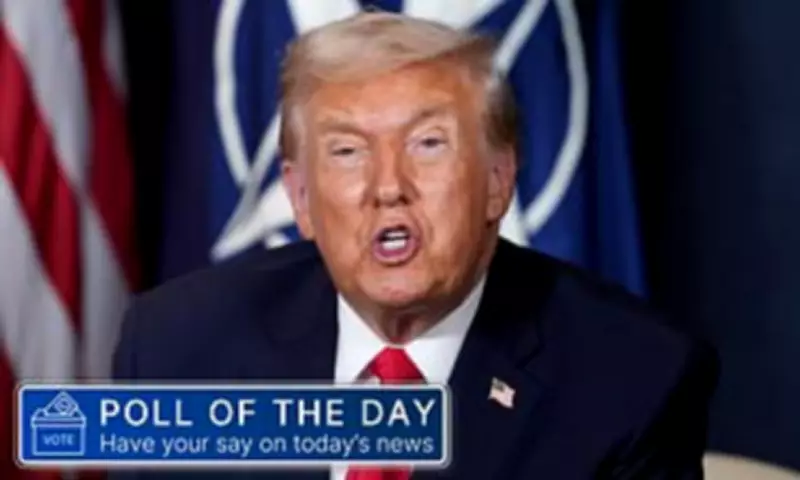
Former US President Donald Trump has launched a fresh verbal assault on NATO and the United Kingdom, branding the defensive alliance as "shameful" due to their reluctance to support the ongoing US-Israeli military campaign against Iran. In a recent interview with Fox News, Trump expressed his frustration, specifically targeting British Prime Minister Sir Keir Starmer for his perceived lack of immediate assistance.
Trump's Scathing Critique of NATO and UK Leadership
During the broadcast, Trump did not hold back in his criticism, stating, "NATO is shameful. I mean, look at the United Kingdom... PM Starmer said 'we'll send the equipment after the war is over'." He elaborated on this point, arguing that such a stance is fundamentally flawed in times of conflict. "I said 'you don't need equipment when the war is over. You need the equipment before the war starts, or during the war'... He made a public statement that 'we will send equipment after the war is over', that's a Neville Chamberlain statement," Trump added, drawing a controversial historical parallel.
Historical Comparison to Neville Chamberlain
By comparing Prime Minister Starmer to Neville Chamberlain, the British Prime Minister from 1937 to 1940 known for his policy of appeasement towards Nazi Germany, Trump has intensified the political rhetoric. This analogy suggests that Starmer's approach to the Iran conflict is similarly weak or conciliatory, a charge that has sparked debate among analysts and the public alike. The reference to Chamberlain, whose actions are often criticised in hindsight, adds a layer of historical weight to Trump's accusations, implying that current UK foreign policy could be making a grave mistake.

Public Reaction and Broader Implications
The comments have ignited a wave of discussion, with many questioning the validity of Trump's position and its impact on international relations. As tensions in the Middle East escalate, the refusal of NATO and the UK to fully endorse the US-Israeli war effort has become a focal point of diplomatic strain. Trump's remarks highlight a growing divide in Western alliances, potentially undermining collective security agreements and fostering uncertainty in global geopolitics. The public is now left to ponder: do they agree with Mr Trump's harsh assessment of NATO and the UK's role in this conflict?