Three US Troops Killed as Iran's Retaliation Intensifies Across Middle East
Three United States service members have been killed as Iran dramatically escalated its deadly retaliation campaign across the Middle East, directly defying warnings from former President Donald Trump about unprecedented military escalation if attacks continued. The fatalities mark the first combat-related deaths of US military personnel in major operations ordered by Mr Trump since his return to the White House last year.
Deadly Strikes and Counterstrikes
Tehran launched a coordinated barrage of ballistic missiles and drones toward Israel and across the Persian Gulf region on Sunday, striking multiple US military bases in Bahrain, Kuwait, and the United Arab Emirates. The Iranian offensive also targeted a US aircraft carrier in the strategic waters. In response, both Israel and the United States unleashed fresh strikes against Iranian positions, with powerful explosions reported across Tehran and other locations.
Former Iranian president Mahmoud Ahmadinejad was among those killed in the escalating conflict, according to reports from the region. The Iranian Red Crescent Society and official state-linked media have confirmed that 201 people have been killed and at least 747 injured in the violence that has spread across multiple countries.

Trump's Warning and Unexpected Talks
In a social media post on Sunday, former President Trump issued a stark warning to Iranian leadership, stating the United States would strike Iran "with a force that has never been seen before" if they attempted to avenge the assassination of Supreme Leader Ayatollah Ali Khamenei. Khamenei was killed during surprise strikes on Saturday that shocked the region.
Israeli Prime Minister Benjamin Netanyahu simultaneously vowed to intensify military action against Iran, declaring that Israeli forces were "striking in the heart of Tehran" and warning that "this will only increase in the coming days."
In a surprising development later on Sunday, former President Trump revealed that Iran's interim leadership had unexpectedly called for diplomatic talks, to which he agreed. Speaking from his Mar-a-Lago residence in Florida to The Atlantic magazine, Trump stated: "... so I will be talking to them. They should have done it sooner. They should have given what was very practical and easy to do sooner. They waited too long."
Operation Epic Fury Casualties
The offer of talks emerged shortly after US Central Command confirmed the three service member fatalities occurred as part of Operation Epic Fury, the codename for the ongoing offensive against Iran. Five other personnel sustained serious wounds, with several additional service members reporting minor injuries and concussions from the intense fighting.
Trump separately claimed that 48 leaders of Iran's regime have been eliminated in Israeli strikes, though this figure has not been independently verified by international observers.
Regional Impact and British Response
The conflict has created widespread disruption across the Middle East, with Iranian missiles landing dangerously close to British troops stationed at a base in Bahrain. Defence Secretary John Healey confirmed the projectiles landed within "a few hundred yards" of UK personnel, putting them at significant risk.
British aircraft have been deployed on defensive operations from bases in Cyprus and Qatar, successfully intercepting drones and missiles threatening UK installations and allied positions. Healey additionally confirmed that a British counter-drone team operating in northern Iraq successfully shot down Iranian drones.
While repeatedly declining to state whether the United Kingdom supported the US-Israeli strikes that killed Ayatollah Khamenei or considered them legally justified, Healey emphasized: "Britain played no part in the strikes on Iran. We share, however, the primary aim of all allies in the region and the US that Iran should never have a nuclear weapon."

Civilian Toll and Travel Chaos
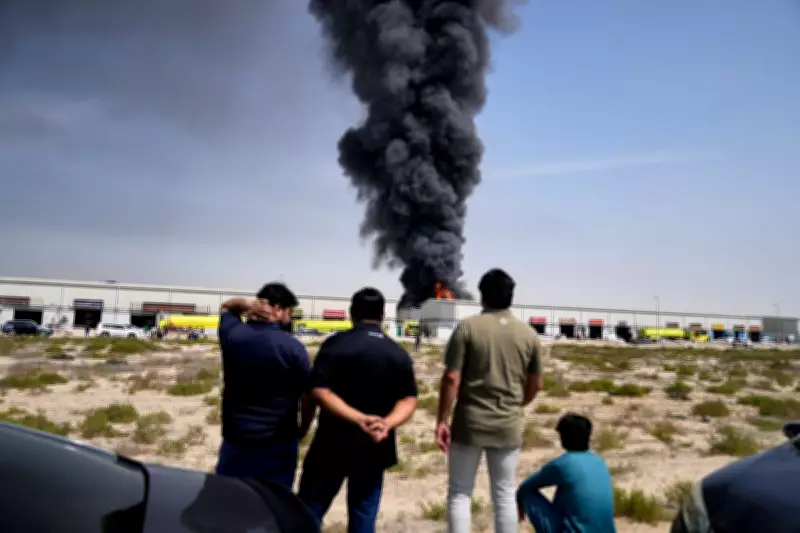
The human cost continues to mount across the region. In the United Arab Emirates, three people have been killed, including one individual at Zayed International Airport in Abu Dhabi after it was struck by an Iranian projectile. Kuwait's Ministry of Health reported one fatality and twenty wounded from Iranian retaliatory attacks.
In Israel, nine people died from a missile strike in Beit Shemesh after air raid sirens sounded overnight on Saturday. American citizens in Oman have received urgent warnings to seek shelter following missile launches in their vicinity.
Major travel disruption has paralyzed the region, with airspace over Iran, Iraq, Kuwait, Israel, Bahrain, the UAE, and Qatar remaining virtually empty according to Flightradar24 monitoring. Three major airlines – Etihad, Qatar Airways, and Emirates – have grounded all regional flights until at least Monday, stranding thousands of travelers.
In Dubai, a global business hub home to over 240,000 British expatriates, panic and uncertainty spread after two hotels were struck overnight. JS Anand, founder and CEO of LEVA Hotels with a flagship property in Dubai, described the situation: "It caused a lot of panic, uncertainty, and there was an emergency message that came out in the night. It said there was a barrage of missiles coming in, everyone came to the lobby and basement, worried about what was going to happen."
Maritime Security Concerns
Growing anxiety surrounds the security of the Strait of Hormuz, a critical global shipping lane located off Iran's southern coast. Two vessels reported being struck by "unknown projectiles" on Sunday, raising fears about the safety of commercial maritime traffic through this economically vital passage.
The US military announced it had sunk an Iranian ship during the hostilities, while Iran's Revolutionary Guards claimed to have launched four ballistic missiles at the US aircraft carrier Abraham Lincoln. US Central Command countered that the carrier was not hit and that Iran's missiles "didn't come close" to their intended target.
Military Assessments and Future Projections
Israeli military spokesperson Lieutenant Colonel Nadav Shoshani indicated that numerous targets within Iran remain vulnerable, including sites of military-industrial production. "We have the capabilities and the targets to keep going on for as long as necessary," he stated, suggesting the conflict could extend well beyond the current hostilities.
Labour leader Sir Keir Starmer expressed "solidarity" with Middle Eastern leaders confronting what he termed "dangerous Iranian escalation," reflecting the international concern about the spreading violence.