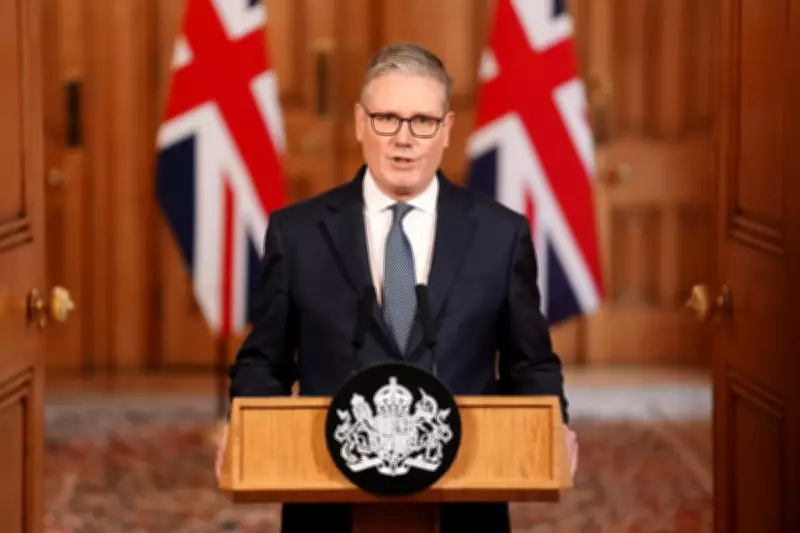
Prime Minister Keir Starmer's recent manoeuvring regarding American utilisation of British military installations for strikes against Iranian missile sites should not be dismissed as political vacillation. Instead, it merits recognition as a judicious attempt to navigate one of the most significant international crises of this century. The prime minister's initial stance to keep Britain out of the conflict was legally and morally sound.
Legal Foundations and Initial Resistance
Sir Keir Starmer, a lawyer by profession, naturally upholds international law. His initial refusal to permit US attacks from British soil was grounded in clear legal advice. A serious military assault by one nation upon another, absent an immediate threat of aggression, constitutes an unlawful act. Such actions breach the United Nations Charter and dangerously revive the archaic principle that "might is right" in resolving international disputes.
Unlike the multinational invasions of Afghanistan in 2001 or Iraq in 2003, the recent US and Israeli operation lacked even a token effort to secure UN authority. Diplomacy, notably through talks chaired by Oman's foreign minister regarding Iran's nuclear programme, was progressing effectively. An agreement was nearly finalised before Operation Epic Fury was launched, rendering the military action unnecessary and reckless.

Escalating Threats and a Shift in Policy
The prime minister's concerns were multifaceted. He rightly feared the conflict spreading uncontrollably across the Middle East, with severe implications for global security and the world economy. Furthermore, shielding British interests and upholding the nation's honour as a responsible international actor provided ample justification for initially denying US requests.
This decision undoubtedly frustrated former President Trump and some allies, who accused Britain and its European partners of disloyalty. However, the context shifted dramatically following successive aggressive actions by Iranian leadership. These included attacks on Gulf states and, critically, a drone strike on RAF Akrotiri in Cyprus.
This direct threat to British personnel and assets introduced the legitimate justification of self-defence under international law. Consequently, the UK government revised its position, permitting the US to use British bases specifically to neutralise the Iranian facilities launching missiles, rockets, and drones.
Clear Limitations and Domestic Criticism
The prime minister has imposed strict limitations: there is no authorisation for the US to use RAF Fairford or the base at Diego Garcia for operations targeting civilian infrastructure or populations. This calibrated approach attempts to balance legal obligations with the realities of the alliance.
Domestically, the initial hesitation attracted partisan criticism. Opposition Leader Kemi Badenoch engaged in divisive rhetoric, suggesting the prime minister's reluctance stemmed from placating certain voter blocs swayed by Middle East conflicts rather than the British national interest. Such accusations are unworthy and counterproductive during a time of international crisis.
The Path Forward Requires Nuanced Leadership
For the foreseeable future, Prime Minister Starmer must continue to balance often conflicting demands: adherence to international law, the pursuit of peace, the protection of British national interest, and the maintenance of the historic alliance with the United States. This requires the utmost skill, pragmatism, and statesmanship.
His evolving stance—from principled non-involvement to a limited, legally-justified cooperation—demonstrates a nuanced understanding of the crisis's complexity. It is a pragmatic response to changing circumstances, not an indication of weakness or indecision. In principle, this careful, lawyerly navigation of perilous geopolitical waters deserves continued support as the situation develops.