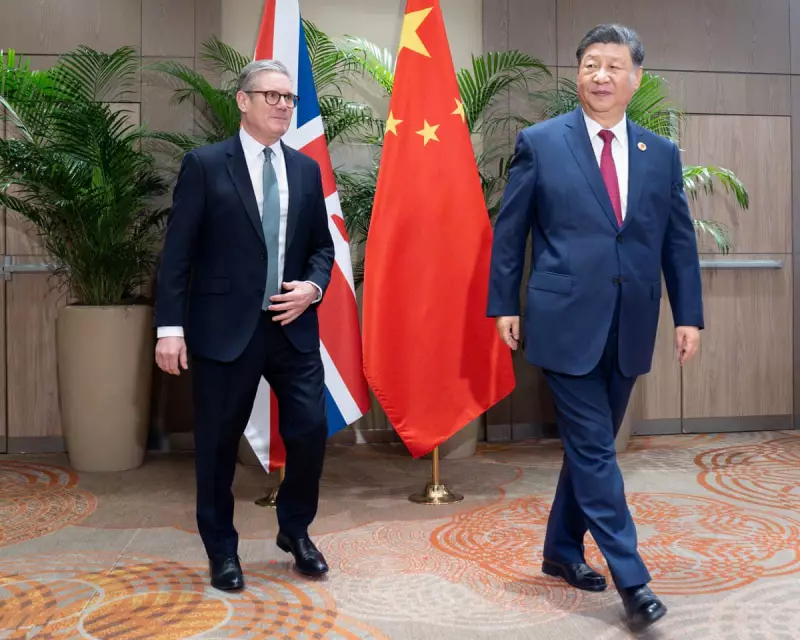
Keir Starmer's forthcoming diplomatic mission to China represents a significant milestone in UK foreign relations, being the first such prime ministerial visit since Theresa May's trip to Beijing in 2018. This high-stakes engagement unfolds against a backdrop of increasingly strained ties between London and Beijing, where mounting security apprehensions intersect with profound economic interconnectedness.
A Delicate Balancing Act for British Diplomacy
The relationship between the United Kingdom and China has grown progressively more complex and fraught in recent years. Allegations concerning espionage activities and influence operations have heightened political and public suspicion within Britain. Simultaneously, the deep-rooted trade links and supply chains that the UK economy depends upon make any notion of complete disengagement from China fundamentally unrealistic.
Recent controversies, including the heated debate surrounding the approval for a new Chinese embassy, have revealed sharply divided opinions about how best to manage relations with Beijing. Determining what precisely constitutes a genuine threat versus a potential opportunity has become a central challenge for policymakers navigating this delicate diplomatic terrain.

Security Concerns and Economic Realities
Britain's security anxieties are grounded in tangible recent experiences. In December, the Foreign Office disclosed it had been targeted by a sustained cyber-attack two months earlier, with suspicions pointing toward a Chinese group known as Storm 1849. This incident followed investigations into alleged espionage involving parliamentary researchers and repeated warnings from security agencies about technology transfer and data exposure within sensitive industries.
Despite these security challenges, the economic dimension remains equally compelling. China stands as the world's second-largest economy and serves as a central hub within global manufacturing and supply chains. This position grants Beijing considerable weight on issues ranging from climate crisis responses to financial stability, making international cooperation with China essentially unavoidable for nations like Britain.
Britain's Geopolitical Position and China's Strategic Ambitions
As Starmer prepares for his Beijing discussions, he must carefully consider what cards Britain truly holds. Despite current moods of national malaise and diminished confidence, the UK retains significant geopolitical influence as a permanent member of the UN Security Council, a nuclear-capable state, and a G7 nation. However, China approaches negotiations with formidable leverage derived from its economic might and strategic positioning within global networks.
Beijing's objectives appear clearly defined: securing a more predictable and less adversarial posture from the UK and Europe, limiting criticism of its internal and regional policies, maintaining access to British financial markets, and deepening cooperation in education, research, green technology, and investment sectors.
China's Global Network Building
Over the past three decades, China has systematically constructed extensive international networks through substantial investments in infrastructure, energy, and transport projects, often in regions where Western capital has been hesitant to venture. Across Asia, Africa, the Caribbean, and Latin America, Beijing has paired finance with diplomacy, trade, and development assistance, presenting itself as a growth-focused partner rather than one emphasising governance or political reform.
This strategic approach has gradually translated into considerable influence: enhanced access to markets and resources, diplomatic support in international forums, and a strengthened voice across much of the global south. For Britain, this evolving landscape raises fundamental questions about common interests and collaborative possibilities with China, as well as deeper considerations about the UK's place in a rapidly changing world order.

Strategic Sectors and Supply Chain Dependencies
China's concerted efforts to embed itself within global supply chains while simultaneously reducing its own external dependencies have targeted strategic sectors including ports, railways, energy, mining, telecommunications, and manufacturing. Through state-backed financing, Chinese companies have positioned themselves at crucial junctures within international trade and logistics networks.
This expansion has provided Beijing with broader access to foreign markets and resources while strengthening its capacity to insulate against external pressures domestically. Meanwhile, as Britain has long grappled with energy strategy uncertainties, China has systematically addressed its reliance on Middle Eastern and other foreign oil and gas sources by developing comprehensive ecosystems that have created near-monopolies in photovoltaic cells, wind turbines, and battery technologies.
The Clean Energy Dimension
While clean energy advancements benefit the global environment, China's incentives for dominating these technologies have been equally underpinned by desires for self-sufficiency in what Beijing perceives as an era of rising geopolitical turbulence. Similar strategic steps across rare earths, biotechnology, data analytics, and artificial intelligence sectors have strengthened China's global position through open-source models that accelerate adoption and diffusion at scale.
For nations like Britain, this matters profoundly because Chinese companies now occupy deep positions within supply chains that underpin everything from energy transition initiatives and manufacturing processes to consumer goods and digital infrastructure development.
Trade Realities and Policy Constraints
Recent trade data reveals China is on course to record a trade surplus of $1.19 trillion this year, despite attempts to restrict its economic expansion through tariffs and export controls. Beijing has skilfully circumvented these measures by routing shipments through countries like Mexico and Vietnam or by flooding other markets, including European ones, with competitively priced goods.
For Britain, the implications are stark: reliance on China directly constrains policy choices across security, human rights, and technology domains. Decisions in these areas must be weighed not only on their merits but against risks of disrupted trade flows, increased costs for consumers and businesses, and potential retaliation against key economic sectors.
Navigating a Complex Diplomatic Landscape
Starmer's challenge involves developing genuine clarity of vision regarding what Britain wants from China and what it can realistically offer in return. This task is complicated by a period in which UK national security faces vulnerabilities not seen since the Second World War's conclusion. Like the United States under previous administrations, Beijing has demonstrated willingness to employ coercive economic tools, as evidenced by tariffs of up to 42.7% imposed on the EU dairy industry in response to European protections for its automotive sector.
How Starmer navigates the opportunities and challenges presented by this Beijing visit will not singularly define his premiership, but it forms part of the broader question concerning the Prime Minister's vision for Britain during a transformative global era. Many observers await clearer articulation of this vision, and the China trip offers a significant platform for its expression amid complex security concerns and deep economic interdependencies.