
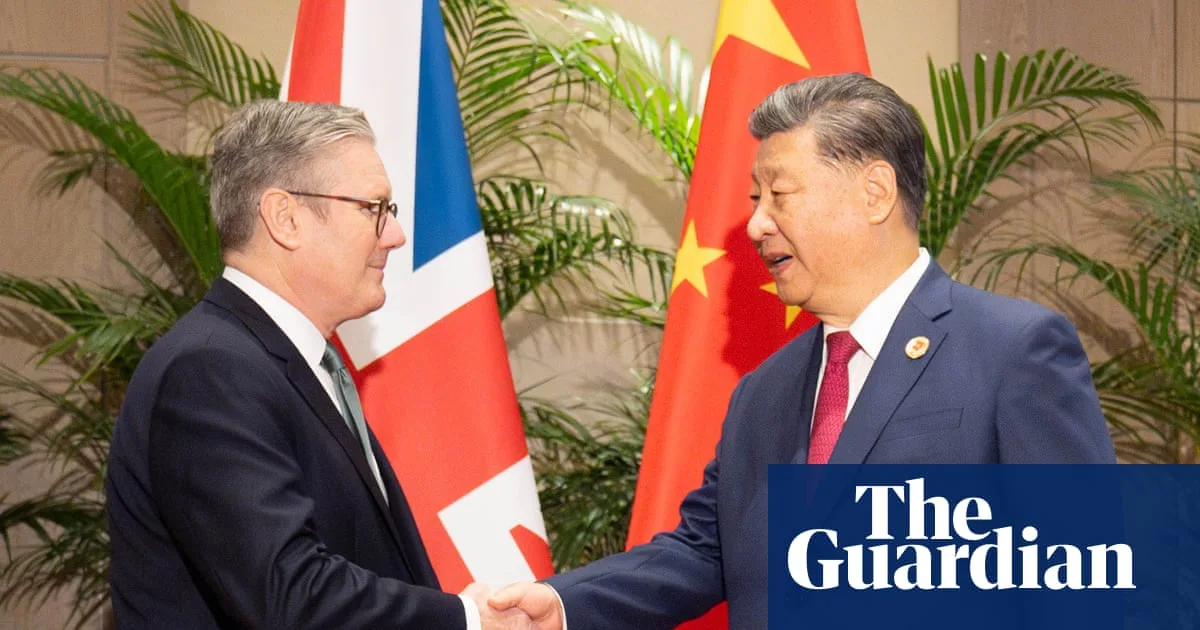
Prime Minister Sir Keir Starmer has said the UK government will remain “clear-eyed and realistic” on the national security threat posed by China as he travels to Beijing in an effort to improve relations with the economic powerhouse. The visit is the first by a British leader in eight years.
Starmer promised “stability and clarity” in his approach to Beijing after years of what he described as “inconsistency” under the previous Conservative government. The trip comes amid tensions between Britain and its close ally, the United States, over Donald Trump’s threats to take control of Greenland and his criticism of the Chagos Islands deal.
Downing Street said that at a time of growing global instability, the prime minister would act in the UK’s national interest. He is due to meet China’s president, Xi Jinping, and the premier, Li Qiang, in Beijing on Thursday for talks.
Starmer has faced criticism at home for pursuing a thaw in relations while China remains a national security threat. The Conservatives have accused him of lacking leverage and making concessions, including approving a new mega-embassy in London. However, a No 10 source said refusing to engage would be a “staggering dereliction of duty”.
The prime minister has argued the UK cannot afford to ignore the economic opportunities presented by China, which is the world’s second largest economy and the UK’s third largest trading partner, supporting 370,000 British jobs. He is accompanied by a delegation of about 60 British businesses and cultural organisations, including HSBC, GSK, Jaguar Land Rover and the National Theatre.




