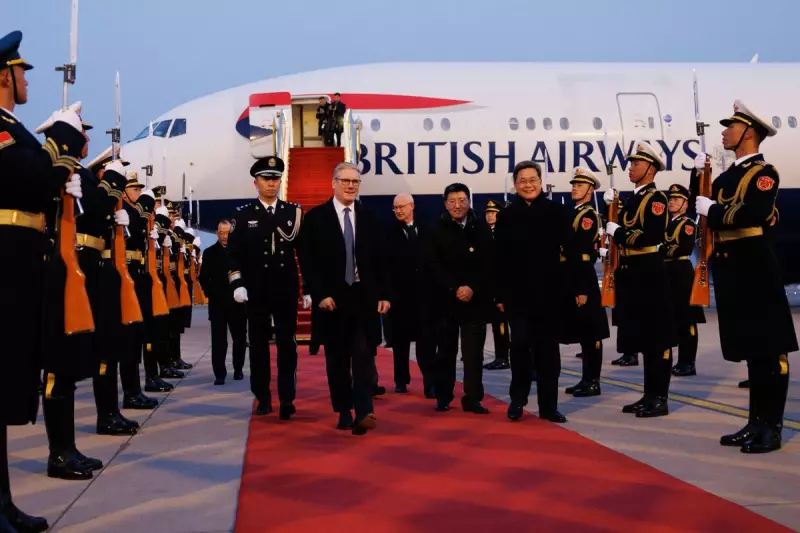
Sir Keir Starmer has embarked on a delicate diplomatic mission to Beijing, becoming the first British prime minister to visit China in eight years. His three-day visit comes at a pivotal moment in international relations, with Britain attempting to navigate increasingly complex global power dynamics.
The Balancing Act of Modern Diplomacy
As Sir Keir Starmer joins the procession of European leaders making the journey to meet President Xi Jinping, he faces what Westminster insiders describe as a "three-body problem" in foreign policy. The prime minister must simultaneously maintain positive relations with Washington, engage constructively with Brussels, and develop a working relationship with Beijing - a challenging diplomatic equation that requires careful calibration.
An official Chinese commentary declared that "Britain has finally come to its senses" upon Starmer's arrival in Beijing, though such praise from his hosts may have created mixed feelings for the British leader. While Starmer rejects opposition claims of a "kowtow" to Chinese leadership, Beijing has portrayed the visit as evidence that global dynamics are shifting in its favour.

Meeting the Red Emperor
When Starmer meets President Xi Jinping, he will encounter a leader at the height of his power. Xi has recently consolidated control over the world's largest standing army, weathered American trade pressures, strengthened alliances with Russia and North Korea, and dispelled rumours about his health or political stability. The Chinese president presides over what some observers describe as an increasingly imperious leadership style.
The spectre of American politics also looms over the discussions, with former President Donald Trump - sometimes characterised by critics as an "orange emperor" - due to visit the Forbidden City himself in April. Contrary to some speculation, the Trump administration has reportedly sidelined its most hawkish China advisors, and recent Pentagon planning documents no longer identify China as the primary enemy.
The European Context
Starmer can hardly be criticised for following the path already taken by numerous European leaders. The King of Spain, the President of France, and the Prime Minister of Finland have all made similar journeys to Beijing, with German Chancellor Friedrich Merz expected to follow shortly. This European procession reflects the complex reality that Western nations must engage with China while managing their own strategic interests.
The Chinese perspective, as articulated through state-controlled media, suggests that Starmer's approach represents a welcome shift. The Global Times - a publication that operates in China's "semi-official" media space - praised Starmer's comment that he did not have to choose between countries like the US and China. The paper described this as reflecting "a more rational British diplomatic approach" and evidence that "'small circles' and bloc-based confrontations are increasingly losing traction" even within Western alliances.
Strategic Calculations and Risks
Behind the diplomatic pleasantries lie serious strategic calculations. American officials have previously valued face-to-face contact between their closest allies and the increasingly enigmatic President Xi. As Xi consolidates power, concerns have grown about his potential isolation from dissenting viewpoints, particularly regarding sensitive issues like Taiwan and military tensions across East Asia.
The Biden administration previously sent numerous envoys to deliver difficult messages in person, fearing that China's own hardliners might be tempted toward rash actions. Effective diplomacy remains uncertain, however, as demonstrated when Canadian premier Mark Carney emerged from Beijing with a trade pact while speaking of a new world order where medium powers must act independently - precisely the narrative Xi seeks to promote.
Thawing Relations After the Ice Age
Chinese commentary acknowledges that relations between China and Britain have "endured a prolonged downturn lasting several years," attributing this partly to the "hot and cold" policy emanating from 10 Downing Street. The question now is whether this diplomatic "ice age" will begin to thaw, even if the much-discussed "golden era" of relations remains a distant memory.

The unstated ambition of Starmer's visit likely combines hopes for increased trade with reduced geopolitical friction. Yet as the prime minister attempts this diplomatic balancing act, he follows in the footsteps of predecessors including Tony Blair, Gordon Brown and David Cameron, all of whom performed similar routines with varying degrees of unease. The fundamental difference now is the dramatically altered global context in which these diplomatic engagements occur.
As Michael Sheridan, longtime foreign correspondent and diplomatic editor, observes through his expertise on Chinese leadership, the challenge for Starmer is maintaining equilibrium in a world where traditional alliances are being tested and new power dynamics are emerging. The success or failure of this approach will determine whether Britain can effectively navigate between competing global powers without losing its footing on the international stage.