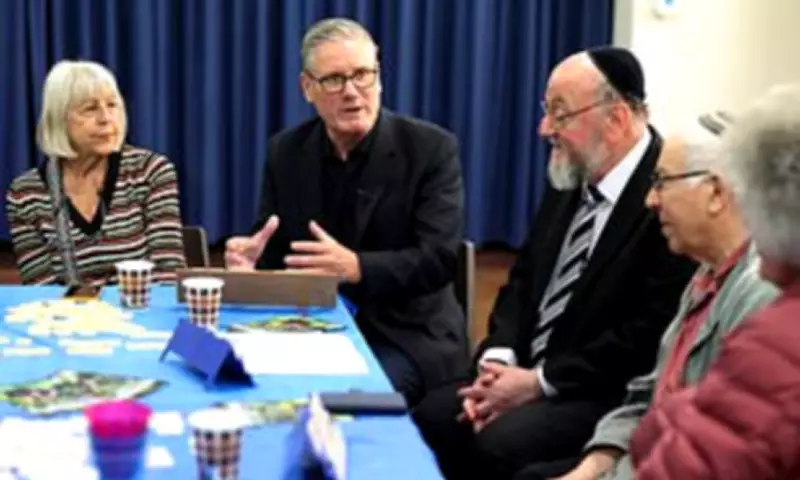
Sir Keir Starmer today said he is 'increasingly concerned' about countries using proxies for attacks in the UK. The Prime Minister expressed his fears as he visited the Kenton United Synagogue in north-west London on Thursday.
It is one of several Jewish venues to have been targeted by arsonists in recent weeks. Police are currently working to establish whether Iran has paid British criminals to carry out acts on UK soil.
'We have to deal with malign state actors, that will require legislation,' Sir Keir said. 'We're going to bring that legislation forward. It's really important we do that.'

'It's very important this particular context because I'm increasingly concerned that a number of countries are using proxies for attacks in this country.'
'It's very, very important that the counter terrorism police, and the police are working with CST (Community Security Trust) together on this.'
'But on both fronts, we need to move forward.'
The Prime Minister met with the Chief Rabbi Ephraim Mirvis at the Kenton United Synagogue in north-west London. Kenton United Synagogue was attacked on Saturday with a 17-year-old boy having since pleaded guilty to arson not endangering life.
A series of incidents has also seen an arson attack on Jewish community ambulances, and attempted arson attacks at a synagogue in Finchley and a former Jewish charity in Hendon. Another incident saw a drone flown near the Israeli embassy in London, and a petrol bomb was thrown towards the site of Volant Media, the parent company of Persian news channel Iran International.
A group that calls itself Harakat Ashab al-Yamin al-Islamia, the Islamic Movement of the Companions of the Right, that is suspected to be Iran-backed, has claimed responsibility for most of the incidents, along with other attacks in Europe, since March 9.
Metropolitan Police Deputy Commissioner Matt Jukes told LBC on Monday: 'We're going to look incredibly closely at whether those claims stand up.'
'They're intended to intimidate so we have to distinguish what's happening online and being broadcast and claimed, from those things we can prove.'
'But I think this is an extraordinary period. We've sadly seen hate crime in our communities before, we've seen radicalisation towards terrorism.'
'But now what we've got is the prospect of a foreign state actually using that as a mechanism to sow discord, discontent and to create anxiety in our communities. That is really troubling.'