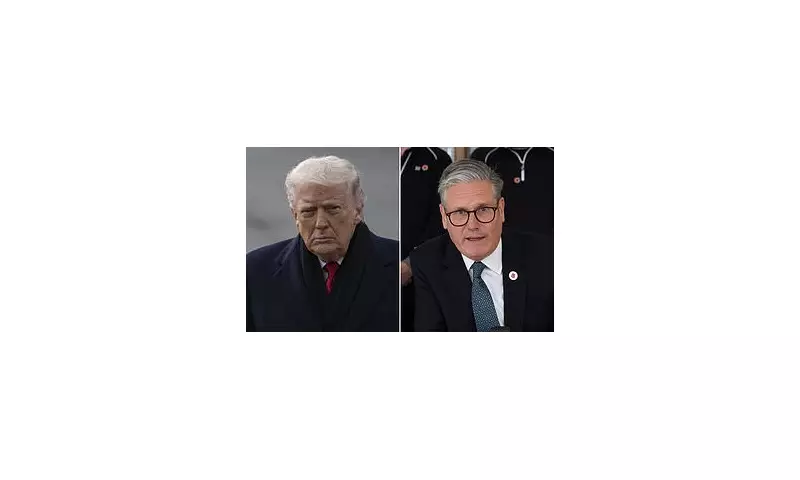
Prime Minister Keir Starmer has issued a direct rebuke to US President Donald Trump over his "extraordinary" threat to seize Greenland and impose punitive tariffs on defending allies, in a confrontation that has plunged the NATO alliance into a deepening crisis.
A Direct Diplomatic Confrontation
In an unprecedented move on Sunday afternoon, Sir Keir told President Trump in a telephone call that his proposal was "wrong". The Prime Minister challenged the US leader's plan to impose tariffs on countries willing to defend the vast Arctic island, a self-governing territory within the Kingdom of Denmark.
The confrontation came after Western leaders collectively warned Mr Trump he risked triggering a "dangerous downward spiral" in transatlantic relations. They emphasised that a new allied military exercise in the Arctic, named Arctic Endurance, posed "no threat to anyone" and was a necessary step for collective security.

A Downing Street spokesman confirmed the call, stating: "The Prime Minister reiterated his position on Greenland. He said that security in the High North is a priority for all NATO allies... He also said that applying tariffs on allies for pursuing the collective security of NATO allies is wrong."
The Trump Ultimatum and European Retaliation
The crisis erupted after President Trump, using his Truth Social platform, declared that from February 1, the US would impose a 10 per cent tariff on all exports from eight nations: Denmark, Finland, France, Germany, the Netherlands, Norway, Sweden, and the United Kingdom. He threatened to increase this to 25 per cent in June.
He stated the tariffs would remain "until such time as a deal is reached for the complete and total purchase of Greenland." Mr Trump has long coveted the territory for its strategic value, believing it bolsters US security against potential Chinese expansion.
In response, European leaders are now considering deploying a powerful economic weapon for the first time: their so-called trade "bazooka". This anti-coercion instrument, adopted in 2023, allows the EU to hit the US with retaliatory tariffs worth an estimated £81 billion. The measures could restrict US access to public tenders, limit trade licences, and shut off parts of the single market.
Danish Prime Minister Mette Frederiksen was defiant, stating: "Europe will not be blackmailed. We want to co-operate and we are not the ones seeking conflict."
Warnings of NATO's Collapse and UK Political Fallout
The severity of the rift has prompted grave warnings about the very future of the NATO alliance. A senior UK Government figure told the Daily Mail: "I have never seen anything like this. Our adversaries will be rubbing their hands with joy. We are heading towards a disaster."
Former head of the diplomatic service, Lord McDonald, told the BBC the situation was existential: "If there were any kind of clash between the Americans and Europeans over Greenland, that would be the end of NATO. There's no way back, when one ally turns against another militarily."
Within the UK, the political reaction has been fierce. Tory MP Simon Hoare demanded the cancellation of King Charles's planned state visit to America this spring, calling Mr Trump a "gangster pirate". However, Culture Secretary Lisa Nandy dismissed the idea as "childish", stressing the need for continued serious dialogue.
Experts fear the proposed US tariffs could cost British exporters up to £6 billion, potentially driving the UK economy into recession. Despite the high stakes, there was no immediate sign of the White House backing down, with US Treasury Secretary Scott Bessent claiming: "Europeans project weakness, US projects strength."
Sir Keir is expected to continue his diplomatic efforts, with plans to lobby President Trump in person at the upcoming World Economic Forum summit in Davos.