Barack Obama personally pushed architects to scale up his sprawling Chicago presidential center beyond their original vision – pressing for something bolder, larger, and more sculptural. His demands came even as the architects tasked with bringing it to life admitted it left them feeling 'uneasy,' according to a new report.
The revelation sheds new light on the controversial $850 million Obama Presidential Center, a hulking, granite-clad complex rising from Jackson Park that has already drawn fierce criticism from locals, architects, and political opponents alike.
From the earliest design meetings, some held while Obama was still in the White House, the former president urged designers to 'up our ante,' according to architect Tod Williams. The repeated push for scale and ambition, he acknowledged, came with tension.
'He was saying we should up our ante,' Williams said to The New Yorker, adding that the insistence on going bigger made him uneasy at times. 'Another time, he drew on one of my drawings, made a strong mark, which indicated that he didn't think I was being bold enough. Those little things sting. But they also moved everything forward,' Williams added.
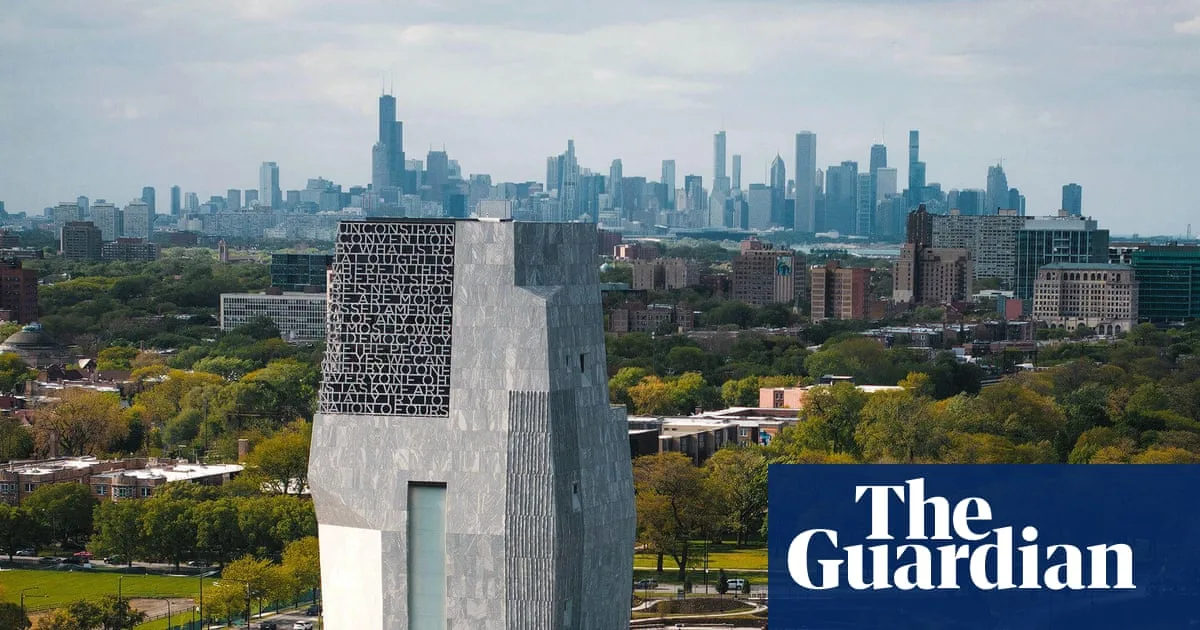
What began as a more understated campus concept soon evolved into something far more imposing: a 225-foot granite tower, nicknamed by critics as the 'Obamalisk,' dominating a 19-acre site in one of Chicago's most historic parklands. Obama himself challenged the architects to think beyond traditional civic design - at one point invoking modernist sculptor Constantin Brancusi as inspiration.
The reference initially baffled the design team. 'What the hell does he mean?' Williams recalled thinking. But the message became clear that this was not to be just a building but a statement and more a piece of art or a monument. 'That really cranked it up for us,' Williams said. 'He wanted us to do something that we had not done before… He didn't let it rest.'
Williams acknowledged that the final design is 'very much a product of his vision as well as ours.' That relentless push for scale has coincided with a dramatic escalation in both ambition and price. Originally pitched at around $300 million, the project's cost ballooned to $500 million, then $700 million, and now stands at roughly $850 million fueled by rising construction costs, expanded programming, and lavish design elements.
Financial disclosures show tens of millions spent on exhibits and operations alone, while executive salaries at the foundation have also drawn scrutiny. Valerie Jarrett, a longtime Obama confidante, earned $740,000 last year. Despite the soaring costs, fundraising has remained strong, surpassing $1 billion, according to the foundation.
Critics have argued the scale of the project and the president's role in shaping it has contributed to a structure many now view as out of place. The center is located in Jackson Park, a landscape originally designed by Frederick Law Olmsted, and features a museum, library branch, playground, and even a man-made sledding hill. Staff say it is intended to serve as 'a physical manifestation' of the Obamas' philosophy.
Inside, visitors will find a teaching kitchen, recording studios, and a 'Democracy in Action Lab,' alongside exhibits chronicling Obama's presidency and America's racial history. But outside, the reaction has been far less agreeable. Residents have described the towering structure in stark terms - 'a monstrosity,' a 'concrete tomb,' even a 'totalitarian command center.' Others say it feels disconnected from the surrounding parkland and community.
Concerns have also mounted over rising rents and displacement tied to the development. Local leaders have warned that large-scale investment risks pricing out the very residents the project claims to serve. 'We're going to see rents go higher and we're going to see families displaced,' one local official said previously, reflecting broader anxieties about gentrification on Chicago's South Side.
The building's controversial aesthetics have only intensified scrutiny. An excerpt from Obama's 2015 Selma speech, etched across the exterior in massive lettering, has been widely criticized as difficult to read. Some observers say the fragmented text resembles placeholder 'lorem ipsum' rather than a coherent inscription. Others have mocked the structure's stark, fortress-like appearance, comparing it to everything from a prison to a sci-fi set.
Defenders argue the design reflects a bold attempt to redefine what a presidential center can be - less of an archive and more an immersive civic space. Michelle Obama has also been closely tied to the project's mission, particularly its emphasis on community engagement and youth programming. After the 2013 killing of Chicago teenager Hadiya Pendleton, she famously said: 'Hadiya Pendleton was me, and I was her,' a sentiment reflected in the naming of spaces within the campus.
The Obama Presidential Center is officially scheduled to open to the public on June 19 (Juneteenth).






