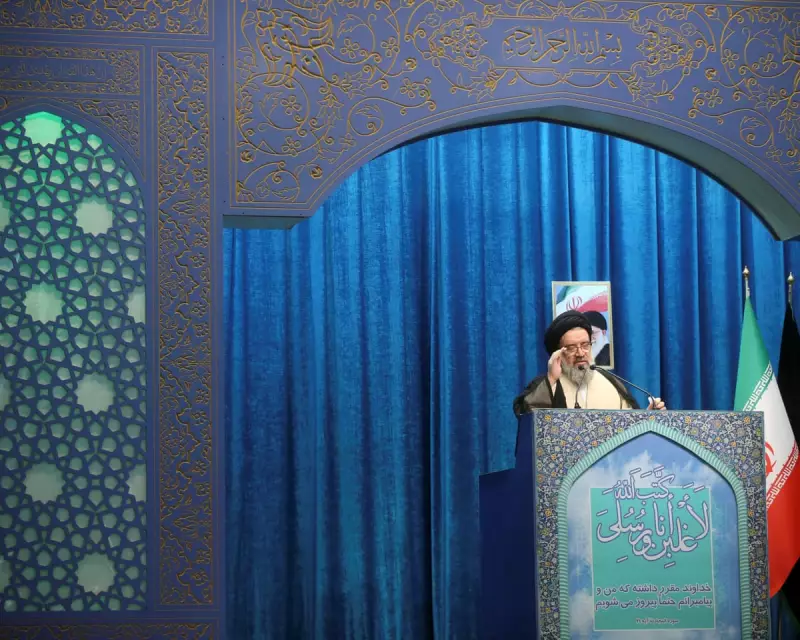
A prominent hardline cleric in Iran has publicly called for the execution of demonstrators, directly contradicting recent statements from US President Donald Trump regarding the fate of those arrested in the recent nationwide unrest.
Hardline Sermon Calls for Severe Punishment
During a Friday sermon, Ayatollah Ahmad Khatami launched a fierce verbal attack on protesters, labelling them as agents of foreign powers. He described participants in the demonstrations as 'butlers' and 'soldiers' of Israel and the United States, vowing that neither country should 'expect peace'. Khatami, who holds influential positions on both the Guardian Council and the Assembly of Experts, explicitly stated that 'armed hypocrites should be put to death'.
His incendiary remarks stand in stark opposition to claims made by President Trump. Earlier in the week, Trump indicated he had postponed a military strike after being told Iranian authorities would halt the execution of protesters. On Friday night, the US president thanked Iran for stopping what he said were planned executions of 800 protesters, although the origin of this figure remains unclear.

Supreme Leader's Rejection and Ongoing Crackdown
Iran's Supreme Leader, Ayatollah Ali Khamenei, swiftly rejected Trump's narrative. On Saturday, Khamenei branded the US president a 'criminal' for his 'personal' involvement in the protests and promised further retribution. 'By God's grace, the Iranian nation must break the back of the seditionists just as it broke the back of the sedition,' Khamenei declared.
Rights groups report that the state repression continues unabated. According to the Human Rights Activists news agency, the death toll from the unrest has surpassed 3,090, with nearly 4,000 more cases pending review. The scale of arrests is vast, with more than 22,100 people detained, raising significant concerns about the potential for mistreatment in custody.
Origins and Aftermath of the Deadly Unrest
The protests, which represent the most serious challenge to the Iranian government since the 1979 revolution, began on 28 December. They were initially triggered by a sudden devaluation of the Iranian rial but rapidly evolved into broader anti-government demonstrations. The movement was brutally quashed by security forces, in what Human Rights Watch has termed the 'mass killings of protesters'.
With the immediate street protests largely suppressed, authorities have shifted to a public campaign of punishing those involved, framing the unrest as a foreign-backed conspiracy. In his sermon, Ayatollah Khatami cited extensive damage to state and religious property, claiming protesters had damaged 350 mosques, 126 prayer halls, 400 hospitals, and over 100 ambulances.
The country remains largely isolated from the global internet due to a government-imposed shutdown lasting over a week, obscuring the full picture of the fallout. Meanwhile, prominent opposition figure Reza Pahlavi, son of the late Shah, continues to call for the government's overthrow from Washington DC, urging President Trump to intervene.
The future of the protest movement remains uncertain. While the visible demonstrations have been driven from the streets, the underlying tensions and the regime's harsh response have set the stage for continued instability and heightened international confrontation.