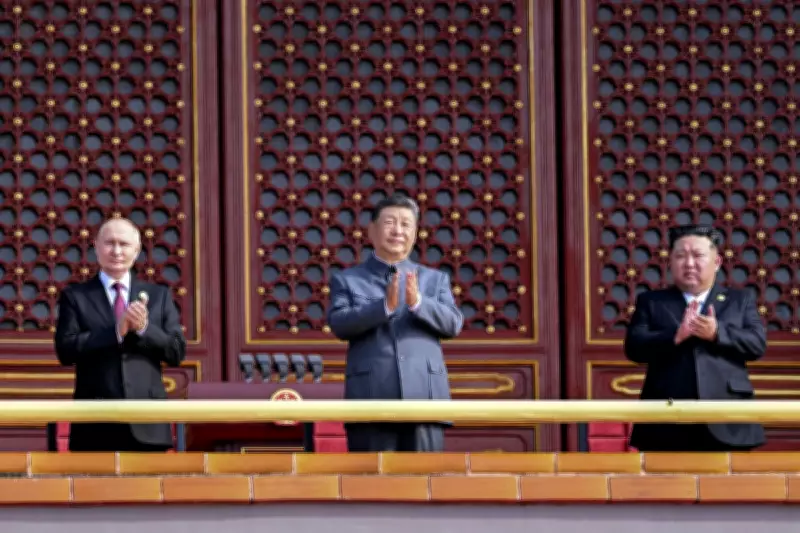
Vladimir Putin launched his invasion of Ukraine four years ago with ambitions to rebuild Russia's imperial glory. Instead, as former British foreign office special adviser Ben Judah argues, the conflict has produced a starkly different outcome: Russia has effectively become China's subordinate, while Ukraine has transformed into a formidable military force. The wider consequences of this war for both nations and the global order are only now becoming fully apparent.
The Ukrainian Military Transformation
Judah, who served as special adviser to Foreign Secretary David Lammy from 2024 to 2026, witnessed firsthand the dramatic evolution of Ukraine's armed forces. "A year and a half ago," he notes, "the Ukrainian military was a crowd-sourced, volunteer-led mess, relying on courage to compensate for inadequate equipment. Today, it stands as one of the most deadly, high-tech fighting forces on Earth."
This transformation did not occur spontaneously. Judah explains that during his tenure, he participated in high-level briefings at the White House, where British officials detailed Ukraine's remarkable progress. He personally conveyed this assessment to Vice President Vance, whose nuanced views on Ukraine significantly influence US policy.

Zelensky's Relentless Leadership
Central to this military overhaul is President Volodymyr Zelensky. Judah describes meetings with Zelensky as revealing "a man utterly consumed with every aspect of the front lines, the diplomacy, and the war economy his people depend on." Unlike many politicians Judah encountered—distracted by social media and likely to be forgotten by history—Zelensky exhibited a rare concentration and determination.
"He is one of the few men I've ever met whom I consider a real hero, perhaps the last in Europe," Judah states. Zelensky's historic role, from resisting American evacuation advice early in the war to navigating complex relations with figures like Donald Trump, has been crucial in hardening Ukraine's defenses.
The Changing Nature of the Conflict
The war has evolved from a war of movement into a grueling war of attrition across surreal, net-covered front lines where drone warfare dominates. Judah characterizes it as "both the First World War with trenches and something cyberpunk." While Ukraine faces significant manpower challenges, Russia confronts an even more severe crisis.
Contrary to popular perception, Ukraine is not battling the Soviet Union with its vast 1980s population. Instead, it faces an ageing Russia with just over twice the UK's population—hardly an unlimited resource. After approximately 1.2 million Russian casualties (equivalent to Britain losing 600,000 people), the strain is evident on the battlefield.
Russia's Desperate Recruitment
Along key front lines, roughly one-third of captured "Russian" prisoners of war are now recruits from Africa and Bangladesh. Judah reveals that Ukraine has recently tipped the scales, with Moscow losing more soldiers monthly than it can recruit domestically. This forces the Kremlin into a desperate search for cannon fodder among the world's poorest populations, treating these recruits as expendable bullets.
"This is the army—not Zhukov's Red Army—that is so bogged down," Judah observes, highlighting the stark contrast between Russia's current forces and its historical military prowess.
Geopolitical Realignments
While Ukraine remains outside NATO formally, Judah emphasizes that Western support has deeply integrated it into the European family. "When the war ends," he predicts, "Ukraine's integration into the European Union will proceed at pace. The irony is that such accelerated integration likely wouldn't have occurred without the war. Putin effectively pushed Ukraine decisively westward."
Conversely, the same conflict has pushed Russia decisively eastward. The rupture with Western finance—from Mayfair to Saint-Tropez—has been profound, but more significantly, China has emerged as the Kremlin's primary patron. This relationship comes at a steep cost: extensive oil and gas deals on unfavorable Chinese terms and, more importantly, increasing Chinese influence in Russia's domestic politics.

China's Growing Influence
Judah notes that Chinese President Xi Jinping is known to favor certain Russian ministers, raising the question: "How long before the Chinese are directly picking them?" This represents a painful irony for Russia—a war launched to revive an empire has accelerated its transformation into an imperial subordinate.
"The geopolitics of this shift," Judah concludes, "are something we are going to be living with for the rest of our lives." The four-year conflict has not only reshaped Ukrainian and Russian history but has fundamentally altered global power dynamics, with Russia's diminished status and Ukraine's strengthened position creating a new geopolitical landscape that will endure for generations.