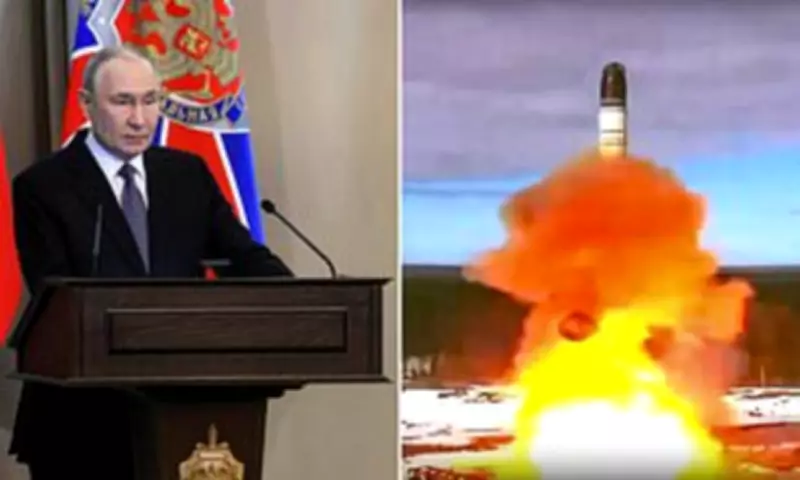
Russian President Vladimir Putin delivered a stark warning on Tuesday, stating that Moscow's adversaries likely comprehend the grave consequences of any assault on Russia or its military forces involving 'a nuclear element'. The remarks were made during an address to the Federal Security Service (FSB), the successor organisation to the Soviet-era KGB, underscoring the heightened tensions in global security dynamics.
Russia's Updated Nuclear Doctrine and Deterrence Strategy
In 2024, Russia revised its nuclear doctrine, explicitly outlining the defensive circumstances under which it might deploy nuclear arms. The updated policy frames these weapons primarily as a deterrent against enemies, reinforcing Moscow's stance on maintaining strategic stability. This doctrinal shift aligns with Putin's recent statements, emphasising Russia's readiness to respond to perceived threats with overwhelming force.
Allegations of Western Nuclear Plotting
Earlier, the Russian Foreign Intelligence Service (SVR) levelled serious accusations against Britain and France, claiming they are secretly conspiring to supply Ukraine with nuclear capabilities. According to the SVR, London and Paris are engaged in a clandestine operation to equip Kyiv with a 'wonder weapon', aimed at bolstering Ukraine's military strength against Moscow.

The spy agency asserted in a statement: 'Britain and France realise that the developments in Ukraine leave no chance of achieving their much-desired victory over Russia at the hands of the Ukrainian Armed Forces. However, the British and French elites are not prepared to accept defeat. It is believed that Ukraine needs to be equipped with "wunderwaffe".'
The SVR further alleged that possessing a nuclear bomb or a so-called 'dirty bomb' would enable Kyiv to negotiate more favourable terms to end hostilities. These claims, presented without evidence, are viewed by analysts as a potential manoeuvre by Moscow to disrupt peace efforts, possibly those overseen by figures like former US President Donald Trump.
Details of the Alleged Covert Operation
The Russian intelligence service detailed that 'London and Paris are actively working to resolve the issue of providing Kyiv with such weapons and their delivery systems.' This purportedly involves the covert transfer of European components, equipment, and technology to Ukraine, with the French TN75 small-size warhead from the M51.1 submarine-launched ballistic missile being considered as a viable option.
In contrast, the SVR noted that Berlin 'wisely declined to participate in this dangerous adventure', highlighting divisions within Western alliances. The allegations stress that such actions would constitute a gross violation of international law, particularly the Nuclear Non-Proliferation Treaty, and risk dismantling the global non-proliferation framework.
Western Efforts and Global Implications
The SVR contended that Western efforts are focused on masking Kyiv's acquisition of nuclear weapons as a result of indigenous Ukrainian development, in an attempt to evade accountability. The statement warned: 'Such extremely dangerous plans by London and Paris demonstrate their loss of a sense of reality. They are futilely hoping to avoid responsibility. Moreover, all that is hidden will inevitably be revealed.'
It also suggested that many sensible individuals within British and French military, political, and diplomatic circles recognise the peril their leaders' reckless actions pose to global security. These developments occur against a backdrop of ongoing conflict in Ukraine, where recent reports indicate Russia is suffering significant troop losses, with nearly 40,000 casualties per month, straining its recruitment capabilities.
Putin's warning and the SVR's allegations reflect escalating nuclear rhetoric and geopolitical tensions, raising concerns about potential miscalculations and the stability of international security protocols. The situation underscores the critical need for diplomatic engagement and adherence to non-proliferation agreements to prevent further escalation.