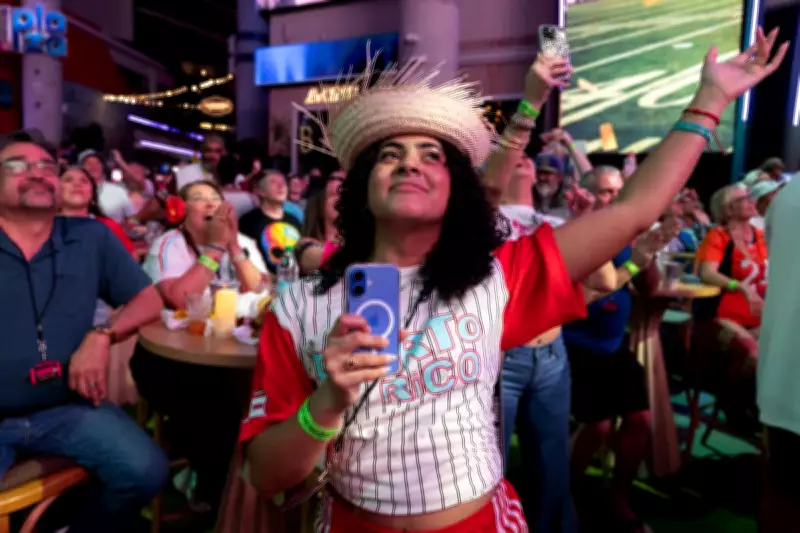
Puerto Rico's 13-Minute Super Bowl Pause for Bad Bunny's Historic Moment
For countless Puerto Ricans in San Juan and throughout the island, the Super Bowl effectively lasted just 13 minutes. As the first half of the game unfolded with food, music, and chatter filling homes and venues, many turned their backs to television screens until a profound hush descended across Puerto Rico. The reason? The halftime show was beginning, marking a pivotal moment for the island.
A Spotlight on Puerto Rico's Global Star
This was Puerto Rico's moment in the international spotlight, focusing on a native son who abandoned bagging groceries a decade ago to become the world's most streamed artist on Spotify last year. Since his meteoric rise, Bad Bunny has consistently used his platform to applaud immigrants, sing about Puerto Rico's complex identity and turmoil, and denounce U.S. immigration policies.
"He appeared at the right moment in the history of Latin America," observed Marielys Rojas, 39, originally from Venezuela but a 22-year resident of Puerto Rico. She joined hundreds gathered on a grassy knoll near a beach in the capital, watching the halftime show on a massive screen as waves crashed behind them and the sounds of endemic coquí frogs filled the salty air.

Watch Parties and Cultural Celebration
Amarilys Reyes, 55, attended the seaside watch party with her 22-year-old daughter, having never watched a Super Bowl and unaware of who was playing. Like many others, she was present solely for Bad Bunny. "It's the biggest show of his life," Reyes declared.
Energy, nerves, and excitement had been building across Puerto Rico ever since the NFL, Apple Music, and Roc Nation announced that Benito Antonio Ocasio Martínez would headline the Super Bowl XL Halftime Show. Watch parties were swiftly organized both on the U.S. mainland and the island, with some dubbing it "Super Bori Sunday"—a shortened nod to "Boricua," referring to someone with Puerto Rican ancestry—while others called it "The Benito Bowl: Morcilla, Sancocho, Mofongo, Reggaetón and a little bit of Football."
Creativity flourished as February 8 approached. One bar in Puerto Rico posted a promotional image featuring quarterbacks from the Seattle Seahawks and New England Patriots sitting on the iconic white plastic lawn chairs that grace the cover of Bad Bunny's newest album. Even the Teletubbies joined the excitement, shaking their colorful rumps to Bad Bunny's "Baile Inolvidable" a day before the show.
Criticism and Swift Rebuttals
However, criticism of the first all-Spanish NFL halftime show emerged as the first half concluded. Jake Paul, a YouTuber-turned-boxer with property in Puerto Rico, wrote on social media: "Turn off this halftime. A fake American citizen performing who publicly hates America. I cannot support that."
Puerto Ricans quickly responded, with many noting that Puerto Ricans are U.S. citizens. Luke Lavanway, a 35-year-old New Yorker vacationing in Puerto Rico to escape a cold snap, stated he had no issue with a Spanish-language halftime show. "That's part of us," he said. "That's what makes us great, and we should just enjoy it."
Post-Show Reflections and Cultural Pride
As soon as the second half began, the crowd at the watch party began streaming out, smiling as they reflected on the performance. Carlos Ayala, 36, of San Juan, remarked: "I thought it was phenomenal that Bad Bunny brought all Latinos together in one place and represented them all equally. It's an important moment for Latino culture."
He also praised Ricky Martin's performance of Bad Bunny's "Lo que le pasó a Hawaii," which laments gentrification in Puerto Rico—a worsening issue on an island with a poverty rate exceeding 40%. "Transmitting that message is extremely important in these times," Ayala added, appreciating the light posts and exploding transformers featured during the show, a nod to Puerto Rico's chronic power outages "so the world can see what we live through."

Among those beaming after the show was Juliana Santiago, 35, whose heart swelled with pride. She said Bad Bunny proved that "you can accomplish things, that the American dream truly is real." The 13-minute pause became a powerful testament to cultural identity and collective celebration.