
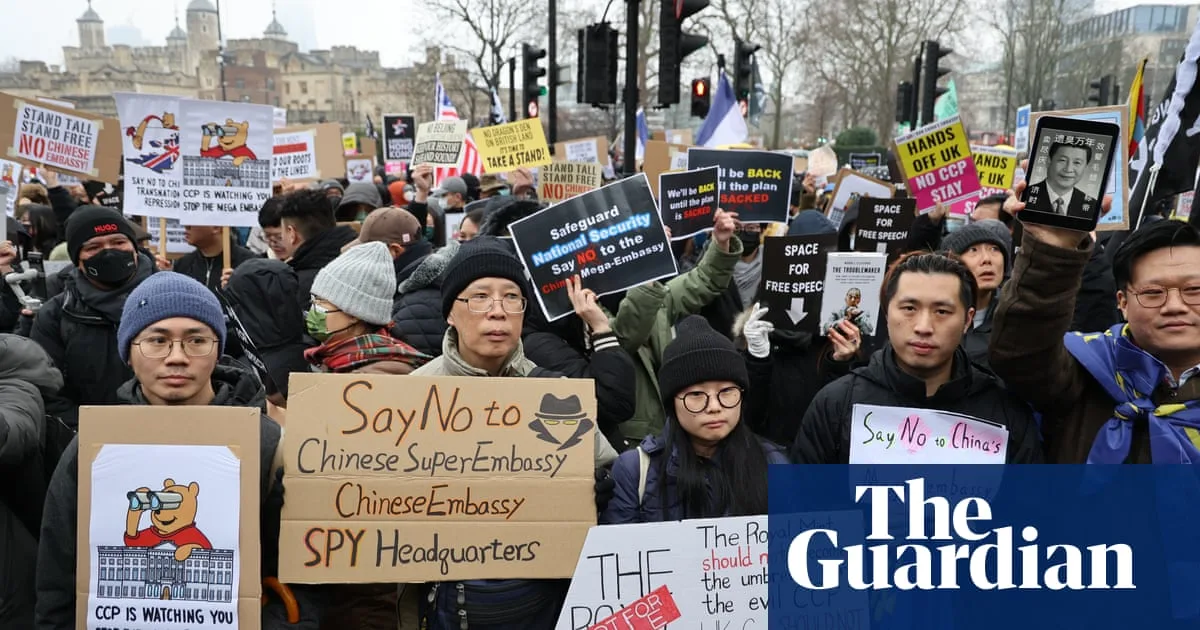
More than 1,000 people gathered outside the proposed site of a Chinese 'mega-embassy' in London on Saturday, voicing concerns that the new premises could be used to control and detain dissidents illegally. The demonstration took place at the Royal Mint Court near the Tower of London, the former headquarters of the UK's coin maker, which China has purchased and plans to convert into its largest embassy in Europe.
Tower Hamlets Council refused planning permission in 2022, citing concerns about the impact of large protests. The previous Conservative government chose not to intervene. However, after Labour came to power, the Chinese president Xi Jinping raised the matter directly with Prime Minister Keir Starmer, and the new administration called in the application. Cabinet ministers Yvette Cooper and David Lammy have indicated support for the proposal, with a local inquiry set to begin next week. The final decision rests with Deputy Prime Minister and Housing Secretary Angela Rayner.
Many of the protesters were from Hong Kong, who have sought refuge in the UK. One demonstrator, Tai, a 50-year-old carer, said: 'We come from Hong Kong. We are afraid that China will use this place to look over us, against us.' Another protester, who gave her name as Mitochondria, 20, expressed fears that the building could be used to hold Chinese dissidents illegally. She was seen holding a Uyghur flag, saying China had 'imperialist interests' and was committing genocide against the Uyghur people.
During the demonstration, police officers dragged a woman to a police van, prompting a group of protesters in black to surround the van in an attempt to block it from leaving, shouting 'let her go'. Another woman appeared unwell and lay on the rain-covered road. Fred, a 29-year-old engineer, said he was concerned the building could be used for espionage, adding: 'We are the beacon of freedom in the world. It’s a shame to see this beautiful compound... fall into a dictator’s hands.'
Several high-profile politicians addressed the crowd, including former Conservative MP Iain Duncan Smith, former Security Minister Tom Tugendhat, and Labour MP Blair McDougall. Tugendhat described allowing the embassy to go ahead as a 'grave mistake', saying it would signal that the British government had 'chosen the wrong side'. He added that continuing with the plans in 2025 would be 'wilful ignorance' of lessons from the past decade.




