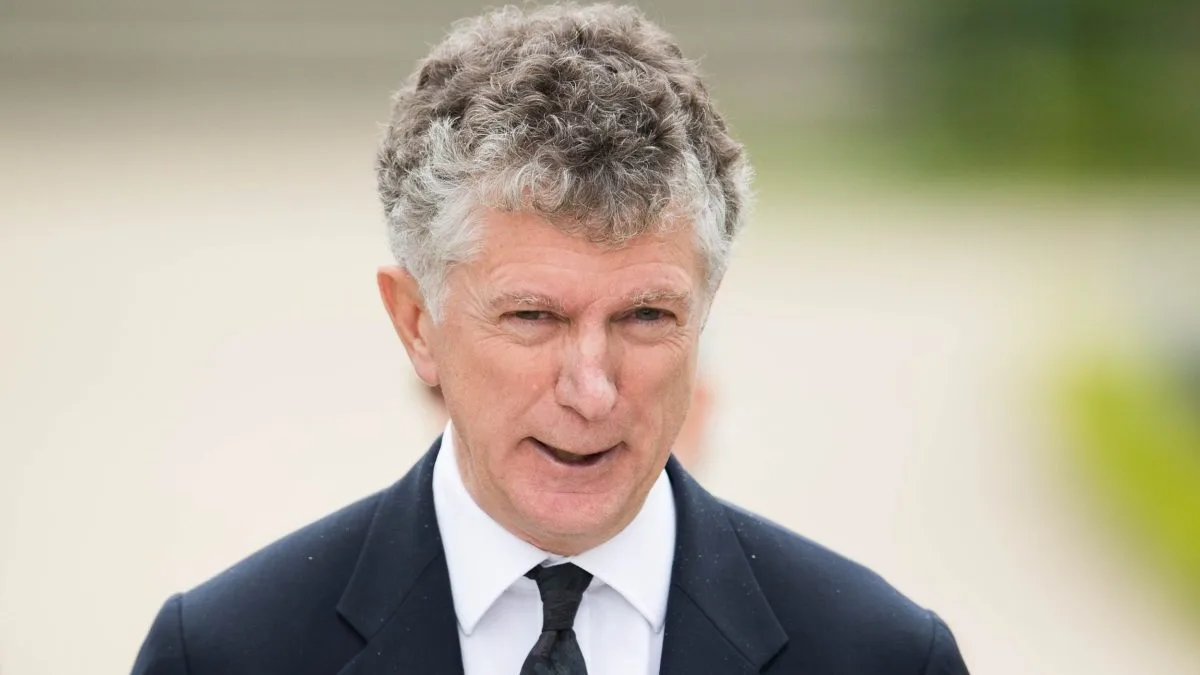
Sometimes you simply have to acknowledge Jonathan Powell's unique talent: nobody possesses quite the same remarkable ability for landing his political superiors in profoundly hot water. Sir Keir Starmer's national security adviser, a figure whose legacy includes masterminding Britain's involvement in the Iraq War a generation ago, has once again demonstrated his flair for controversy. His infamous instruction to a former ambassador to 'get up the a*** of the White House and stay there' now finds a modern parallel in his latest strategic counsel, which appears to have backfired spectacularly.
A Double Diplomatic Catastrophe Unfolds
Two cunning plans, seemingly orchestrated under Powell's influence, detonated on the very same day, sending shockwaves through Downing Street. The government awoke to the news that former US President Donald Trump had publicly denounced what he termed the 'great stupidity' of a British diplomatic manoeuvre concerning the Chagos Islands, a strategy widely linked to Powell's advisory role. This stinging rebuke arrived mere hours after Sir Keir had been publicly boasting about his administration's closeness to the Trump camp, creating a moment of supreme political irony that would require a heart of stone not to find darkly amusing.
Operation Kow-Tow and the Chinese Embassy Controversy
Before the Prime Minister's breakfast could be cleared away, a second crisis, dubbed by critics as 'Operation Kow-Tow', landed with a thud. The government confirmed it would permit China to construct a new London embassy complex of monumental proportions, a facility roughly comparable in scale to Blenheim Palace but, as wags noted, likely featuring more dungeons. Jonathan Powell's fingerprints were perceived to be all over both these diplomatic initiatives, which critics swiftly labelled as triumphs not for Britain, but for its perceived adversaries—a term preferred by cautious politicians over the more direct 'enemies'.
Transatlantic Relations Turn Stormy
The fallout from Trump's remarks effectively torpedoed a carefully arranged morning event at Westminster, where the Speaker of the US House of Representatives, Mike Johnson, had travelled to address assembled peers and MPs. Johnson, a preppy and diplomatic figure, had intended his visit to 'calm the waters' of Anglo-American relations. Instead, Trump's outburst rendered those waters as turbulent and foreboding as the stormy Sea of Galilee described in the Gospel of Matthew.
The occasion was marked by full parliamentary pomp, with the Speakers of the Commons and Lords present in ceremonial dress, accompanied by mace-holders and the Serjeant-at-Arms bearing a sword. Commons Speaker Sir Lindsay Hoyle delivered a lengthy, meandering opening address that meticulously avoided any mention of Donald Trump, instead offering the bizarre well-wish to Johnson's American football team, the LSU Tigers, of 'lots of lunch'—a Freudian slip where 'luck' was clearly intended. Johnson responded with a masterclass in subtle American sarcasm, noting that Sir Lindsay's speeches were 'infamous – just like Churchill and it goes on and on and on'.
Visibly embarrassed by his President's inflammatory comments, Johnson, appearing pink-eared and tense, repeatedly stressed Britain's continued status as a valued ally—a gracious sentiment, even if its veracity was privately questioned by many in the room. The core of his speech constituted an eloquent plea for British and European elites to abandon their 'truly menacing scepticism towards history', a message that was, perhaps inevitably, received with a heavy dose of the very scepticism he decried. The shadow of 'Trumpery' evidently has a corrosive effect on diplomatic credulity.
Global Echoes of Discontent
Meanwhile, at the Davos summit in Switzerland, the annual congregation of global elites—snooty social democrats and wealthy technocrats—was underway. In a striking paradox, grandees from the European Union, an institution frequently accused of eroding national sovereignty, were heard loudly championing the principle of self-determination. The governor of California added to the surreal atmosphere by branding European leaders as 'pathetic' and likening Donald Trump to a Tyrannosaurus Rex with ambiguous intentions towards them—a characterisation more terrifying than the dilemma in 'Sophie's Choice'. France's President Macron, notably sporting dark glasses due to a reported eye injury, added to the sense of a world stage in disarray.
Domestic Fallout and Security Fears
Back in the House of Commons, Security Minister Dan Jarvis endured a torrid session attempting to justify the decision on the Chinese embassy. He faced outright laughter from MPs, while his own Labour colleagues largely absented themselves, with the few present appearing visibly horrified. Jarvis, echoing the lexicon typical of Jonathan Powell's subordinates, spoke of 'sensible' and 'serious, grown-up people' being behind the move. Critics retorted that truly sensible individuals would run a mile from any strategy bearing Powell's hallmark.
The proposed embassy's location, immediately adjacent to a tunnel carrying vital communications cables for the City of London, has sparked major national security anxieties. A long-winded and visibly irritated Minister Jarvis insisted that a 'package of national security mitigations' would prevent Chinese espionage, a assurance that failed to convince. Notably, no one in authority suggested—though this commentator will—that Britain might utilise the same tunnel to conduct reciprocal surveillance operations.
A Surreal Finale from Moscow
To cap a truly surreal day in global diplomacy, Russian Foreign Minister Sergei Lavrov held a press conference where, with characteristically rigid demeanour, he proceeded to deplore the evils of colonialism. The spectacle prompted observers to muse that a meeting between Lavrov and Jonathan Powell might be the one event capable of hastening President Putin's political downfall, such would be the catastrophic diplomatic synergy.
In summary, through a combination of ill-judged advice on dealing with America and a dangerously accommodating stance towards China, Jonathan Powell has once again proven his unparalleled capacity for generating diplomatic crises, leaving the Starmer government scrambling for credibility on the world stage.






