Philippines Accuses China of Cyanide Poisoning in South China Sea Dispute
The Philippines has levelled serious allegations against China, accusing its vessels of the "deliberate use of cyanide" to poison waters near contested shoals in the South China Sea. This claim follows laboratory tests that confirmed the presence of the highly toxic substance in bottles seized from Chinese fishing boats.
Laboratory Analysis Confirms Cyanide Presence
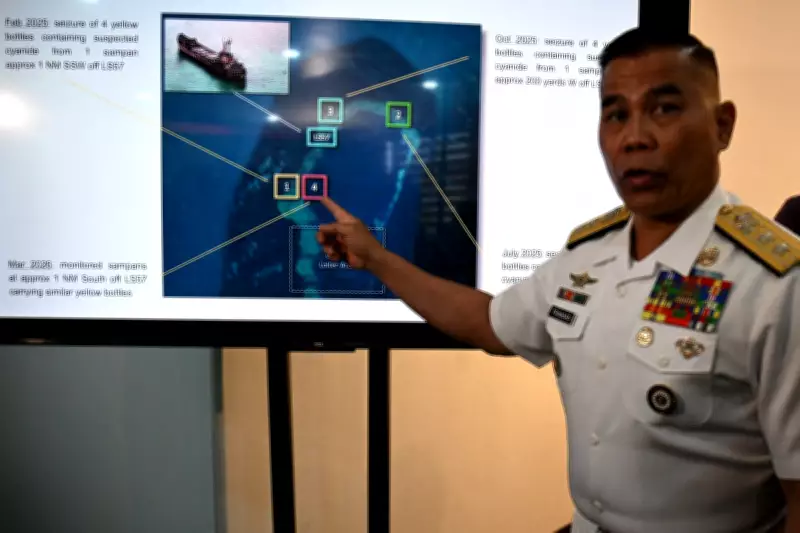
The Philippines' National Security Council announced on Tuesday that forensic analysis of bottles seized from Chinese vessels near the Ayungin Shoal last year revealed they contained cyanide. "Laboratory analysis conducted by the National Bureau of Investigation's Forensic and Scientific Research Service has conclusively established that the yellow bottles seized from the sampans contain cyanide," stated NSC spokesperson Cornelio Valencia Jr.
He emphasized that cyanide is "a highly toxic chemical known to cause severe and irreversible damage to humans and marine ecosystems." The investigation began after Philippine military personnel seized ten bottles of the lethal substance from flat-bottomed wooden sampan boats allegedly launched from Chinese fishing vessels in February, July, and October last year near the Spratly Islands.

Environmental Sabotage Allegations
Philippine officials have characterized the alleged poisoning as a form of environmental sabotage aimed at depleting local fish populations. According to Rear Admiral Roy Vincent Trinidad, Philippine navy spokesperson, military personnel discovered another Chinese sampan crew poisoning waters near the shoal just last month, with subsequent samples testing positive for cyanide.
Valencia Jr. explained that this alleged sabotage seeks to "kill local fish populations, depriving military personnel of a vital food source." In a separate briefing, he warned that the poisoning not only endangered personnel who might consume contaminated fish or water but could also damage coral reefs that help support vessel foundations.
China Dismisses Claims as "Farce"
China has vehemently rejected the allegations, with foreign ministry spokesperson Guo Jiakun dismissing them as a "farce" and "so-called cyanide stunt." Guo accused Manila of causing environmental harm by "illegally grounding its vessel" on Ren'ai Jiao and claimed Philippine authorities had "grabbed the fishermen's living supplies."
"There is no credibility whatsoever to their story," Guo asserted, maintaining that Chinese fishing boats were conducting normal operations when allegedly harassed by Philippine forces.
Ongoing Territorial Tensions
The cyanide allegations emerge amid persistent territorial disputes in the resource-rich South China Sea, where Beijing claims sovereignty despite competing claims from five other regional nations. The Philippines has previously accused China of disrupting resupply missions, including a June 2024 confrontation where Chinese personnel armed with axes, knives, and spears boarded Philippine vessels after aggressive maneuvers, resulting in a Filipino sailor losing a finger.
Philippine authorities reported raising the cyanide case with Chinese counterparts at a recent meeting but received no formal response. The NSC plans to submit a report to the foreign ministry that could form the basis for a diplomatic protest.
Philippine Response and Patrols
In response to the alleged poisoning, the NSC has directed Philippine forces and coast guard to strengthen patrols and take measures to prevent further environmental damage. "Let it be clear: the Philippines will not tolerate any act – whether by state or non-state actors – that endangers its personnel or the marine environment," Valencia Jr. declared.
He affirmed the government's commitment to "defending the nation's territory, protecting its natural resources, and upholding the rule of law" in the West Philippine Sea, as the Philippines refers to the portion of the South China Sea within its exclusive economic zone.