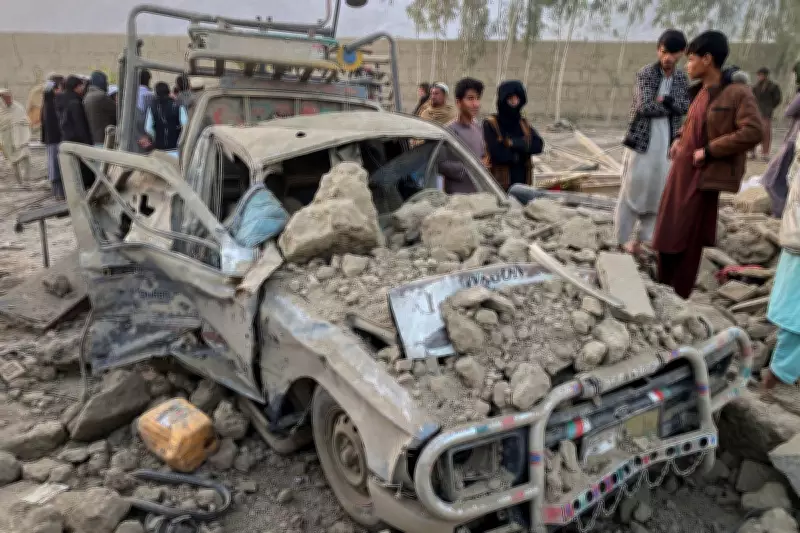
Pakistan Launches Airstrikes in Afghanistan, Killing Dozens
Pakistan has conducted a series of airstrikes on what it described as militant hideouts inside Afghanistan, resulting in the deaths and injuries of dozens of people. The operation was framed as a direct response to cross-border attacks that have claimed the lives of Pakistani security forces and civilians in recent weeks.
Taliban Condemns Strikes and Vows Response
Afghanistan's Taliban authorities have strongly condemned the airstrikes, asserting that they struck a religious school and multiple residential homes, causing significant civilian casualties. The Taliban-run defence ministry labelled the action as a blatant violation of national sovereignty and declared that an appropriate and measured response will be taken at a suitable time. They further argued that the strikes constitute a clear breach of international law, principles of good neighbourliness, and Islamic values.
Taliban spokesperson Zabihullah Mujahid issued a forceful condemnation via social media, stating that Pakistani special military circles have once again trespassed into Afghan territory. He reported that dozens of civilian compatriots, including women and children, were killed or injured in the provinces of Nangarhar and Paktika. Mujahid accused Pakistani generals of compensating for their country's security weaknesses through such actions.

Pakistan's Justification for the Military Operation
Pakistan's military described the operation as intelligence-based, targeting hideouts belonging to the Tehrik-e-Taliban Pakistan (TTP), an outlawed militant network responsible for a surge in attacks in Pakistan's north-western regions. A statement from Pakistan's ministry of information and broadcasting claimed the country possessed conclusive evidence that militants behind recent assaults were operating under the direction of Afghanistan-based leadership and handlers.
The statement detailed that the operation targeted seven militant camps and criticised the Taliban regime for failing to undertake any substantive action despite repeated urgings from Pakistan. It emphasised that Pakistan has always strived to maintain peace and stability in the region but asserted that the safety and security of its citizens remains the top priority.
Background of Escalating Tensions
The airstrikes followed a suicide vehicle bombing in Bajaur district on Tuesday, which killed eleven Pakistani security personnel and a child, an attack claimed by the TTP. Hours before the strikes, a separate suicide bomber targeted a security convoy in Bannu district, killing two soldiers, including a lieutenant colonel. Pakistan's military warned after Saturday's attack that it would not exercise any restraint and that operations against those responsible would continue irrespective of their location.
Relations between Pakistan and Afghanistan have been strained since October, when clashes along the border resulted in dozens of casualties among soldiers, civilians, and suspected militants. This escalation occurred after explosions in Kabul that Afghan officials attributed to Pakistan. Although a ceasefire brokered by Qatar has largely held, negotiations in Istanbul in November 2025 failed to produce a formal settlement, leaving bilateral ties fragile and unresolved tensions simmering.
Since the Taliban forcibly seized control of Kabul in August 2021, Pakistan has repeatedly accused the regime of failing to curb TTP fighters who allegedly use Afghan territory as a base to organise and launch cross-border attacks. Kabul has consistently denied permitting any group to use its soil to threaten other nations, setting the stage for ongoing diplomatic and military friction.