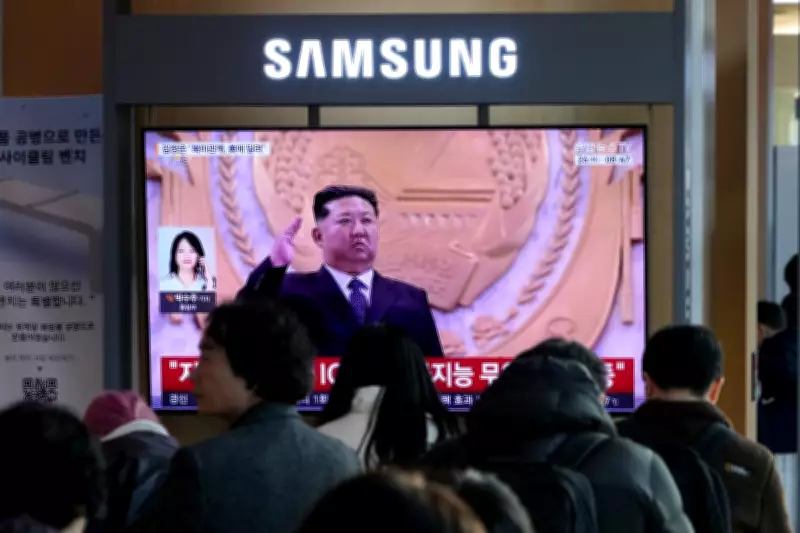
In a significant geopolitical development, North Korean leader Kim Jong Un has declared that his nation could "get along well" with the United States, but only under strict conditions that include American recognition of Pyongyang's status as a nuclear state and the abandonment of what he termed a "hostile policy" towards North Korea. The remarks, delivered as the ruling Workers' Party concluded a landmark congress on 25 February, were reported by the state news agency KCNA and have immediately sparked international analysis.
A Conditional Overture to Washington
Kim Jong Un's statement represents a calculated diplomatic overture, suggesting a potential pathway for renewed engagement with the United States. "If the US respects our country's current status as stipulated in the constitution, and withdraws its hostile policy," the leader was quoted as saying, "there's no reason why we cannot get along well." This explicit linkage between improved relations and formal US acceptance of North Korea's nuclear arsenal underscores Pyongyang's unwavering position on its military capabilities.
Analysts swiftly noted that the comments could signal an intention to pursue bilateral relations with Washington independently, bypassing South Korea entirely. Professor Yang Moo Jin, former president of the University of North Korean Studies in Seoul, told AFP that the remarks indicate a clear strategy to engage the US directly. He added that Kim is making it unequivocally clear he will "reject any negotiations premised on denuclearisation," a stance that has historically been a major obstacle in diplomatic talks.

Speculation Surrounds Potential Trump Meeting
The timing of Kim's statement has fuelled intense speculation regarding a potential meeting with former US President Donald Trump, who is planning a trip to China in April. Such a encounter could revive high-level diplomacy after the collapse of the 2019 Hanoi Summit, which foundered over disputes concerning sanctions relief and denuclearisation demands. However, Kim's firm rejection of any negotiations based on relinquishing nuclear weapons presents a formidable barrier to any substantive progress.
Confrontational Stance Towards South Korea
In stark contrast to the conditional offer extended to the United States, Kim Jong Un adopted a sharply confrontational and definitive tone towards South Korea. He declared the rival neighbour a hostile state and explicitly ruled out any possibility of reconciliation, marking a significant hardening of position. "North Korea had absolutely no business dealing with South Korea," he stated, describing it as the "most hostile entity."
Furthermore, Kim announced that North Korea would "permanently exclude South Korea from the category of compatriots," a symbolic severance of ethnic ties. He issued a stark warning to Seoul, asserting that "as long as South Korea cannot escape the geopolitical conditions of having a border with us, the only way to live safely is to give up everything related to us and leave us alone." This rhetoric signifies a profound deterioration in inter-Korean relations and suggests a long-term strategy of isolation and confrontation.
Military Posturing and Strategic Ambitions
Accompanying the diplomatic declarations were strong warnings and revelations about North Korea's military ambitions. Kim Jong Un cautioned that the North Korean military would "immediately launch a fierce retaliatory attack against any military hostile act committed by any force that infringes upon the sovereignty of our country." This statement reinforces the regime's doctrine of aggressive deterrence.
According to KCNA, Kim also laid out ambitious plans to develop advanced military technologies, including stronger intercontinental ballistic missiles capable of underwater launch, attack systems utilising artificial intelligence, unmanned drones, and anti-satellite weapons. These disclosures align with independent assessments; the Stockholm International Peace Research Institute (SIPRI) estimated last year that North Korea has assembled around 50 warheads and possesses sufficient fissile material to produce more, while accelerating production of additional material.

Congress Conclusion and Succession Speculation
The remarks were made as the Workers' Party congress concluded, an event marked by a military parade in Kim Il Sung square. State media photographs showed formations of soldiers marching under bright lights, with some troops in camouflage and special warfare gear, and jets conducting a fly-by. Notably, the parade did not showcase strategic weapons like those displayed in October, a possible calculated omission.
The presence of Kim's daughter, Ju Ae, alongside senior officials on the podium has further fuelled ongoing speculation about her potential role as his successor. Her visible participation in such a high-profile state event continues to be closely monitored by observers seeking clues about the regime's future leadership plans.
In summary, Kim Jong Un's latest pronouncements craft a dual-track foreign policy: a conditional, nuclear-centric opening to the United States, paired with an uncompromisingly hostile stance towards South Korea. This approach seeks to leverage Pyongyang's military capabilities to reshape its international relationships while solidifying domestic control and strategic ambitions.